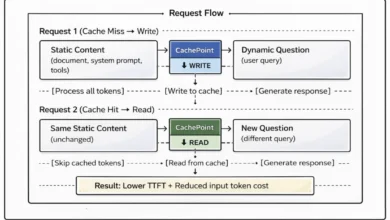
Cutting AI Costs and Improving Model Performance Through Markdown Data Optimization

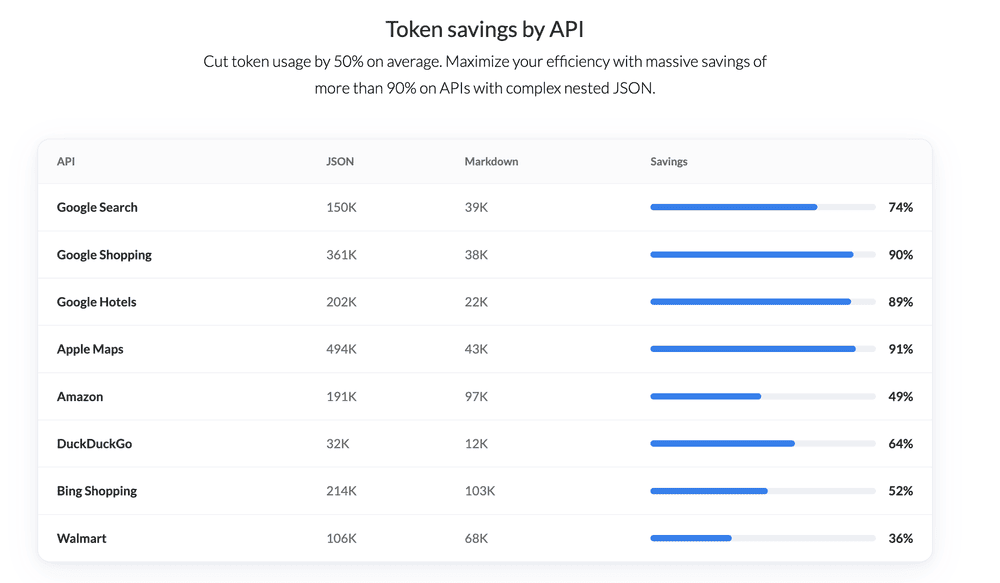
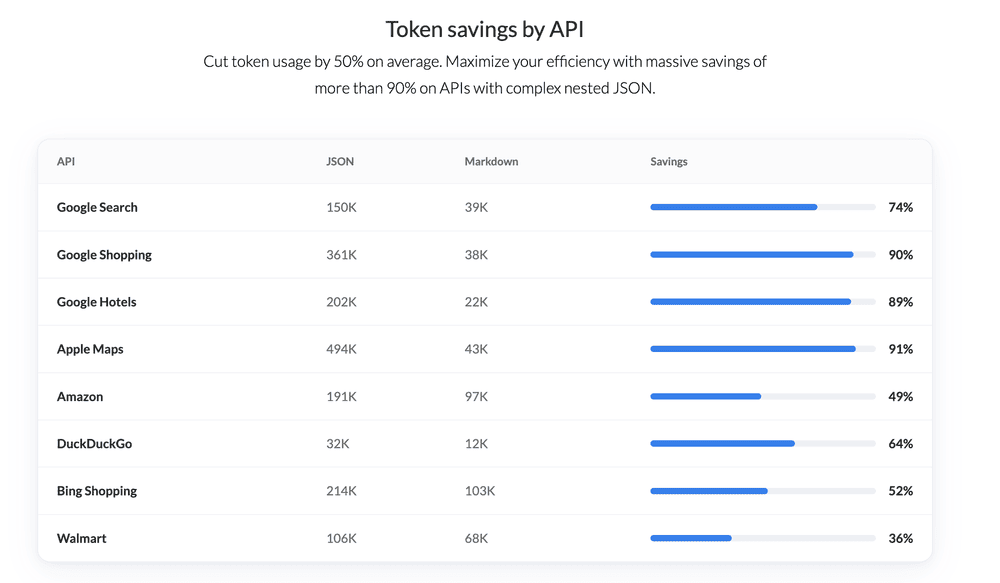
The integration of autonomous AI agents into enterprise workflows has fundamentally shifted the economics of Large Language Model (LLM) operations. As these agents are increasingly tasked with complex research, file retrieval, and iterative problem-solving, the overhead of token consumption has emerged as a primary bottleneck for scalability. Industry data suggests that a significant percentage of an AI agent’s operational cost—and its associated latency—is derived not from the reasoning process itself, but from the ingestion of redundant, high-entropy data structures. To address this, developers are moving away from traditional JSON-based data delivery in favor of Markdown-optimized pipelines, a shift that promises to reduce token consumption by as much as 75 percent.
The Anatomy of Token Bloat in AI Workflows
The current paradigm of AI-driven research often involves "agentic" loops, where a system performs a search, retrieves logs or full-length files, and then recursively processes the results. When an AI agent requests information from a search API, the response is typically delivered in JavaScript Object Notation (JSON). While JSON is the industry standard for machine-to-machine communication, it is inherently verbose. It includes extensive metadata, tracking identifiers, nested object hierarchies, and repeated keys that are essential for software parsing but largely irrelevant for the semantic reasoning required by LLMs.
In a typical scenario, a search query for a common topic such as "coffee shops" can return thousands of tokens of data. When this raw JSON is fed into a model like GPT-4 or Claude 3.5, the model must expend "attention" on every character, including brackets, quotes, and metadata fields. Because LLMs charge per input token, this "noise" creates a recurring, compounding cost. Furthermore, as the context window fills with non-essential formatting, the model’s ability to maintain focus on the core information—the actual search results—is diminished, potentially leading to performance degradation.
Comparative Efficiency: The Markdown Shift
SerpApi’s recent introduction of Markdown output represents a strategic pivot in how data is structured for LLM ingestion. By converting search results into a human-readable, lightweight Markdown format, developers can strip away the structural overhead of JSON while retaining the semantic essence of the data.
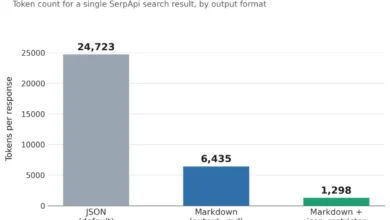
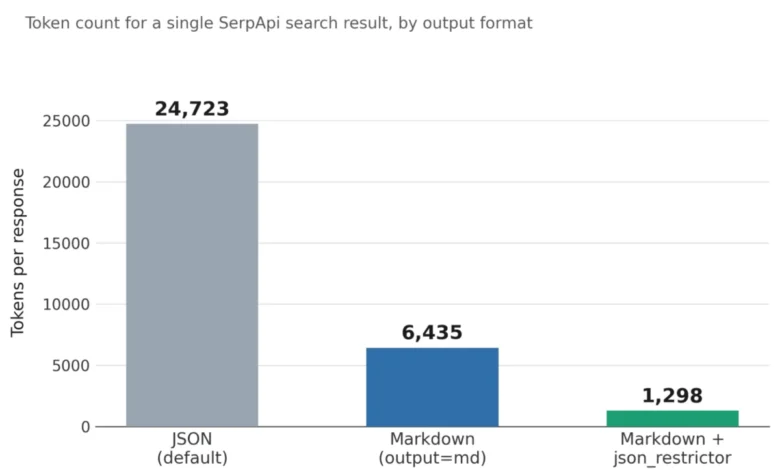
The empirical evidence for this transition is significant. In internal benchmarks conducted by the provider, a search query for "coffee" in standard JSON format consumed approximately 24,723 tokens. By utilizing the new Markdown output format, the same search request was fulfilled using only 6,435 tokens. This represents a 74 percent reduction in total token usage. Even more aggressive filtering, which restricts the output to essential data fields, can reduce the footprint to as little as 1,298 tokens. This efficiency serves a dual purpose: it lowers the immediate financial cost of API calls and expands the effective capacity of the model’s context window, allowing for more comprehensive data analysis within a single prompt.
Chronology of Data Delivery Standards
The evolution of API output formats reflects the shifting priorities of the software development lifecycle over the last two decades.
- 2000s–2010s: The XML and JSON Dominance. As web services grew, the industry moved from the bulky, tag-heavy Extensible Markup Language (XML) to the more concise JSON. JSON became the bedrock of the "API Economy," favored for its strict typing and ease of use in web development and mobile applications.
- 2022–2023: The LLM Inflection Point. With the widespread adoption of Generative AI, developers began using traditional JSON APIs to feed data into LLMs. The mismatch between human-readable intent and machine-readable JSON became a critical pain point, leading to "prompt engineering" hacks designed to force models to ignore non-essential JSON tags.
- 2024: The Rise of LLM-Native Formats. Providers began recognizing that the optimal data format for an AI agent is not necessarily the same as the optimal format for a web application. The introduction of Markdown-first API outputs marks the beginning of an era where data delivery is explicitly optimized for semantic consumption rather than programmatic serialization.
Technical Implications: When JSON Remains Superior
Despite the clear benefits of Markdown for LLM-based summarization and research, industry experts caution against a wholesale abandonment of JSON. The utility of a data format is highly dependent on the intended downstream application.
JSON remains the superior choice for pipelines requiring high-fidelity, machine-parseable data. For instance, if an AI agent is tasked with a task that requires exact mathematical calculations, such as comparing product prices across different retailers, the strict typing of JSON—where prices are integers and ratings are floats—is indispensable. Markdown, while efficient for natural language processing, lacks the rigid schema required for financial calculations or automated inventory management.
In these environments, developers are encouraged to utilize a hybrid approach. This involves using JSON for the analytical, numerical, or transactional components of a workflow, while reserving Markdown for the informational, descriptive, or search-based components. This modularity ensures that the agent receives data in the format most conducive to the specific sub-task it is performing at any given moment.
Operational Strategies for Token Reduction
For developers looking to implement these optimizations, there are several tactical approaches available. The most straightforward method is the implementation of a "field restrictor" or a "selector" pattern. By narrowing the scope of the data requested from an API, developers can ensure that only the fields required for the specific LLM prompt are included in the response.
SerpApi, for example, has integrated these capabilities into their standard API structure. By utilizing query parameters such as output=md or employing a json_restrictor tool, users can filter unnecessary noise server-side. This is a critical distinction; by performing the reduction on the server side, the developer saves on both the payload size and the latency associated with transferring redundant data over the network.
Beyond the reduction in token counts, these strategies offer a secondary benefit: improved prompt reliability. LLMs are prone to "hallucinations" or logical errors when overwhelmed by large, messy datasets. By delivering clean, structured Markdown, the system reduces the cognitive load on the model, leading to more accurate and concise outputs.
The Broader Impact on Agentic Systems
The implications of this shift extend beyond simple cost savings. In the context of "agentic" systems—AI agents that operate with a degree of autonomy—efficiency is a core requirement for functionality. An agent that spends its entire budget on reading through irrelevant search metadata will inevitably fail to perform its actual task within the constraints of its budget and time limits.
Furthermore, as AI agents become more deeply embedded in enterprise infrastructure, the cumulative effect of small inefficiencies becomes a major operational issue. A service making millions of API calls per month can see its overhead reduced by thousands of dollars through these optimizations. This shift toward "AI-native data delivery" suggests that we are moving toward a future where API providers offer specialized endpoints tailored specifically for LLM ingestion, distinct from those intended for human-facing web interfaces.
Future Outlook and Conclusion
The movement toward Markdown-optimized data delivery is a response to the inherent constraints of current LLM architectures. As the industry matures, the standard for "good" data delivery will no longer be measured by how well it fits into a JavaScript environment, but by how well it maps to the underlying neural representation of an LLM.
Organizations currently struggling with the rising costs of AI research or the limitations of their model’s context window should conduct a thorough audit of their data payloads. By measuring the "token density" of their incoming data—comparing the amount of useful information against the total token count—teams can identify areas where structural optimization can provide immediate gains.
Ultimately, the goal is to create a more efficient, high-performance ecosystem for AI development. Whether through Markdown conversion, strict field restriction, or other innovative data-shaping techniques, the ability to deliver precise, high-signal data to an AI model is becoming a core competency for modern software engineering. As these tools become more accessible, the barrier to entry for building complex, high-utility AI agents will continue to drop, further accelerating the integration of machine intelligence into the global economy.