Empowering Healthcare and Life Sciences AI Agents: A Comprehensive Guide to the New Open-Source Skill Framework

The rapid integration of foundation models into healthcare and life sciences has revealed a persistent, structural vulnerability: artificial intelligence agents frequently misapply domain-specific decision frameworks. Even when deep learning architectures have been thoroughly exposed to clinical guidelines, regulatory standards, and scientific literature during their training phases, they routinely stumble when tasked with executing complex, multi-step procedures. A model might correctly cite the American College of Medical Genetics and Genomics (ACMG) and the Association for Molecular Pathology (AMP) guidelines for classifying a variant, yet completely skip vital population frequency thresholds, misapply evidence categories, or entirely hallucinate computational predictor scores.
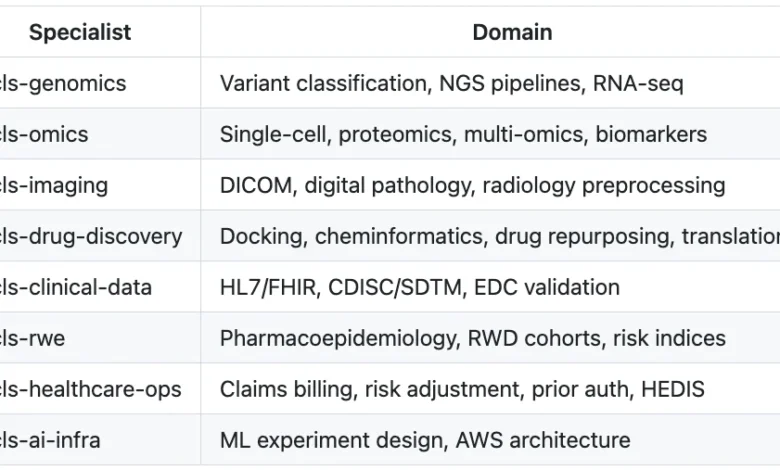
This methodology gap produces what industry experts term "silent failures." The generated outputs consistently look polished, authoritative, and superficially correct, yet they apply the wrong analytical criteria. In highly regulated sectors like variant interpretation, healthcare claims adjudication, clinical trial design, and radiological imaging analysis, these errors carry severe regulatory consequences and palpable patient safety risks. To address this structural deficiency, a collaborative initiative has introduced an open-source collection of 38 agent skills spanning 11 healthcare and life sciences (HCLS) domains. Designed to bridge the chasm between raw computational capability and internalized domain expertise, this repository aims to elevate agentic reliability across complex technical workflows.
Understanding the Methodology Gap: Why Foundation Models Stumble
Foundation models excel at pattern recognition, linguistic fluency, and broad knowledge retrieval. However, they fundamentally lack the structured reasoning procedures that domain practitioners spend years internalizing. In traditional software engineering or general text generation, a minor logical drift is often inconsequential. In precision oncology or healthcare economics, however, missing a single exclusion criterion or miscalculating a reimbursement risk adjustment factor can invalidate an entire downstream workflow.
Historically, developers have attempted to close this capability gap using Retrieval-Augmented Generation (RAG) or model fine-tuning. While RAG effectively pulls limited passages from indexed document libraries, it rarely encodes the exact sequence of logical steps, error-handling protocols, and boundary conditions required for rigorous scientific analysis. Conversely, fine-tuning modifies model weights directly, making updates expensive, slow, and structurally opaque when annual medical policies or experimental protocols change.
The newly released HCLS Agent Skills collection bypasses these limitations by adopting the open Agent Skills standard. Rather than modifying model parameters or relying solely on external document chunks, the solution encapsulates domain decision procedures into structured markdown documents (SKILL.md). These documents are consumed by AI agents at inference time through progressive disclosure. Each skill cleanly declares its triggers, dependencies, and metadata within a YAML frontmatter block, followed by granular decision frameworks, parameter tables, code patterns, and rigorous validation criteria. Released under the permissive MIT-0 license, the initiative offers a transparent, portable, and easily auditable mechanism for injecting procedural judgment directly into AI systems.
Dual Taxonomy: Separating Reasoning from Pipeline Execution
The architecture of the 38 open-source skills is bifurcated into two distinct categories: reasoning skills and pipeline skills. This dual taxonomy ensures that deployed agents possess both the macro-level judgment required to make correct analytical decisions and the technical precision needed to execute them programmatically.
Reasoning skills are engineered to guide how an agent thinks. They encode complex methodologies, decision trees, and conceptual frameworks. For example, the genomic-variant-interpretation skill hardcodes the comprehensive ACMG/AMP classification framework, explicitly outlining evidence categories, allele frequency cutoffs, and computational predictor thresholds. This prevents the agent from casually skipping critical verification steps or offering generic summaries.
Pipeline skills, on the other hand, focus on operational execution. They encode tool-specific commands, validated execution parameters, and runnable code templates that generate reproducible artifacts. The variant-calling skill, for instance, provides verified GATK4 HaplotypeCaller command structures complete with precise annotation groups, Variant Quality Score Recalibration (VQSR) tranche sensitivity targets, and Mutect2 tumor-normal configuration settings.
Because these skills are maintained as human-readable markdown files rather than hidden within neural network weights, organizations can effortlessly update them to reflect annual medical policy shifts or evolving laboratory protocols simply by editing a text file. Furthermore, the modular design ensures portability across more than 20 distinct services and development environments—including Amazon Bedrock AgentCore, the AWS Strands Agents SDK, Kiro, Amazon Quick Desktop, Claude Code, and OpenAI Codex—without requiring platform-specific custom code rewrites.
Implementation Pathways and Deployment Patterns
Deploying the HCLS Agent Skills collection can be accomplished across diverse technical infrastructures, ranging from interactive desktop environments to heavily scaled cloud production pipelines.
For interactive exploration and multi-agent orchestration, developers can utilize the Kiro CLI or Kiro IDE. Running the provided ./install.sh --target kiro script automatically provisions both the skills library and a pre-configured routing agent. For complex multi-agent architectures, the multi-agent mode (./install.sh --target kiro --mode multiagent) deploys a lightweight coordinator agent that delegates tasks to specialized domain agents, thereby dramatically reducing context window competition and token overhead.
For custom application development, the AWS Strands Agents SDK offers native, programmatic skill loading. Developers can integrate the library directly into their Python codebase with minimal configuration:
from strands import Agent
from strands.skills import AgentSkills

agent = Agent(
    model=model_id,
    skills=AgentSkills(skills="./skills/"),
)
In enterprise production environments, organizations can leverage Amazon Bedrock AgentCore. By configuring agent skills at the environment level within the AgentCore harness, teams gain access to managed hosting, automatic scaling, strict security boundaries, and deep observability capabilities without the administrative overhead of managing underlying infrastructure. For graphical interfaces, Amazon Quick Desktop supports direct skill integration, enabling non-technical domain experts to interact with highly specialized reasoning agents out of the box.
Real-World Use Cases in Healthcare and Life Sciences
To fully appreciate the impact of structured agent skills, it is instructive to examine how skill-equipped agents perform across representative domain workflows compared to their unequipped baselines.
Evaluating Drug Repurposing Candidates for Rare Fibrotic Diseases
Consider a biotech research team investigating drug repurposing candidates for idiopathic pulmonary fibrosis (IPF) by targeting TGF-$beta$1 signaling through receptor kinase TGFBR1 (ALK5). A researcher might pose a broad, unstructured query: "I’m investigating TGFBR1 as a therapeutic target for IPF. Are there any approved drugs worth repurposing? What’s the strongest candidate and how realistic is clinical translation?"
Without skills, a base foundation model typically returns a standard literature review listing known TGFBR1 inhibitors alongside generic descriptions, entirely lacking a structured ranking hierarchy, evidence scoring matrices, or translational feasibility assessments. When equipped with the drug-repurposing and translational-research skills, the agent systematically queries interaction databases, ranks candidates using explicit evidentiary thresholds, evaluates mechanism-of-action overlap against IPF pathophysiology, and rigorously analyzes existing clinical safety data to deliver an audit-defensible, prioritized evaluation report.
Constructing CMS-HCC Risk Adjustment Pipelines
In healthcare operations, a Medicare Advantage plan managing thousands of members must accurately calculate Risk Adjustment Factor (RAF) scores from ICD-10 diagnosis claims using official Centers for Medicare & Medicaid Services Hierarchical Condition Category (CMS-HCC) coefficients. A junior analyst might ask an agent to build a Python and SQL pipeline to compute these scores for a live database.
An unequipped agent frequently generates flawed code—omitting disease hierarchy resolution entirely, utilizing outdated coefficient models (such as V24 instead of V28), or incorrectly applying hierarchies after summing risk scores, which artificially inflates financial projections. When armed with the risk-adjustment and claims-billing-rules skills, the agent implements the exact ICD-10-to-HCC crosswalk logic, resolves disease interactions sequentially, applies demographic adjustments correctly, and generates robust, compliant pipelines designed to withstand stringent CMS Risk Adjustment Data Validation (RADV) audits.
Radiological Preprocessing for Voxel-Based Morphometry
In academic medical research, neuroimaging studies requiring voxel-based morphometry (VBM) demand precise, sequential preprocessing of T1-weighted MRI scans. A researcher asking an agent to draft an FSL and ANTs hybrid preprocessing script runs the risk of receiving poorly ordered code—such as performing bias field correction after skull stripping, which systematically compromises brain tissue masks.
Equipped with the radiology-preprocessing and imaging-study-design skills, the agent enforces strict methodological ordering: initial format reorientation, precise bias field correction prior to extraction, robust skull stripping, and accurate spatial normalization to MNI152 space using validated parameter sets tailored specifically for healthy adult cohorts.
Empirical Evaluation and Performance Metrics
To rigorously quantify the efficacy of the HCLS Agent Skills framework, researchers conducted a comprehensive pairwise evaluation across 410 domain prompts (comprising 380 single-skill and 30 cross-skill challenges) under two distinct agent harness configurations: the Kiro CLI (utilizing automated model selection and file-read capabilities) and the AWS Strands Agent SDK (explicitly pinned to Claude Sonnet 4.6).
Using Claude Opus 4.7 as an independent LLM judge, responses were scored on a 0–100 scale across five distinct dimensions: scientific accuracy, coherence, relevance, critical thinking, and actionability. To mitigate score compression phenomena inherent to LLM-based evaluations, researchers prioritized two robust statistical metrics: win rates (the percentage of prompts where the skilled agent outperformed the baseline) and Cohen’s d effect sizes.
| Metric | Kiro CLI Configuration | Strands Agent Configuration |
|---|---|---|
| Prompts Evaluated | 410 | 410 |
| Overall Win Rate (d) | 69.5% ($d = 0.39$) | 85.9% ($d = 0.97$) |
| Critical Thinking Win Rate (d) | 78.0% ($d = 0.65$) | 85.1% ($d = 1.03$) |
| Scientific Accuracy Win Rate (d) | 69.3% ($d = 0.34$) | 86.2% ($d = 0.85$) |
| Actionability Win Rate (d) | 68.0% ($d = 0.37$) | 77.3% ($d = 0.56$) |
| Baseline-Benefit Correlation ($r$) | $-0.59$ | $-0.61$ |
The empirical results demonstrate that skilled agents capture between 69.5% and 85.9% of head-to-head comparisons against unequipped baselines. Notably, the strongest performance gains materialized in critical thinking ($78.0%$ to $85.1%$ win rates; $d$ ranging from $0.65$ to $1.03$), confirming that the primary value proposition of agent skills is methodological. Rather than simply supplying raw factual trivia that a base foundation model might already possess, skills actively instruct the agent on which regulatory frameworks to apply, which foundational assumptions to actively challenge, and which operational limitations must be formally flagged.
Furthermore, correlation analysis revealed a strong inverse relationship between baseline response quality and skill benefit ($r = -0.59$ in Kiro CLI; $r = -0.61$ in Strands). This indicates that agent skills provide the most dramatic performance enhancements when dealing with complex, multi-step regulatory procedures or niche analytical methodologies where unguided models historically struggle. In addition to elevating average output quality, the implementation of skills drove substantial variance reduction—dropping standard deviations by up to 51% across clinical data responses—thereby ensuring the operational consistency required in highly regulated healthcare environments.
Customization and Future Outlook
Organizations operating within specialized sub-sectors can readily tailor the existing open-source repository to reflect proprietary clinical protocols, internal regulatory thresholds, or specialized experimental pipelines. By copying existing SKILL.md templates and incorporating organizational guidelines, teams can quickly establish standardized reasoning frameworks. The repository includes dedicated developer tooling, prompt generation scripts, and pairwise evaluation dashboards (review.html) to facilitate rapid prototyping, iterative refinement, and local testing.
Ultimately, the introduction of the HCLS Agent Skills framework marks a maturing of agentic AI within the life sciences and healthcare sectors. By shifting the paradigm from opaque weight modifications to transparent, auditable, and portable markdown-based skill sets, developers can reliably bridge the gap between general artificial intelligence capabilities and the rigorous, highly specialized standards demanded by modern medicine and biotechnology.