How Abnormal AI Scaled Autonomous Security Agents to Process Billions of Production Operations Using Amazon Bedrock AgentCore


The modern enterprise artificial intelligence landscape has matured significantly past simple conversational interfaces and basic semantic text generation. Today, production-grade AI agents operate continuously at massive scale, handling billions of transactions daily across diverse corporate networks. As these intelligent systems transition from experimental playgrounds to mission-critical infrastructure, a distinct and recurring architectural requirement has emerged across the industry: autonomous agents demand a dedicated, secure compute scratch pad. Beyond traditional software engineering and coding workflows, modern agents require dynamic computational environments for complex data aggregation, multi-variable mathematical analysis, automated verification, and deep contextual reasoning where pure semantic processing falls short.
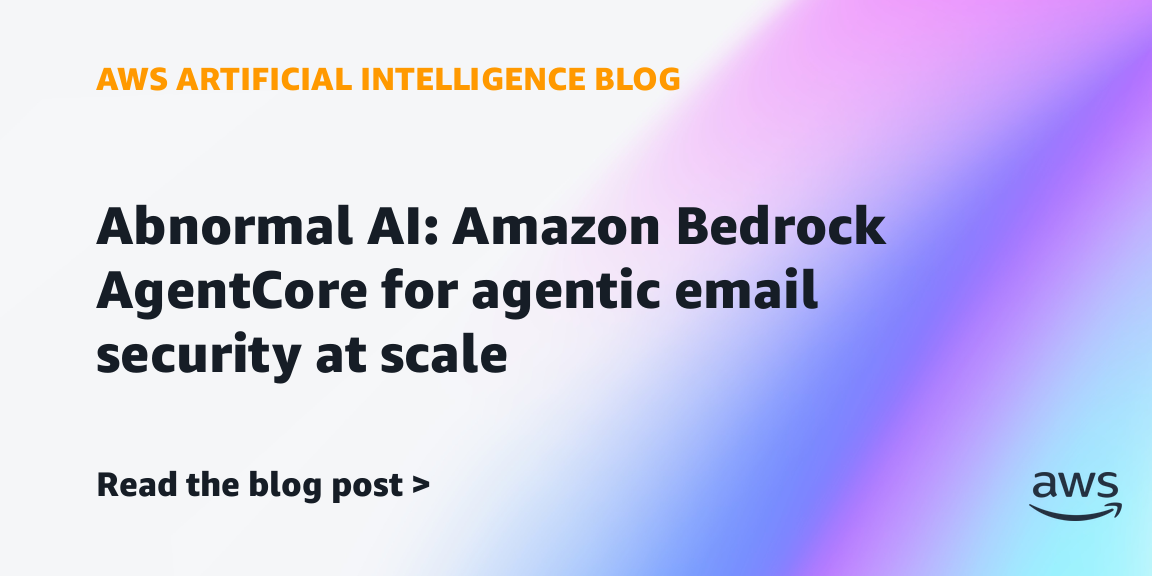
This architectural shift is vividly demonstrated at Abnormal AI, a behavioral cybersecurity leader that protects more than 25 percent of the Fortune 500. The company has successfully integrated the Amazon Bedrock AgentCore Code Interpreter—a fully managed, serverless runtime capability within Amazon Bedrock AgentCore—directly into its real-time inline email threat detection architecture. Operating continuously in high-throughput production environments, these systems process billions of electronic messages, executing dynamic agent-driven code to identify, intercept, and neutralize sophisticated cyberthreats inline, blocking malicious payloads before they ever reach an end-user’s inbox.
The integration of advanced code interpretation infrastructure highlights a broader cultural and operational transformation within Abnormal AI. Presently, approximately 80 percent of the organization’s code changes involve an AI agent in some capacity, with a remarkable 40 percent built entirely end-to-end by background autonomous agents rather than merely being human-assisted. By deploying the Amazon Bedrock AgentCore Code Interpreter to safeguard enterprise mailboxes, Abnormal AI has successfully extended its AI-native software development philosophy into its high-stakes, real-time production runtime environment.
Understanding the Architecture of Amazon Bedrock AgentCore Code Interpreter
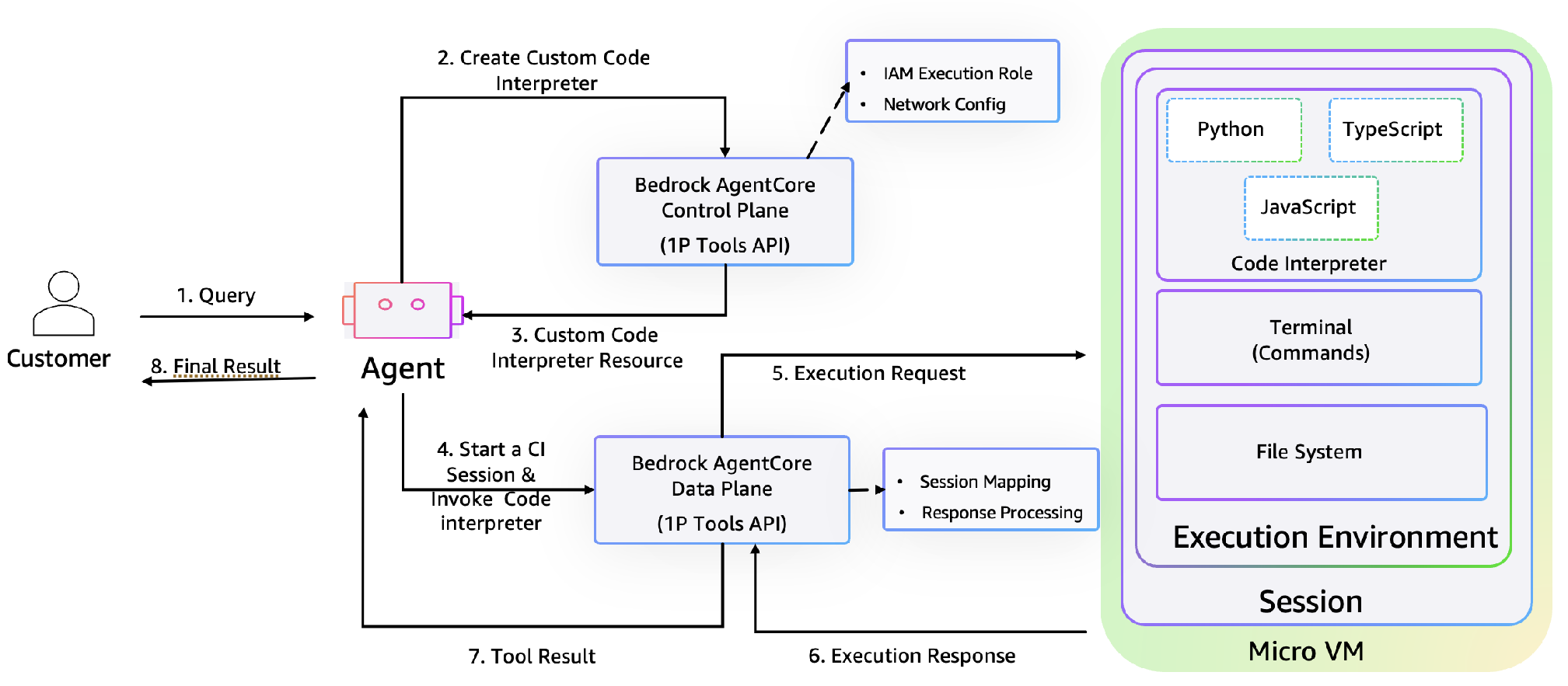
The Amazon Bedrock AgentCore Code Interpreter functions as a fully managed, serverless runtime environment specifically engineered to empower autonomous agents with dynamic code execution capabilities. Rather than enforcing a rigid, predefined procedural workflow, the Code Interpreter is exposed cleanly via a flexible application programming interface (API). This API-driven paradigm allows the runtime to act as a secure, isolated container where an agent can independently generate commands, upload relevant data files, execute programmatic logic, and retrieve analytical results.
For enterprise engineering teams maintaining existing agent infrastructures, this plug-and-play architectural design significantly reduces integration friction. The system provisions ephemeral MicroVM sandbox sessions on demand. When an agent encounters a complex analytical problem that requires empirical verification, it invokes the Code Interpreter API to spin up a secure sandbox. Within this isolated environment, the agent can write scripts, process data structures, and extract actionable insights without exposing the core host infrastructure to potential security vulnerabilities.
The Imperative for Computational Scratch Pads in Enterprise AI
While large language models (LLMs) demonstrate extraordinary proficiency in semantic coherence, contextual understanding, and general reasoning, many practical, real-world operational challenges defy purely semantic solutions. Cybersecurity threat detection, financial fraud analysis, and large-scale data verification often require deterministic mathematical calculations, exact string matching, cryptographic hashing, and statistical modeling. Relying solely on a language model’s parametric memory to perform arithmetic or multi-step logical deduction frequently results in hallucinations or systemic errors.
By coupling a large language model with a robust, programmatic compute scratch pad, developers can fundamentally transcend these inherent limitations. As Shrivu Shankar, Vice President of AI Strategy at Abnormal AI, aptly noted regarding the necessity of these environments, pretty much any agent, whether it is writing code or not, requires a code interpreter sandbox that allows it to actually crunch data and arrive at accurate answers. This compute-augmented reasoning model ensures that agent outputs are empirically verified before they manifest as actionable system decisions.
Abnormal AI’s Three-Tiered Detection Pipeline at Billion-Message Scale
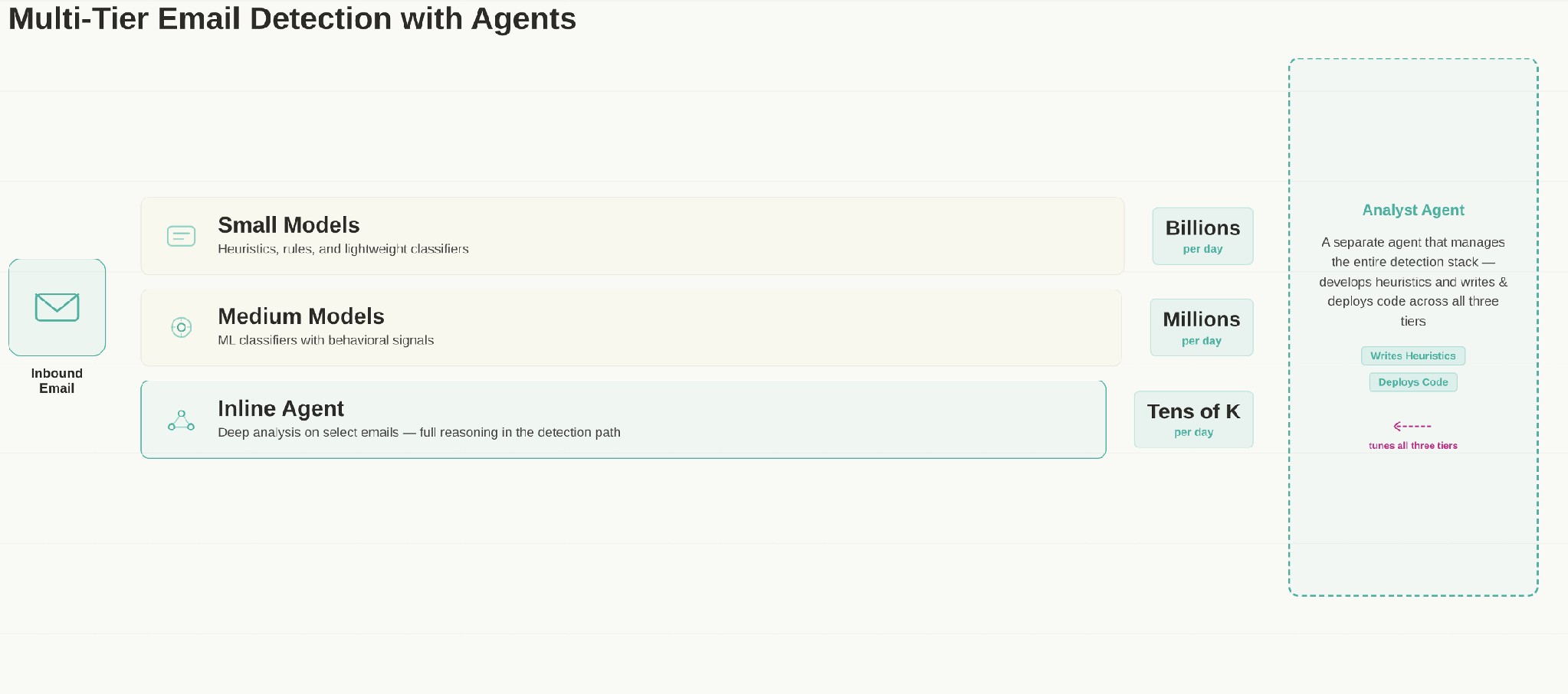
To maintain high availability, minimal latency, and extreme accuracy across billions of daily interactions, Abnormal AI utilizes a sophisticated, three-tiered detection architecture designed to handle progressively complex computational workloads.
At the foundational base of this architecture is Tier 1, which manages high-volume, lightweight classification across billions of messages daily. Operating at this unprecedented scale requires extreme computational efficiency; running large, parameter-heavy foundational models for every incoming email would be both cost-prohibitive and computationally unnecessary. Consequently, Tier 1 employs small models, heuristic rules, and lightweight classifiers, such as logistic regression models, to rapidly filter out the vast majority of benign traffic and obvious spam without deep analysis.
Messages that present ambiguous characteristics or evade definitive classification at Tier 1 are automatically escalated to Tier 2. This middle tier processes millions of messages daily using advanced deep learning and machine learning models designed to execute comprehensive behavioral signal analysis. These models evaluate sender reputation, historical communication patterns, and structural anomalies within the message payload.
The most sophisticated and elusive threats—cases that typically demand the nuanced judgment of a human security analyst—are routed to Tier 3. Operating on tens of thousands of messages daily, Tier 3 deploys advanced inline agents integrated with the Amazon Bedrock AgentCore Code Interpreter. These autonomous agents receive contextual threat intelligence data, dynamically write and execute analysis scripts within a secure sandbox, evaluate how the specific data aligns with broader enterprise behavioral models, and render a definitive security determination in real time. Any rare misclassifications are systematically captured by a separate feedback loop designed to continuously refine the system, supported by rigorous live monitoring frameworks.
Scaling Batch Intelligence via the Analyst Agent Feedback Loop
In addition to the real-time, inline classification pipeline, Abnormal AI deploys an advanced analyst agent operating asynchronously in batch mode. This batch architecture addresses complex, long-running analytical tasks that exceed the temporal constraints of real-time request-response cycles.
The analyst agent continuously ingests historical data and misclassification logs from the real-time pipeline, executing deep pattern analysis across extensive datasets using persistent Code Interpreter sessions. These batch operations can span extended periods—running continuously for more than 30 minutes, or operating intermittently across day-long workflows. For instance, the agent may initialize a session, execute external model training routines, and subsequently re-invoke the Code Interpreter to evaluate and process the empirical results.
Once the analyst agent completes its evaluation, the insights are fed back into the system, automatically updating heuristics and machine learning models across Tier 1 and Tier 2. This closed-loop architecture ensures that the enterprise security apparatus continually adapts to emerging, zero-day threat vectors without requiring manual intervention from human security operations teams.
Zero-Trust Sandbox Design and Security Considerations
When deploying autonomous agents capable of executing arbitrary code in production environments, enterprise security architecture is paramount. Abnormal AI adopted a strict zero-trust sandbox configuration—specifically implementing a no-egress policy—for its Code Interpreter deployment, driven primarily by two foundational security considerations.
First, isolating the runtime environment prevents any unauthorized outbound network connections, effectively neutralizing the risk of data exfiltration or malicious command-and-control communication if an agent processes a compromised payload. Second, the sandbox design ensures strict workload isolation, protecting the core production infrastructure from untrusted code execution.
To reinforce this zero-trust posture, the implementation incorporates several supplementary security practices. Ephemeral MicroVMs ensure that every execution session is completely stateless and destroyed upon completion, preventing cross-session contamination. Furthermore, rigorous input sanitization and strict resource quotas prevent denial-of-service conditions resulting from infinite loops or excessive memory consumption within the agent-generated code.
Production Lessons and Strategic Best Practices
Reflecting on the extensive deployment of code interpretation infrastructure at massive enterprise scale, Abnormal AI engineering leadership has identified several core best practices for builders deploying similar systems.
First, developers should embrace flexibility by providing agents with a lightweight, general harness rather than locking them into rigid, step-by-step procedural workflows. Supplying high-level principles and objectives allows the agent to leverage its intrinsic intelligence to determine the most effective computational approach for a given problem.
Second, architecture planners must recognize that compute scratch pads are not exclusively for software engineering agents. Security agents, financial analysts, and data operations systems derive immense value from isolated scratch pads capable of executing data aggregation, statistical analysis, and empirical verification.
Third, engineering teams should incorporate programmatic verifiers as mandatory guardrails. By providing agents with automated unit tests, integration testing frameworks, and code linters, systems can empower agents to self-test and self-correct their generated scripts within the sandbox before committing final outputs to production.
Finally, architects should utilize persistent file systems as recovery checkpoints for long-running computational tasks. For operations that exceed standard session timeouts—such as large-scale model training or extensive data mining—agents can persist intermediate states to files, allowing external operations to execute before re-invoking the Code Interpreter to synthesize the final results.
Broader Implications and Industry Outlook
The successful integration of the Amazon Bedrock AgentCore Code Interpreter into Abnormal AI’s billion-message security pipeline highlights a critical paradigm shift for enterprise artificial intelligence. Code interpretation is rapidly evolving from a niche developer utility into foundational infrastructure that autonomous agents require to execute reliable, verifiable computational reasoning.
By combining the managed, secure sandbox capabilities of AWS with agile, lightweight agent harnesses, organizations can achieve unprecedented operational scale, drastically reduce manual analyst overhead, and maintain uncompromising security postures. As autonomous agents continue to assume greater responsibility in production environments, the industry consensus is clear: providing agents with a secure compute scratch pad—and trusting empirical computational verification over raw semantic assertions—represents the definitive blueprint for scalable enterprise AI architecture.