Deploying Qwen3.8-2.4T-A95B on Amazon SageMaker HyperPod with vLLM for Trillion-Parameter AI Inference

On August 12, 2026, the artificial intelligence community reached a significant milestone as Alibaba’s Qwen team officially released the open-weights version of its flagship model, Qwen3.8-2.4T-A95B. This release marks the first instance in which a Qwen-Max-class frontier model has been made available with open weights, granting developers and enterprises unprecedented local control over an AI system comprising 2.4 trillion total parameters, with 95 billion activated per token. Featuring a hybrid linear-plus-full-attention architecture and a native context window scaling up to 262,000 tokens—which can be further extended to one million tokens—the model is engineered specifically to handle rigorous agentic workflows, multi-step code generation, long-horizon operational planning, and autonomous tool utilization.
The introduction of open-weights models at this scale alters the strategic landscape for enterprise AI adoption. Organizations are no longer strictly bound to per-token API pricing models offered by proprietary cloud services. Instead, internal infrastructure teams can maintain strict data residency, tailoring inference behavior and security parameters directly within their own boundaries. However, this absolute operational control comes with significant computational and engineering trade-offs. Hosting a model with 2.4 trillion parameters demands dedicated, purpose-built GPU infrastructure and heavily optimized inference serving stacks to maintain practical throughput and latency metrics.
Technical Architecture and Design Innovations
To understand the operational scope required for hosting Qwen3.8-2.4T-A95B, engineers must examine its underlying structural layout. The model operates as a fine-grained Mixture of Experts (MoE) system, utilizing a total of 512 routed experts alongside a single shared expert, with precisely 10 routed experts activated for every processed token. Spanning 92 total layers, the architecture employs a distinct structural pattern: three consecutive layers of Gated DeltaNet coupled with MoE blocks, followed by a single layer of Gated Attention coupled with MoE blocks, repeating sequentially across the network.
This hybrid attention mechanism is the cornerstone of the model’s efficiency during long-context operations. The 69 Gated DeltaNet layers leverage linear attention equipped with a bounded recurrent state, successfully replacing the traditional, memory-intensive KV-cache with a fixed-size memory footprint. Meanwhile, the remaining 23 Gated Attention layers utilize full quadratic attention to preserve high-fidelity token interactions. This calculated 3:1 layer ratio ensures that both compute demands and memory consumption remain strictly bounded as context lengths stretch toward the one-million-token threshold—a vital characteristic for autonomous agents accumulating extensive codebases, tool outputs, and multi-turn reasoning traces.
Furthermore, the fine-grained MoE distribution spreads capacity across hundreds of smaller specialized experts rather than a handful of massive ones. Because only roughly 95 billion parameters are active during any given forward pass, compute and serving costs scale according to activated parameters rather than the colossal 2.4-trillion full parameter count.
Infrastructure Deployment on Amazon SageMaker HyperPod
Overcoming the operational hurdles of managing a 2.4T-parameter model requires orchestration platforms capable of handling automated cluster management, container scheduling, proactive health monitoring, and node failure recovery without human intervention. Amazon SageMaker HyperPod has emerged as a premier platform for this exact class of infrastructure workload.
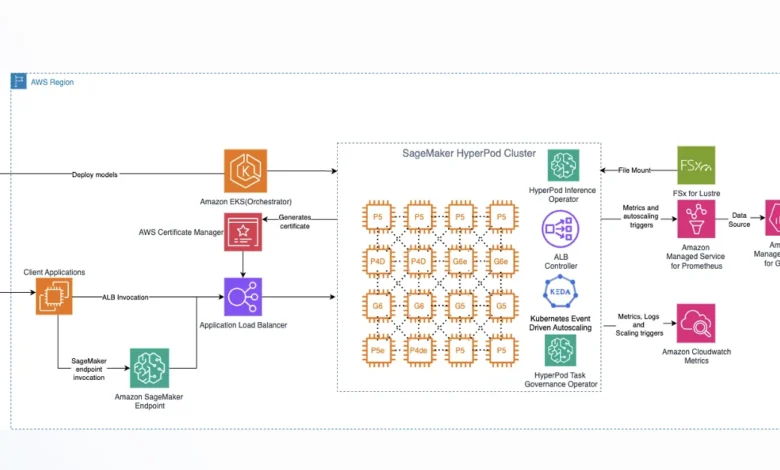
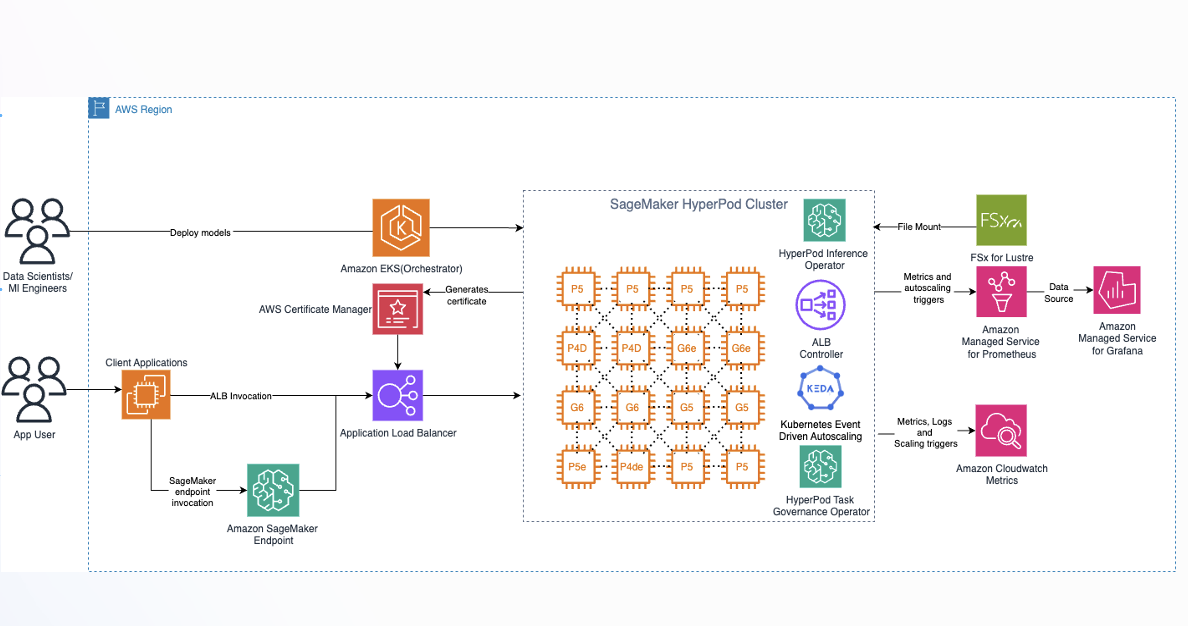
HyperPod clusters utilize Amazon Elastic Kubernetes Service (Amazon EKS) as their underlying control plane, providing administrators with familiar Kubernetes management tooling such as kubectl and Helm charts while AWS manages complex backend responsibilities. These include high-speed networking, storage provisioning, GPU driver installations, and native NVIDIA device plugins. The introduction of the HyperPod Inference Operator streamlines deployment further through the InferenceEndpointConfig custom resource definition, allowing engineers to declare their target model container images, GPU allocations, and serving arguments in a single YAML manifest.
Procuring hardware for models of this magnitude involves navigating strict capacity requirements. The ml.p6-b300.48xlarge instance type, which serves as the foundational hardware block for this deployment, requires dedicated resource allocation through Amazon’s Flexible Training Plans. These committed GPU reservations eliminate the risks of resource contention with on-demand pools and prevent cold-start capacity deficits during critical production rollouts.
Hardware Sizing and NVFP4 Quantization Strategy
At standard BF16 precision, Qwen3.8’s 2.4 trillion parameters would require approximately 4.8 terabytes of memory solely to store model weights, completely overwhelming a single 8-GPU node. To resolve this limitation, developers employ NVFP4 (W4A4) quantization, compressing the weights down to roughly 4 bits per parameter. This reduces the total weight footprint to approximately 1.2 terabytes, fitting comfortably within the 2.1 terabytes of aggregate high-bandwidth memory (HBM3e) available on a single ml.p6-b300.48xlarge instance, which is powered by eight NVIDIA B300 Blackwell Ultra GPUs.
The physical specifications of the ml.p6-b300.48xlarge instance highlight its extreme compute density:
- GPUs: 8× NVIDIA B300 (Blackwell Ultra)
- GPU Memory: 288 GB HBM3e per GPU (2.1 TB total aggregate memory)
- Memory Bandwidth: 8 TB/s per GPU
- Interconnect: NVLink and NVSwitch providing 14.4 TB/s bisection bandwidth
- Compute Performance: Approximately 15 PFLOPS per GPU in FP4 precision (120 PFLOPS total)
- Networking: 6,400 Gbps Elastic Fabric Adapter (EFA) integration
Within this environment, the memory budget is carefully partitioned. Model weights consume roughly 1.2 terabytes, while the recurrent states of the DeltaNet layers claim a fixed 50 to 100 gigabytes. Activations, tensor-parallel buffers, and framework overhead take an additional 100 to 200 gigabytes. This leaves an ample headroom of 500 to 700 gigabytes dedicated strictly to dynamic batching operations and extended context window expansions.
Advanced vLLM Configuration and Serving Parameters
Deploying the model via vLLM requires a precise set of configuration parameters to unlock advanced features such as reasoning extraction, auto-tool selection, and speculative decoding. The baseline serving command relies on specialized flags optimized for the Blackwell architecture:
vllm serve Inferact/Qwen3.8-2.4T-A95B-NVFP4
    --tensor-parallel-size 8
    --quantization nvfp4
    --load-format fastsafetensors
    --trust-remote-code
    --enable-prefix-caching
    --moe-backend auto
    --reasoning-parser qwen3
    --enable-auto-tool-choice
    --tool-call-parser qwen3
    --speculative-config '"method":"mtp","num_speculative_tokens":1'
    --served-model-name Qwen3.8
Through the integration of the --reasoning-parser qwen3 flag, the inference engine automatically isolates and extracts the model’s internal thinking phase enclosed within <think> and </think> tags, separating exploratory logic from final deliverables. Similarly, the tool-calling parameters allow the endpoint to seamlessly parse OpenAI-compatible function-calling schemas, ensuring strict JSON compliance during autonomous agent execution.
Furthermore, Qwen3.8 features native Multi-Token Prediction (MTP) draft heads built directly into its architecture. By passing the speculative configuration flag, the model generates speculative tokens internally without requiring a separate auxiliary draft model, significantly accelerating generation speeds.
Performance Optimization and Empirical Findings
Rigorous benchmarking of Qwen3.8-2.4T-A95B on a single p6-b300 node demonstrates the profound impact of combining Expert Parallelism (EP) and Multi-Token Prediction (MTP). Evaluations conducted across 512 requests with standardized input and output token lengths at a concurrency level of 32 reveal substantial performance gains.
When comparing standard Tensor Parallelism (TP) against configurations enhanced with MTP and EP, the data shows that enabling TP combined with MTP and EP reduces Time-to-First-Token (TTFT) by nearly 59.7%. Overall request latency drops by 12.2%, while aggregate output throughput increases by 12.6%. These metrics underscore the value of hardware-software co-design when managing sparse mixture-of-experts architectures at scale.
Additional performance tuning strategies include leveraging Automatic Prefix Caching (APC) via the --enable-prefix-caching flag. In multi-turn agentic workflows where system prompts and conversation histories are repeatedly queried, prefix caching can slash initial token latency by 50 to 80 percent by reusing cached KV blocks across requests.
Industry Implications and Future Outlook
The availability of Qwen3.8-2.4T-A95B as an open-weights model hosted on scalable cloud infrastructure like Amazon SageMaker HyperPod represents a turning point for enterprises seeking sovereign artificial intelligence capabilities. Organizations previously restricted by the recurring costs and privacy limitations of commercial APIs can now deploy world-class reasoning engines internally.
As enterprises increasingly transition from simple chatbots to autonomous, tool-using agents capable of executing complex research workflows and software engineering pipelines, the combination of advanced silicon like the NVIDIA Blackwell architecture, flexible cloud orchestration, and high-performance serving stacks establishes a new benchmark for enterprise AI deployment. The successful operationalization of trillion-parameter models demonstrates that self-hosted frontier intelligence is no longer restricted to a handful of foundational model providers, opening new avenues for innovation across global industries.
Related posts: