The Reality of Software Engineering in the Age of Artificial Intelligence

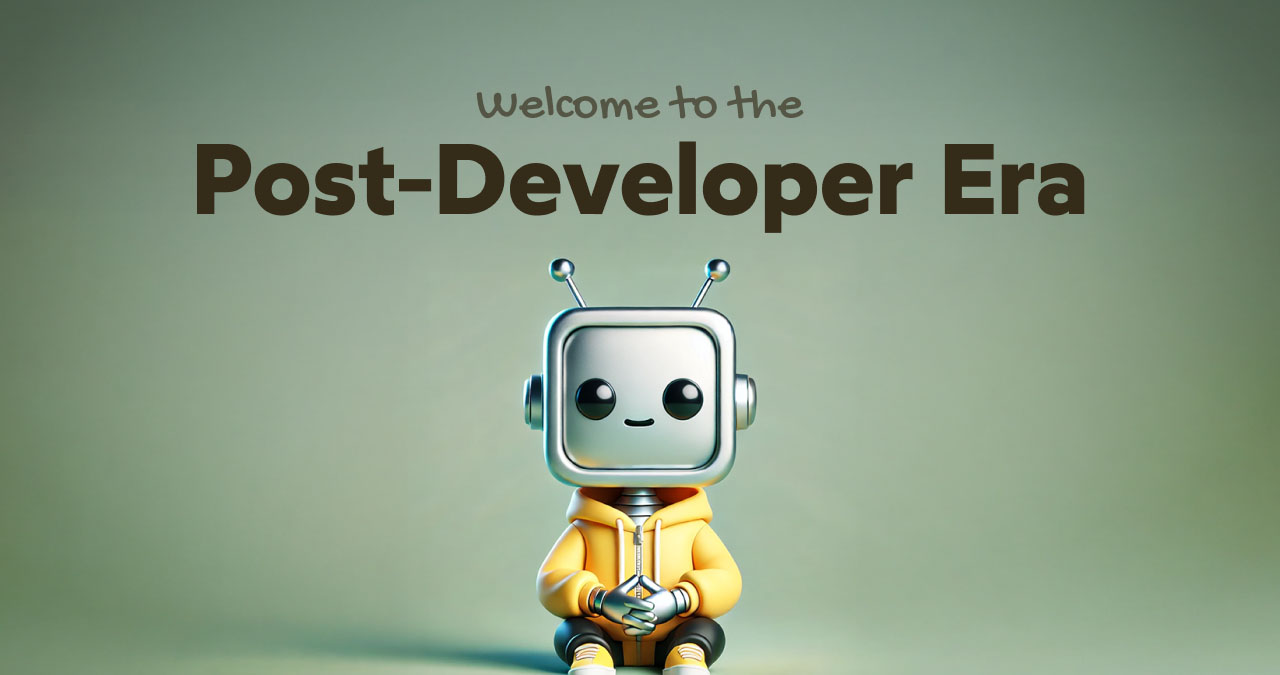
In March 2023, the global tech industry was gripped by a narrative suggesting that the rapid advancement of Large Language Models (LLMs), particularly following the public release of GPT-4, signaled the imminent obsolescence of human software developers. Two years later, the landscape of software engineering has undergone a significant transformation, yet the fundamental role of the human programmer remains not only intact but increasingly essential. While the integration of AI tools into the development lifecycle has reached record levels, evidence suggests that the industry is experiencing an evolution in workflow rather than a transition to a post-developer era.
A Chronology of the AI Disruption Narrative
The discourse surrounding the "end of front-end development" began in earnest in early 2023. At that time, social media platforms and industry forums were saturated with claims that autonomous AI agents would soon replace junior and mid-level developers, theoretically reducing the need for human input in coding tasks. This sentiment was driven by the unprecedented capabilities of early generative AI to write, debug, and optimize code snippets.
By March 2024, companies such as Cognition launched high-profile autonomous agents like "Devin," marketed as AI software engineers capable of executing complex end-to-end tasks. This prompted intense speculation from venture capitalists and corporate leadership regarding the potential to reduce headcount. However, by early 2025, real-world deployment data began to contradict the narrative of autonomous replacement. Reports from technical teams who stress-tested these systems indicated that while AI performed well on isolated, micro-tasks, it frequently faltered on complex, multi-layered projects. In one documented case, an engineering team found that an AI agent could only successfully complete 15% of assigned tasks, concluding that the time required to manage the agent exceeded the time required for a human to perform the work manually.
The Integration of AI in Modern Development
Current data from industry leaders illustrates a more nuanced reality. Reports from Alphabet, for instance, indicate that over 25% of all new code submitted at Google is generated with the assistance of AI. A critical distinction must be made between "AI-generated" and "AI-authored." In a professional engineering context, AI acts as a sophisticated assistant or force multiplier. A human developer remains the architect of the system, responsible for the structural integrity, security, and maintenance of the codebase.
The "driver-in-the-loop" model has become the industry standard. In this framework, the developer inputs requirements, reviews the AI-generated output for logical errors, and integrates it into the larger architecture. The reliance on human oversight is primarily due to the "hallucination" rate of current models, where AI may provide syntactically correct but functionally flawed or insecure code. Consequently, the role of the developer has shifted toward higher-level systems design and rigorous quality assurance.
Economic and Market Implications
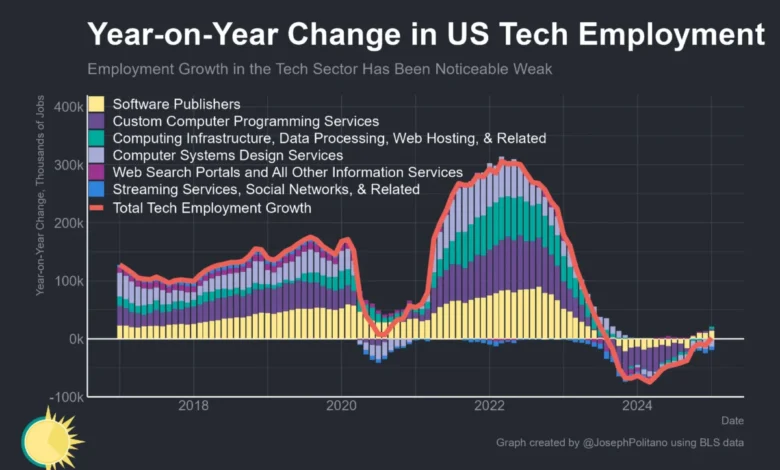
Despite the ongoing integration of AI, the total number of technology-related job openings has shown signs of resilience. Data from the U.S. Bureau of Labor Statistics and independent market analysts indicates that after a contraction in 2023, the demand for software engineering talent has begun to stabilize and, in some sectors, increase.
The current challenges in the job market are multifaceted. Macroeconomic volatility, shifting corporate investment strategies, and a period of post-pandemic correction have played larger roles in hiring slowdowns than the adoption of AI. Furthermore, uncertainty regarding the long-term impact of current political and economic policies—including shifts in federal regulation and global trade dynamics—has led some enterprises to adopt a cautious stance toward human capital expansion.
The "Vibe Coding" Challenge and Skill Erosion
A primary concern among industry veterans is the phenomenon of "vibe coding," where junior developers, over-reliant on AI assistance, may fail to develop the foundational debugging and logic skills necessary for complex problem-solving. When AI tools generate code that functions on the surface but contains underlying technical debt or logical inconsistencies, a developer without a deep understanding of the language or framework is ill-equipped to intervene.
This potential erosion of fundamental skills poses a long-term risk to software sustainability. Educational institutions and training programs are now re-evaluating their curricula to emphasize "AI-augmented" learning, which focuses on critical thinking and architectural design rather than rote syntax memorization. The objective is to produce engineers who can harness the speed of AI while maintaining the rigor required to manage complex systems.
Future Outlook and Industry Trajectory
The industry appears to be moving toward a "developer renaissance." As companies move past the initial hype cycle, they are beginning to recognize that AI is not a substitute for human ingenuity, but rather a catalyst for productivity. A skilled developer paired with an advanced LLM can accomplish significantly more than a developer working alone, but the human remains the final arbiter of quality and intent.
Looking forward, the demand for software engineers is unlikely to vanish. The complexity of modern software ecosystems—characterized by distributed cloud architectures, cybersecurity threats, and the need for ethical AI deployment—requires human oversight that current models cannot provide.
While the tools of the trade are changing, the profession remains fundamentally focused on problem-solving, communication, and system design. For those entering the field, the current environment presents a unique opportunity: the ability to leverage AI as a personalized tutor and productivity tool, provided they maintain a commitment to mastering the underlying principles of the craft. As the market continues to correct and companies finalize their AI integration strategies, the value of the human engineer—one who can bridge the gap between abstract business requirements and functional, reliable software—will remain the cornerstone of the technology sector.