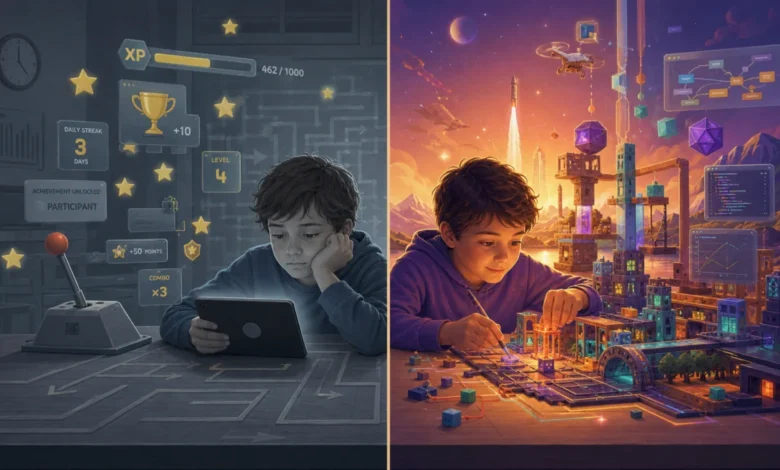
The landscape of modern education is undergoing a profound shift, yet a significant disconnect has emerged between the developers of educational technology and the students who consume it. For the generation known as Gen Alpha and the younger cohort of Gen Z, digital interaction is not a novelty; it is a fundamental pillar of their cognitive development. These students, having been raised on sophisticated gaming platforms such as Minecraft, Roblox, and Fortnite, possess an intuitive understanding of complex systems, agency, and social coordination. When schools and software developers attempt to bridge the gap between pedagogy and engagement through superficial "gamification"—the application of points, badges, and leaderboards to static academic tasks—the result is often rejection by the very demographic they intend to capture.
The Evolution of Student Engagement
To understand why contemporary students are resistant to rudimentary gamification, one must look at the timeline of their digital literacy. The early 2010s marked a pivot point where mobile tablets became primary tools for entertainment. By 2015, the global proliferation of sandbox environments allowed children to move beyond passive consumption. Unlike previous generations that engaged with educational software designed as "edutainment"—often featuring repetitive, linear structures—current students have spent thousands of hours in virtual worlds that offer high-level creative autonomy.
In Minecraft, for example, students do not simply complete tasks; they manipulate logic through redstone circuitry, engage in resource management, and collaborate on massive architectural projects. This represents a mastery of systems that far exceeds the complexity of the digital worksheets currently prevalent in many classroom management systems. When an educational app presents a math problem and awards "experience points" for a correct answer, students identify this not as a game, but as a transparent attempt at behavioral modification.
Data and Behavioral Analysis
Empirical observation and user engagement metrics suggest that students are highly sensitive to "extrinsic motivation" versus "intrinsic interest." A 2023 study regarding digital learning habits noted that engagement with gamified platforms drops by approximately 60% within the first two weeks if the underlying mechanics do not evolve. The "Skinner box" approach—a psychological framework relying on repetitive rewards to condition behavior—is failing because it lacks the one element that defines successful gaming: agency.
Data from the education technology sector indicates that tools emphasizing "passive reward systems" experience high bounce rates. Conversely, applications that incorporate open-ended problem solving and creative sandboxes show significantly higher retention. Educators are increasingly reporting that students view superficial gamification as an insult to their intellect. When a student is told that they have "leveled up" for completing a basic vocabulary drill, they recognize the mechanism as a hollow simulation of progress, devoid of any genuine challenge or mastery.
Chronology of the Gamification Mismatch
The rise of gamification in classrooms can be traced to the "EdTech Boom" of the late 2000s and early 2010s. During this period, the focus was primarily on digitizing physical textbooks. As software development costs decreased, developers began incorporating "game-like" elements to increase user time-on-app, primarily to satisfy stakeholders and administrators who prioritize engagement metrics over pedagogical depth.
- 2010-2015: Introduction of basic gamification, characterized by digital badges and progress bars.
- 2016-2020: Expansion of personalized learning platforms that utilized algorithmic sequencing.
- 2021-Present: A growing realization among teachers and students that "gamified" worksheets are not increasing academic outcomes, leading to a push for more immersive, inquiry-based digital tools.
The current failure of these platforms is rooted in a fundamental design flaw: the designers are often not gamers themselves. They view games as reward-delivery systems—where a task is completed, and a point is earned—rather than as experiential systems where the task itself provides the satisfaction.
Industry Perspectives and Official Responses
The industry response to this critique has been bifurcated. Some legacy EdTech corporations argue that points and badges are essential for providing immediate feedback to students in remote or hybrid learning environments. They maintain that for students who struggle with academic focus, these markers serve as necessary scaffolding.
However, researchers in game design and cognitive psychology offer a different perspective. Dr. Elena Vance, a lead designer in interactive learning environments, states, "We are confusing motivation with manipulation. True engagement arises from the learner’s sense of discovery. When you add a leaderboard to a spelling test, you aren’t making it a game; you are simply making the test more stressful."
Critics within the gaming industry argue that the EdTech sector has failed to distinguish between "gamification" and "game design." Gamification, as currently practiced, is an overlay of superficial mechanics. True game design, by contrast, is the integration of goals, rules, and outcomes that allow for emergent play.
The Broader Impact on Academic Outcomes
The implications of this disconnect are significant. When students treat learning tools with skepticism, the efficacy of the software is nullified. If a student perceives a platform as a "homework machine" in disguise, they will likely employ strategies to circumvent the learning process—such as guessing answers to accumulate points quickly or seeking workarounds for time-based requirements.
Furthermore, this mismatch risks alienating students from technology-aided learning altogether. If their experience with "educational games" is consistently one of boredom and patronization, they are less likely to engage with more sophisticated, truly educational tools later in their academic careers. The "gamification" label has, in many circles, become a signal to students that they are about to engage in a chore rather than a learning opportunity.
A Framework for Future Design
Moving forward, developers are being encouraged to move away from the "gamify everything" mentality. A more robust approach involves identifying the inherent genre of the learning objective.
If the objective is to teach language, designers might look to the principles of narrative-driven RPGs, where the student’s progress is tied to their ability to navigate complex social interactions rather than the number of vocabulary words memorized. If the goal is to teach physics, a simulation-based approach—where the student is tasked with building a bridge or a circuit that must function under simulated constraints—provides the necessary "flow state" that keeps students engaged.
The transition from "points-based" to "principle-based" design requires a fundamental shift in business models. It requires companies to stop prioritizing the "streak" metrics that appeal to school administrators and start prioritizing the "mastery" metrics that appeal to the learners themselves.
Conclusion: The Need for Authenticity
The primary takeaway for those developing for the next generation is that the audience is already experts in high-fidelity interactive media. They have spent their formative years in worlds that offer high stakes, deep strategy, and meaningful creative freedom. They can differentiate between a system designed to empower them and one designed to keep them clicking.
To regain the trust of the student demographic, the EdTech industry must undergo a period of critical re-evaluation. This does not mean that every educational tool must become a high-budget video game. It means that if an application is a tool, it should be a high-quality, transparent, and useful tool. If it is a game, it must respect the player’s intelligence and offer authentic agency. The era of the "gold star" as a motivator is coming to an end, replaced by a demand for substance, complexity, and respect for the student as an active participant in their own education. Only by aligning pedagogical goals with the rigorous standards of modern game design can developers create platforms that are truly effective for the digital-native student.