Couchbase Capella iQ Leverages Amazon Bedrock for Scalable Multi-Model AI Architecture


Couchbase, a leading provider of NoSQL cloud databases, has strategically integrated Amazon Bedrock to power its AI-driven developer assistant, Capella iQ. This move signifies a critical evolution in the company’s approach to artificial intelligence, enabling a flexible, scalable, and resilient inference architecture that supports multiple foundation model (FM) providers. As enterprise adoption of Capella iQ rapidly expanded, the imperative to move beyond a single large language model (LLM) became clear, driven by the need for enhanced operational resilience, greater flexibility in model selection, and alignment with diverse customer deployment preferences. The integration of Amazon Bedrock provides Couchbase with a model-agnostic inference architecture capable of scaling through traffic bursts and maintaining high availability across AWS Regions without requiring pre-provisioned capacity, a significant advantage in the dynamic world of AI-powered services.
The Genesis of Capella iQ and the Demand for Advanced AI
Couchbase Capella iQ was conceived as an innovative AI-powered developer assistant designed to streamline database operations and accelerate application development. Its core functionalities include generating database queries, recommending optimal indexes, explaining complex queries, generating iQ Insights, and facilitating multi-turn conversational workflows. This assistant aims to democratize access to advanced database expertise, allowing developers to interact with their data more intuitively and efficiently. Initially, Capella iQ relied on a robust, single LLM setup. However, as the utility and user base of Capella iQ grew, the limitations of a monolithic AI strategy began to surface. Enterprises increasingly demand robust, fault-tolerant AI solutions that can adapt to evolving model capabilities and ensure continuous service. A single point of failure in the underlying foundation model provider or its infrastructure posed an unacceptable risk to operational continuity and customer satisfaction.
The database-as-a-service (DBaaS) market is intensely competitive, with AI integration becoming a key differentiator. Providing intelligent assistance directly within the database platform offers significant value by reducing cognitive load for developers, minimizing errors, and accelerating time-to-market for new applications. To maintain its competitive edge and meet the escalating demands of its enterprise clientele, Couchbase recognized the necessity of a multi-model approach. This strategy not only mitigates risks associated with reliance on a single provider but also opens avenues for leveraging specialized models for specific tasks, potentially optimizing performance and cost.
Couchbase’s Strategic Shift to a Multi-Model AI Architecture
The decision to expand Capella iQ’s AI capabilities to support multiple foundation model providers was a strategic imperative rooted in several key considerations. Firstly, flexibility: the rapid pace of innovation in the LLM landscape means new, more capable, or more cost-effective models are constantly emerging. A model-agnostic architecture allows Couchbase to swiftly evaluate and integrate these advancements without extensive re-engineering. Secondly, improved operational resilience: relying on multiple providers enhances failover capabilities. If one provider experiences an outage or performance degradation, traffic can be seamlessly routed to another, ensuring uninterrupted service for Capella iQ users. Thirdly, alignment with diverse customer deployment preferences: large enterprises often have specific requirements regarding data residency, security posture, or preferred cloud providers. A multi-model, multi-cloud strategy (even within a single cloud provider like AWS through Bedrock) offers greater choice and peace of mind for customers.
The core challenge for Couchbase was to implement this multi-model strategy without incurring significant operational overhead or requiring complex, custom infrastructure management. The ideal solution needed to be serverless, highly scalable, and capable of abstracting away the underlying complexities of managing different foundation models. This led Couchbase to Amazon Bedrock, a fully managed service that offers a choice of high-performing FMs from leading AI companies, along with a broad set of capabilities to build generative AI applications with security, privacy, and responsible AI built-in.
Deep Dive into the Capella iQ Production Architecture with Amazon Bedrock
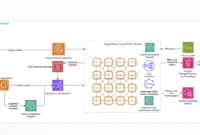
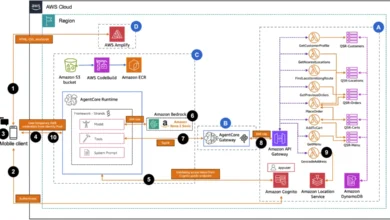
The production architecture for Capella iQ’s integration with Amazon Bedrock is a testament to Couchbase’s commitment to high availability and scalability. Hosted within the AWS Control Plane, the architecture spans two critical AWS Regions: us-east-1 (N. Virginia) and us-west-2 (Oregon). This dual-region deployment is fundamental to achieving the desired level of high availability and disaster recovery, ensuring that even in the event of a regional outage, Capella iQ services remain operational.
At the heart of the us-east-1 deployment, an Amazon Elastic Kubernetes Service (Amazon EKS) cluster orchestrates the Capella iQ microservices. EKS provides a managed Kubernetes control plane, simplifying the deployment, management, and scaling of containerized applications. Within this EKS cluster, several microservices are responsible for different aspects of Capella iQ’s functionality. While the original article did not list them, typical components would include:
- API Gateway/Load Balancer: To manage incoming developer requests and distribute them across backend services.
- Orchestration Service: Responsible for parsing requests, determining the appropriate AI workflow, and coordinating with other services.
- Context Management Service: To store and retrieve conversational history for multi-turn interactions, ensuring continuity and coherence.
- Prompt Engineering Service: To dynamically construct prompts for the foundation models based on user input and workflow requirements.
- Model Abstraction Layer: The critical component that interfaces with Amazon Bedrock, abstracting away the specifics of different FMs and providing a unified API for the Capella iQ services.
- Telemetry and Monitoring Service: To capture performance metrics, logs, and user interactions for observability and continuous improvement.
A crucial architectural decision was the implementation of an Amazon Virtual Private Cloud (Amazon VPC) interface endpoint. This endpoint provides private connectivity from the EKS cluster directly to the Amazon Bedrock runtime. This means inference traffic does not traverse the public internet, enhancing security and reducing latency. The VPC interface endpoint routes inference traffic to infrastructure managed by AWS for Bedrock, leveraging the robust and secure AWS network.
Furthermore, this setup supports Cross-Region Inference (CRIS) within the US geography, specifically across us-east-1, us-east-2 (Ohio), and us-west-2. CRIS is a powerful feature that enables automatic failover, intelligent load distribution, and improved availability during demand spikes. In a scenario where us-east-1 experiences an issue, Bedrock can automatically route requests to an available endpoint in us-west-2 or us-east-2, all without any application-level changes or explicit failover logic needing to be built by Couchbase. This capability dramatically simplifies the operational burden associated with maintaining high availability for AI workloads.
The Operational Flow: From Developer Query to AI-Powered Insight
When a developer interacts with Capella iQ, initiating a request for a SQL++ query, an index recommendation, or continuing a multi-turn conversation, the request traverses a sophisticated pipeline designed for efficiency and resilience:
- Request Initiation: The developer interacts with the Capella iQ interface within Couchbase Capella.
- API Gateway & Service Routing: The request is received by the Capella iQ microservices running on the Amazon EKS cluster. An orchestration service identifies the type of request (e.g., query generation, index recommendation, conversation continuation).
- Context Assembly: For multi-turn conversations, the system retrieves relevant historical context from its internal knowledge base or session store, ensuring the AI can maintain coherence and build upon previous interactions.
- Prompt Engineering: Based on the user’s input and the gathered context, a sophisticated prompt is dynamically constructed. This prompt is carefully engineered to elicit the desired output from the foundation model, incorporating best practices for clarity, specificity, and constraint adherence.
- Bedrock API Call (via Abstraction Layer): The Capella iQ microservice, through its model abstraction layer, makes an API call to Amazon Bedrock. This call specifies the desired foundation model (e.g., Anthropic’s Claude Sonnet 4.5) and passes the engineered prompt. The private VPC interface endpoint ensures secure and efficient communication.
- Bedrock Inference & Response: Amazon Bedrock handles the inference request, utilizing its managed infrastructure to process the prompt with the chosen foundation model. The model generates a response, which Bedrock then sends back to the Capella iQ microservice. Crucially, if the primary Bedrock endpoint (e.g., in us-east-1) is experiencing issues, CRIS automatically routes this request to a healthy endpoint in another configured US Region, ensuring seamless operation.
- Response Processing & Delivery: The Capella iQ microservice receives the model’s response, processes it (e.g., validates syntax for SQL++ queries, formats for display), and then delivers the AI-generated insight back to the developer through the Capella iQ interface.
This end-to-end design ensures that model upgrades or changes in provider require only configuration updates at the namespace layer within Couchbase’s internal systems. There are no code changes, no downtime, and no disruption to the developer experience, embodying the principle of "model evolution as a configuration choice."
Rigorous Model Evaluation: Benchmarking for Production Readiness
Before deploying any foundation model into production, Couchbase established a comprehensive benchmark suite to rigorously evaluate candidate models. This suite covered all core Capella iQ workflows, including SQL++ generation, index recommendations, query explanations, iQ Insights generation, and the nuances of multi-turn conversations. The evaluation process involved using standardized prompt/response test sets against multiple models available on Amazon Bedrock.
Scoring was meticulously focused on four key dimensions:
- Functional Correctness: Does the model generate accurate and valid responses (e.g., syntactically correct SQL, appropriate index recommendations)?
- Determinism: Does the model produce consistent results for identical inputs, which is crucial for predictable system behavior?
- Latency: How quickly does the model generate a response, directly impacting user experience?
- Formatting Consistency: Does the model adhere to expected output formats, ensuring seamless integration with Capella iQ’s UI and downstream processes?
The evaluation revealed that Anthropic’s Claude Sonnet 4.5 achieved approximately 76 percent accuracy on an internal evaluation benchmark. This benchmark was carefully modeled on the BIRD methodology (Benchmarking Information Retrieval and Database systems), a robust framework for assessing text-to-SQL capabilities. This accuracy figure met Couchbase’s stringent production quality bar across all evaluated workflows, with no critical regressions observed. This validated Claude Sonnet 4.5 as the initial production model for Capella iQ’s diverse workload profile, which spans structured code generation, natural language explanation, and complex multi-turn reasoning. More importantly, this rigorous process validated a scalable model evaluation framework, enabling Couchbase to rapidly qualify and adopt newer models as they become available on Amazon Bedrock, ensuring continuous improvement and access to the latest AI capabilities.
The Amazon Bedrock Advantage: A Catalyst for Enterprise AI
Amazon Bedrock provided Couchbase with a suite of advantages critical for enterprise-scale AI adoption:
- Fully Managed, Serverless Inference Environment: This eliminated the need for Couchbase to manage underlying GPU infrastructure, provision servers, or handle complex model deployment. Bedrock handles all the operational heavy lifting, allowing Couchbase to focus on application logic and customer value.
- Growing Catalog of Foundation Models: Bedrock offers access to a diverse and expanding catalog of FMs from various providers (e.g., Anthropic, AI21 Labs, Meta, Stability AI, Amazon’s own models). This allows Couchbase to evaluate and adopt newer model generations or specialized models without re-architecting their inference pipeline, supporting their multi-model strategy.
- Cross-Region Inference (CRIS): As detailed, CRIS delivers built-in resilience and geographic distribution, automatically routing requests to healthy endpoints across regions. This capability, which would otherwise require significant custom engineering and operational complexity, is a game-changer for maintaining high availability.
- Single-API Access: Bedrock offers a unified API to interact with multiple model families. This was a natural fit for Couchbase’s goal of building a provider-agnostic architecture, where model selection is a simple configuration choice rather than a code change requiring significant development effort.
- Enterprise-Grade Security, Data Residency, and Compliance: For enterprise customers, the assurance that inference traffic remains within a well-governed AWS footprint is paramount. By integrating with Amazon Bedrock, Couchbase offers customers the benefit of the AWS security posture, robust data residency controls, and adherence to critical compliance certifications such as SOC, HIPAA, and ISO for AI-assisted workflows within Capella iQ. This instills confidence and simplifies compliance for regulated industries.
Navigating Engineering Challenges in Enterprise-Scale AI Deployment
While Amazon Bedrock significantly simplified much of the infrastructure complexity, building a production-grade multi-model inference layer at enterprise scale introduced its own set of engineering challenges. These challenges highlight the intricacies of deploying advanced AI systems in a mission-critical environment:
- Cross-Region Failover Testing: Perhaps the most significant challenge emerged during the rigorous validation of cross-Region failover scenarios. Testing that inference traffic routed correctly between us-east-1 and us-west-2 under various simulated failure modes—including partial endpoint degradation, network latency spikes, and regional throttling events—required substantial effort. Couchbase’s engineering team had to build custom test harnesses and develop sophisticated simulation tools to reproduce conditions that are inherently difficult to replicate in development environments. This involved close collaboration with AWS solution architects to validate that requests would automatically reroute to a healthy Region without impacting response quality or latency. Fine-tuning timeout and retry configurations was also critical to ensure production readiness and optimal user experience during failovers. This iterative testing process was essential to certify the robustness of the CRIS integration.
- Model Benchmarking at Scale: Running comprehensive benchmarks across multiple candidate models introduced significant complexity, particularly in comparing results fairly. Differences in tokenization strategies, context window handling, and response formatting across various FMs required careful normalization and post-processing before scores could be meaningfully compared. To address this, the team invested in building automated evaluation pipelines. These pipelines facilitated reproducibility, reduced manual overhead during model selection, and ensured that the benchmarking process could be efficiently repeated for future model updates or new FM introductions. This investment in automated evaluation is a continuous workstream, ensuring Couchbase can quickly and accurately assess the performance of new models.
Key Learnings and Strategic Takeaways
Couchbase’s journey with Amazon Bedrock and Capella iQ yielded several invaluable lessons for organizations embarking on similar enterprise AI initiatives:
- Provider Abstraction Pays Dividends: Investing early in building a robust provider abstraction layer within Capella iQ’s architecture proved immensely beneficial. This foresight enabled seamless Bedrock integration without disrupting the existing Capella iQ user experience. More importantly, it maintains long-term flexibility, allowing Couchbase to adopt new models or providers as they emerge without requiring a fundamental re-engineering of core application logic.
- Cross-Region Inference Simplifies Operations: The inherent capabilities of Amazon Bedrock’s Cross-Region Inference (CRIS) feature handled bursty workloads across geographical regions without the need for pre-provisioned capacity or the development of complex custom failover logic. This significantly improved service availability and resilience while simultaneously reducing operational complexity and cost.
- Multi-Model Readiness Requires Dedicated Investment: Achieving production-grade multi-model support is not a one-time setup but rather a continuous workstream. It demands sustained investment in benchmarking infrastructure, sophisticated prompt engineering techniques, and robust observability tools. Teams must plan for this as an ongoing commitment to ensure quality, performance, and adaptability in a rapidly evolving AI landscape.
Future Trajectory: Cost Optimization and Model Evolution
Looking ahead, Couchbase is actively exploring avenues for further optimization and advancement within Capella iQ. A key focus is cost optimization through the strategic deployment of fine-tuned smaller models, leveraging Amazon Bedrock’s Custom Model Import capability. By distilling task-specific knowledge into lightweight models for high-volume, well-bounded workloads—such as specific index recommendations or query explanations—the team aims to significantly reduce per-inference cost while maintaining or even improving the quality and latency for these particular tasks. This approach embodies the value proposition of a multi-model architecture: choosing the right model for the right task.
The roadmap also includes continuous model evolution. Starting with Anthropic’s Claude Sonnet 4.5, Couchbase plans to evolve to newer models, such as Claude Sonnet 5 and future generations, as they become available on Amazon Bedrock. This continuous adoption of the latest model advancements within a single, managed infrastructure ensures that Capella iQ remains at the forefront of AI-powered database assistance, delivering ever-improving capabilities to developers.
Conclusion: A Blueprint for Resilient SaaS AI Integration
Couchbase’s successful adoption of Amazon Bedrock for Capella iQ serves as a compelling blueprint for how to construct a resilient, multi-model AI architecture within a Software as a Service (SaaS) application. In production, Claude Sonnet 4.5 on Amazon Bedrock achieved approximately 76 percent accuracy across Capella iQ’s core workflows, a critical validation of its functional correctness. Crucially, latency and throughput targets were met within acceptable margins, with no user-impacting quality regressions observed during controlled traffic testing and subsequent live deployment. End users now experience the same high quality and responsiveness they expect from Capella iQ, now backed by the managed infrastructure and cross-Region resilience capabilities of Amazon Bedrock.
By proactively investing in a provider-agnostic architecture, implementing a phased rollout strategy, and establishing a rigorous, standardized benchmarking framework, Couchbase has delivered a production-grade implementation that effectively treats model evolution as a configuration choice, not a disruptive code change. This strategic approach ensures that Capella iQ can seamlessly integrate the latest advancements in foundation models, continuously enhancing the developer experience without compromising service availability or operational efficiency. The integration underscores a significant step forward in bringing sophisticated, resilient AI capabilities to enterprise database management, setting a new standard for intelligent developer assistance.