Scikit-Ollama Bridges Scikit-learn with Local Ollama Models for Zero-Shot Text Classification, Eliminating Cloud API Dependency

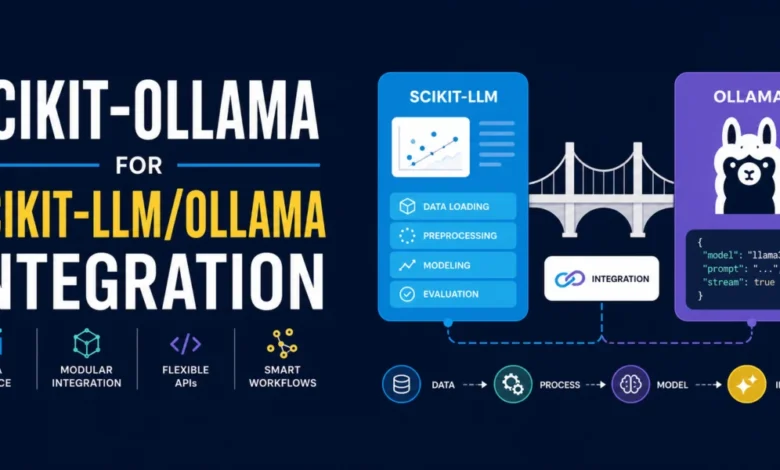
In an era increasingly defined by artificial intelligence, the integration of Large Language Models (LLMs) into conventional machine learning workflows has become a critical frontier, prompting a significant shift in how developers and organizations approach AI deployment. This transformation is not merely about capability but extends profoundly to considerations of cost, security, and data sovereignty. While commercial cloud-based LLM APIs have dominated the early landscape, offering unparalleled computational power and pre-trained models, they frequently present challenges such as prohibitive costs, quota limitations, traffic bottlenecks, and paramount data privacy concerns. A compelling alternative has emerged with the advent of scikit-ollama, a novel library that seamlessly integrates the familiar scikit-learn interface with locally running Ollama models, enabling robust zero-shot text classification without any reliance on external cloud infrastructure.
The Evolving Landscape of LLM Deployment: Cloud vs. Local
The rapid ascent of LLMs like GPT-3, Llama, and Mistral has revolutionized natural language processing, making sophisticated AI capabilities accessible to a wide audience. Initially, the sheer computational demands of training and running these models necessitated reliance on hyperscale cloud providers. Companies leveraged APIs from OpenAI, Google Cloud, AWS, and Azure to integrate LLM functionalities into their applications, from chatbots and content generation to complex data analysis. This cloud-first approach, while convenient, introduced several systemic challenges.
Firstly, the cost factor is often substantial. API calls accrue charges based on token usage, and for applications with high volume or extensive text processing, these costs can quickly escalate into significant operational overheads. Secondly, data privacy and security remain a top concern. Sending sensitive or proprietary data to third-party cloud services for processing raises questions about data ownership, compliance with regulations like GDPR or HIPAA, and potential exposure to data breaches. Many organizations, particularly in sectors such as healthcare, finance, or government, face strict mandates against transmitting certain types of information outside their internal networks. Thirdly, latency and reliability can be issues. Network round-trips to cloud APIs introduce delays, impacting real-time applications. Furthermore, reliance on a single vendor’s API can lead to vendor lock-in and potential service disruptions.
These challenges have spurred a growing demand for local LLM deployment. The ability to run LLMs directly on an organization’s own servers, or even on powerful desktop machines, offers compelling advantages. This shift allows for complete control over data, enhanced security, predictable costs (primarily hardware and electricity), and often lower latency for inference tasks. However, deploying and managing LLMs locally can be complex, requiring expertise in model quantization, framework setup, and resource optimization. This is where platforms like Ollama have proven instrumental.
Ollama: Democratizing Local LLM Access
Ollama has emerged as a crucial tool in the local LLM ecosystem. It provides a simple, user-friendly framework for downloading, running, and managing a wide array of open-source LLMs directly on local machines, including popular models like Llama 3, Mistral, Gemma, and many others. Ollama abstracts away much of the underlying complexity of setting up CUDA drivers, managing model weights, and configuring inference engines. With a single command-line interface, users can pull models and start interacting with them, making local LLM experimentation and deployment accessible to a broader audience of developers and researchers.
The ability to run models locally not only addresses privacy and cost concerns but also fosters innovation by allowing developers to iterate quickly without incurring API charges or being subject to external rate limits. It enables offline applications, crucial for scenarios with intermittent or no internet connectivity, and supports edge computing initiatives where data processing needs to occur close to the source.
Scikit-Ollama: Bridging the Gap with Scikit-learn
Despite the advancements in local LLM deployment, integrating these powerful models into existing machine learning workflows often required custom scripting and departure from established patterns. The scikit-learn library, with its consistent API for training, evaluating, and deploying classical machine learning models, has long been the de facto standard in Python for data scientists and ML engineers. Its familiar fit(), predict(), and transform() methods provide a highly intuitive and robust framework.
Enter scikit-ollama, a library largely inspired by scikit-llm (which focuses on cloud LLMs) but specifically tailored for local Ollama models. scikit-ollama acts as a crucial bridge, allowing users to leverage the power of locally installed LLMs within the comfortable and widely understood scikit-learn syntax. This integration is transformative, enabling data scientists to transition seamlessly from traditional ML models to LLMs for tasks like text classification, without having to re-learn entirely new paradigms or build complex custom wrappers. The library encapsulates the intricacies of communicating with local Ollama instances, parsing LLM outputs, and formatting prompts, presenting it all through a clean scikit-learn-compatible interface.
Zero-Shot Text Classification: A Powerful Paradigm
One of the most compelling applications of scikit-ollama is its support for zero-shot text classification. Traditional supervised machine learning classification requires a substantial labeled dataset for training. For example, to classify movie reviews into "positive," "negative," or "neutral" sentiments, one would typically need thousands of pre-labeled reviews to train a model effectively. Zero-shot learning, however, bypasses this requirement entirely.
In zero-shot text classification with LLMs, the model is not explicitly "trained" on labeled examples for the specific task. Instead, it leverages its vast pre-training knowledge of language to understand the context and classify text based on a prompt and a set of candidate labels. scikit-ollama facilitates this by reformulating the classification task into a text generation prompt that is syntactically constrained. The LLM, despite being a general-purpose language model, is guided to output only the desired classification label, effectively mimicking the output format of a classical classifier while applying its sophisticated language-based reasoning. This dramatically reduces the effort and time spent on data labeling, allowing for rapid prototyping and deployment of classifiers for new categories or domains.
A Step-by-Step Walkthrough: Implementing Sentiment Classification
To illustrate the practical application of scikit-ollama, consider the task of sentiment analysis on movie reviews using a local Llama 3 model. The process begins with ensuring the right development environment.
1. Environment Setup:
scikit-ollama requires Python 3.9 or higher. Developers should verify their Python version, ideally within a virtual environment to manage dependencies effectively. Once the Python environment is ready, scikit-ollama can be installed via pip:
pip install scikit-ollamaThis command fetches and installs the library and its necessary dependencies, preparing the environment for local LLM integration.
2. Data Acquisition:
For demonstration purposes, scikit-llm (on which scikit-ollama is based) provides a convenient dataset catalog. A sentiment analysis dataset containing movie reviews is ideal for this task.
from skllm.datasets import get_classification_dataset

# Loading a demo sentiment analysis dataset containing movie reviews
# The expected labels are: "positive", "negative", "neutral"
X, y = get_classification_dataset()
print(f"Sample text: X[0] nLabel: y[0]")
This code snippet loads the dataset, where X represents the movie review texts and y contains their corresponding sentiment labels. A sample output might reveal a review like: "I was absolutely blown away by the performances in ‘Summer’s End’. The acting was top-notch, and the plot had me gripped from start to finish. A truly captivating cinematic experience that I would highly recommend." with a label of "positive."
3. Ollama Installation and Model Pull:
Before instantiating the classifier, Ollama must be installed locally on the machine, and the desired LLM model must be downloaded. For this example, llama3:latest is used. The process involves downloading and running the Ollama application, then using its command-line interface to pull the model:
ollama pull llama3:latestThis command downloads the Llama 3 model, making it available for local inference. It is crucial to ensure this step is completed successfully, as scikit-ollama will connect directly to the local Ollama server.
4. Classifier Instantiation:
With Ollama and the Llama 3 model ready, the ZeroShotOllamaClassifier can be initialized.
from skollama.models.ollama.classification.zero_shot import ZeroShotOllamaClassifier

# Initializing the classifier with our local Ollama model: llama3:latest
clf = ZeroShotOllamaClassifier(model="llama3:latest")
This line imports the necessary class and creates an instance of the classifier, specifying llama3:latest as the backend LLM. This is a critical juncture where the power of a general-purpose LLM is harnessed for a specific, constrained task. scikit-ollama, in conjunction with scikit-llm under the hood, dynamically constructs a prompt that instructs the LLM to perform classification and formats its output to conform to the expected label structure, making it behave like a traditional machine learning classifier.
5. "Fitting" for Zero-Shot Learning:
In traditional machine learning, the fit() method involves training a model by updating its internal weights based on labeled data. However, in zero-shot LLM-driven classification, there is no actual weight updating for the classification task itself. The fit() call serves a different, yet crucial, purpose: it registers the candidate classification labels with the model.
# "Fitting" the model boils down to just providing the list of candidate labels
clf.fit(None, ["positive", "negative", "neutral"])
By passing the list of possible sentiments ("positive," "negative," "neutral"), the classifier is informed about the universe of acceptable outputs. This guides the LLM during in-context learning, ensuring its responses align with the predefined categories.
6. Generating Predictions:
Finally, the predict() method is invoked to classify new text inputs. The local Ollama instance processes each input as a carefully crafted prompt, and scikit-ollama handles the parsing of the LLM’s output to map it to one of the registered zero-shot classification labels.
# Generating and showing predictions on our dataset
predictions = clf.predict(X)
for text, prediction in zip(X[:3], predictions[:3]):
    print(f"Text: 'text'")
    print(f"Predicted Sentiment: predictionn")
Upon the first run, a brief loading delay might occur as the Llama 3 model initializes, often accompanied by a progress bar, signaling the background operations. The output demonstrates the classifier’s efficacy:
Text: 'I was absolutely blown away by the performances in 'Summer's End'. The acting was top-notch, and the plot had me gripped from start to finish. A truly captivating cinematic experience that I would highly recommend.'
Predicted Sentiment: positive

Text: 'The special effects in 'Star Battles: Nebula Conflict' were out of this world. I felt like I was actually in space. The storyline was incredibly engaging and left me wanting more. Excellent film.'
Predicted Sentiment: positive

Text: ''The Lost Symphony' was a masterclass in character development and storytelling. The score was hauntingly beautiful and complemented the intense, emotional scenes perfectly. Kudos to the director and cast for creating such a masterpiece.'
Predicted Sentiment: positive
As shown, the local model provides accurate sentiment predictions, adhering to the specified output format, all while leveraging its sophisticated language understanding capabilities. This entire process occurs within the confines of the user’s machine, ensuring data privacy and eliminating external dependencies.
Broader Implications and Advantages
The advent of scikit-ollama and similar local LLM integration tools carries significant implications across various domains:
- Data Sovereignty and Privacy: This is perhaps the most critical advantage. By keeping sensitive data entirely on-premise, organizations can comply with stringent data governance regulations and mitigate risks associated with third-party data processing. Industries like finance, healthcare, and government, where data privacy is paramount, stand to benefit immensely.
- Cost Efficiency: Eliminating reliance on pay-per-token cloud APIs leads to predictable and often significantly lower operational costs. After the initial hardware investment, inference costs are primarily tied to electricity, making large-scale LLM usage more financially viable for many entities.
- Reduced Latency: Local inference bypasses network delays, resulting in faster response times crucial for real-time applications such as interactive chatbots, instant content moderation, or rapid data analysis.
- Offline Capabilities: The ability to run LLMs without an internet connection opens up possibilities for applications in remote locations, secure environments, or devices with intermittent connectivity, such as embedded systems or field operations.
- Democratization of LLMs: By simplifying local deployment and integrating with accessible frameworks like scikit-learn,
scikit-ollamalowers the barrier to entry for developers and researchers who may not have access to large cloud budgets or extensive MLOps infrastructure. - Customization and Fine-tuning: While
scikit-ollamafocuses on zero-shot learning, the local Ollama ecosystem provides a foundation for more advanced use cases, including fine-tuning models on proprietary datasets without data leaving the organization’s control, further enhancing model performance for specific tasks.
Challenges and Considerations
Despite its advantages, local LLM deployment with scikit-ollama is not without its challenges:
- Hardware Requirements: Running powerful LLMs locally often demands significant computational resources, particularly GPUs with ample VRAM. While Ollama and quantized models make it more accessible, not all machines can run the largest models efficiently.
- Model Performance Trade-offs: Smaller, quantized models designed for local deployment might not always match the performance of their larger, unquantized cloud-based counterparts, especially for highly nuanced or complex tasks.
- Maintenance and Updates: Managing local LLM deployments requires ongoing maintenance, including updating Ollama, pulling new model versions, and ensuring system compatibility, which can be an operational overhead.
- Scalability: For extremely high-throughput, real-time inference across many users, cloud infrastructure still offers unparalleled scalability and managed services that can be challenging to replicate locally without substantial investment.
Future Outlook
The trajectory of LLM deployment points towards a hybrid future where organizations strategically balance cloud-based solutions for scalability and specialized tasks with local deployments for privacy-sensitive, cost-efficient, and low-latency applications. Libraries like scikit-ollama are pivotal in enabling this future by abstracting complexity and providing familiar interfaces. As open-source LLMs continue to improve in performance and efficiency, and as hardware capabilities advance, the local LLM ecosystem will undoubtedly flourish, empowering a new wave of innovation and secure AI integration. The emphasis on developer experience, exemplified by the scikit-learn interface, will continue to drive adoption and foster a vibrant community around locally powered AI.
In conclusion, scikit-ollama represents a significant step forward in making advanced AI accessible and controllable. By enabling developers to swap out expensive, privacy-compromising cloud LLM APIs for robust, local Ollama models within the well-understood scikit-learn framework, it champions data sovereignty, cost-effectiveness, and democratized access to the transformative power of large language models. This integration is not just a technical convenience but a strategic advantage for organizations navigating the complexities of modern AI deployment.