Pavel Bukengolts on connected stacks, the 48-hour operating loop, and why patterns got cheap while judgment did not.

In the rapidly evolving landscape of modern product development, the fundamental pillars of professional success—critical thinking, rigorous research, clear communication, and empathy—remain unchanged. However, the mechanism by which these pillars support innovation has undergone a radical transformation. Pavel Bukengolts, a noted expert in design operations and product strategy, posits that the industry is currently navigating a period where the cost of generating design patterns and basic code has plummeted, while the value of human judgment and strategic framing has reached an all-time high.
History, according to Bukengolts, does not move in cycles but rather climbs the same conceptual corners, eventually reaching higher floors of efficiency. The distance between an initial idea and a shipped, functional artifact has shrunk significantly. In today’s high-velocity environments, static documentation has been rendered obsolete by live artifacts, and the integration of artificial intelligence agents directly into professional toolsets has fundamentally altered the pace of feedback.
The Evolution of the Design Paradigm
Design is no longer defined by the repetitive creation of user interface elements. As systems, tokens, and component-driven architecture take center stage, the role of the designer has shifted from pixel-pushing to systems orchestration. By leveraging design tokens that map directly to code, teams can eliminate the redundancy of redrawing the same controls. This transition shortens the handoff process between design and engineering, ensuring that prototypes are built within the actual production stack rather than in isolated silos.
This interconnectedness is the cornerstone of modern product development. When Miro boards, Jira tickets, Figma files, and GitHub pull requests are linked through a single chain of truth, decisions are no longer made in a vacuum. Instead, they are tethered to specific metrics and exit conditions. This creates an environment where telemetry flows back into planning, allowing for a continuous, data-informed feedback loop that eliminates the "float" often associated with disconnected project management.
Case Study: The TCE Rebuild
The efficacy of this integrated approach was recently tested during a significant project recovery effort at TCE. Faced with a failed product strategy and slow, ineffective signals, the team opted for a "zero-based" reset. The goal was to simplify the operating model to prioritize learning above all else.
By stripping away bureaucratic ceremony, the team implemented a condensed, high-intensity workflow. They utilized an AI agent trained on historical project data to identify previous gaps in logic and execution. This data-driven audit allowed the team to tighten their hypothesis before moving into production. Design states were clarified in Figma to prevent AI hallucinations, and VS Code was utilized for the rapid generation of scaffolding and test suites.
The result was a drastic reduction in waste. By shipping behind feature flags and monitoring live performance metrics, the team was able to return to market not because they abandoned research, but because they eliminated the operational drag that previously hindered it. This experiment serves as a clear indicator that when the barrier to entry for coding is lowered by AI, the differentiator becomes the quality of the problem framing and the speed of the testing cycle.
Redefining Product Roles
The traditional divide between "UI design" and "engineering" is blurring, giving rise to the modern "Product Designer." As UI elements become commoditized, competitive advantage migrates upstream toward problem definition, the sequencing of bets, and the ownership of final outcomes.
In this new reality, designers are expected to operate closer to the code, while engineers are increasingly expected to participate in user-centric problem solving. This shift necessitates fewer handoffs and cleaner, more decisive bets. AI acts as a force multiplier in this process, facilitating the "zero-to-one" phase of development—scaffolding, test shells, and refactoring—while human professionals remain essential for the "one-to-n" phase: hardening, scaling, and ensuring the security and performance of the architecture.
The 48-Hour Operating Loop
To maintain alignment and transparency, organizations are increasingly adopting a "48-hour operating loop." This cadence is designed to keep the work honest and the team synchronized through five distinct stages:
- Observe: Teams analyze support logs, analytics, and sales feedback to identify friction points.
- Orient: Using a single Miro snapshot, the team defines goals, constraints, and success metrics, employing systems thinking to map second-order effects.
- Decide: A small, testable bet is defined, focusing on the minimum effort required to validate the hypothesis.
- Act: Work is executed using a combination of AI-assisted design, code scaffolding, and rapid usability testing.
- Review: The feature is shipped behind a flag, and metrics are assessed against the original success criteria. Decisions are logged in the pull request to ensure a permanent record of the project’s evolution.
The Role of Custom AI Assistants
Bukengolts highlights that the integration of AI is not a replacement for human intellect but a tool for sharpening it. He advocates for the use of custom-built assistants that function as specialized teammates.
- Design Thinking Facilitator: Assists in rotating methodologies—such as Jobs-to-be-Done (JTBD) or "How Might We" sessions—to prevent cognitive tunneling and ensure diverse approaches to problem-solving.
- Systems Thinking Coach: Maps dependencies and feedback loops to predict the impact of changes, effectively flagging potential issues before they manifest in production.
- Meeting Minutes Facilitator: Perhaps the most rigorous of these tools, this assistant analyzes team dynamics, including talk-time distribution, sentiment, and the clarity of decisions. By extracting risks and tracking follow-ups directly into Jira, it ensures that meetings translate into tangible progress rather than ephemeral conversation.
Broader Implications and Strategic Analysis
The industry-wide move toward these automated, interconnected systems has profound implications for corporate structure. As the cost of "doing" decreases, the cost of "being wrong" also decreases, provided that the feedback loops are sufficiently fast. This enables a culture of experimentation that was previously prohibitive due to time and resource constraints.
However, this speed introduces new risks. Without robust guardrails—such as strict success metrics, exit conditions, and clear documentation—the velocity provided by AI can lead to "speeding in the wrong direction." The professionalization of this process requires a renewed focus on the "why" behind every line of code or design change.
In the current climate, the most successful teams will be those that view their software stack not as a disparate collection of tools, but as a unified, connected surface. By linking research, design, code, and telemetry into a single, cohesive narrative, organizations can maintain a clear view of their objectives and the path to achieving them.
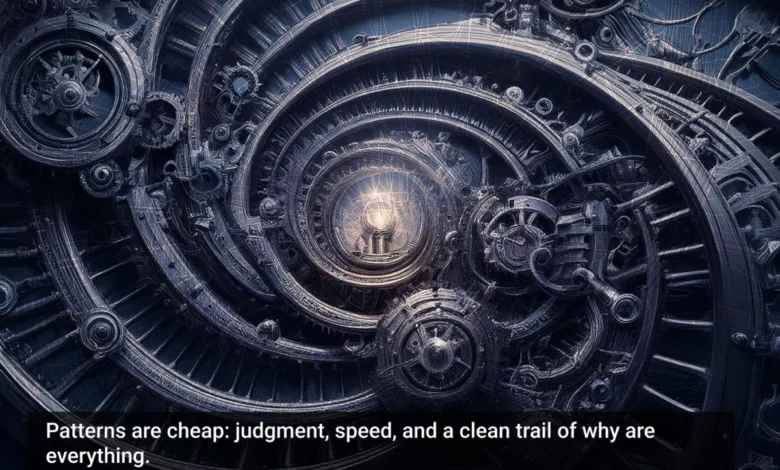
As patterns continue to become cheaper and more automated, the premium on human judgment will continue to rise. Professionals who can successfully frame problems, orchestrate AI-driven workflows, and maintain a rigorous audit trail of their decision-making process will be the architects of the next generation of products.
The lesson for leaders is clear: plans are often discarded as projects evolve, but the process of planning—the rigorous, methodical alignment of goals and constraints—is the engine of long-term success. As the tools of development become louder and more complex, the ability to focus on the human element of judgment remains the ultimate competitive advantage. The climb to the higher floor of efficiency is not a sprint; it is a systematic, iterative ascent.