Unlock Your Potential: 365 Data Science Announces Its Annual Free Access Initiative for Global Learners

In an era defined by the rapid integration of artificial intelligence across all sectors of the global economy, the demand for specialized technical literacy has reached an all-time high. To address this widening skills gap, 365 Data Science has officially announced that it will open its entire educational platform to the public for free from November 5 to November 20, 2026. This initiative represents a concerted effort to democratize access to high-level training in data analytics, machine learning, and AI engineering, providing a bridge for both aspiring professionals and seasoned experts to sharpen their competencies without financial barriers.
The program, which concludes at 15:00 UTC on November 20, provides unrestricted access to the company’s full library of 134 expert-led courses. By removing the subscription paywall for this two-week window, the organization aims to facilitate an intensive period of professional development for individuals across 216 countries, mirroring the global reach achieved in previous iterations of the event.
Historical Context and Evolution of the Initiative
The origins of the Free Access Initiative date back to 2020, at the onset of the global pandemic. As lockdowns forced a transition toward remote work and digital learning, 365 Data Science launched a temporary open-access period to support displaced workers and students whose traditional education paths had been disrupted. What began as a crisis-response measure has since evolved into an annual cornerstone of the company’s corporate social responsibility strategy.
Each year, the initiative has grown in scope and technological focus. While the initial versions focused heavily on foundational statistics and SQL, the 2026 curriculum reflects the seismic shift toward generative AI and autonomous systems. The evolution of this event tracks with the broader maturation of the data science industry—moving from simple data visualization and descriptive analytics to the complex design and deployment of intelligent agents.
Statistical Impact and Global Reach
The scalability of digital education platforms is perhaps best demonstrated by the metrics surrounding the 2025 iteration of the Free Access Initiative. Data released by the platform indicates that over 220,000 unique users participated in the event, accumulating a collective 7.2 million minutes of instructional time. This engagement resulted in the issuance of more than 36,000 professional certificates, a significant indicator of the platform’s efficacy in driving tangible learning outcomes.
The geographic diversity of the participants is equally notable. By attracting learners from 216 countries, 365 Data Science has positioned itself as a critical player in global upskilling. The data suggests that learners are increasingly looking for standardized credentials that are recognized across international borders. As industries move toward more standardized AI implementation, these certificates serve as a common currency for job seekers attempting to demonstrate proficiency in high-demand technical environments.
The Shift Toward AI Engineering and Intelligent Agents
A central theme of the 2026 initiative is the pivot toward AI engineering. The current job market is no longer solely concerned with data processing; it is now focused on the integration of AI models into business workflows. 365 Data Science has curated its current offerings to include training on how to build, deploy, and maintain autonomous agents.
This shift acknowledges that the "AI revolution" is moving beyond theoretical research into practical application. CEO Ned Krastev noted that the ability to synthesize data and AI is now a prerequisite for career longevity in the tech sector. By providing tools that cover both the "how-to" of technical implementation and the conceptual frameworks required for AI strategy, the platform aims to equip students with a versatile skillset capable of adapting to the rapid cycles of technological obsolescence.
Strategic Implications for the Workforce
The broader implications of this free access window extend beyond the individual learner. For employers, the existence of such initiatives creates a larger, better-prepared talent pool. Many sectors, including finance, healthcare, and logistics, are currently struggling to fill roles that require a dual understanding of traditional data infrastructure and modern machine learning frameworks.
Educational analysts have noted that the "skills gap" is not merely a lack of interest, but often a lack of access to structured, high-quality, and updated content. By offering a comprehensive, project-based curriculum, 365 Data Science is addressing the "practicality gap." Participants do not simply watch lectures; they engage in simulations that mirror real-world data science challenges. This approach is intended to produce graduates who can transition directly into roles as data analysts, machine learning engineers, or AI architects.

Curriculum Structure and Pedagogical Approach
The platform’s structure is designed to guide users through a logical, modular progression. For those at the beginning of their journey, the platform offers pathways that start with basic mathematics and programming languages such as Python. As users advance, the curriculum branches into sophisticated topics including neural networks, deep learning, and the management of large language models (LLMs).
During the November 2026 event, the platform’s interactive exercises will be fully unlocked. These exercises are critical to the platform’s pedagogical philosophy, as they require students to perform tasks such as cleaning messy datasets, designing query structures, and fine-tuning models. This "learning by doing" model is increasingly prioritized by hiring managers who value verifiable project experience over theoretical knowledge.
Professional Certification as a Career Catalyst
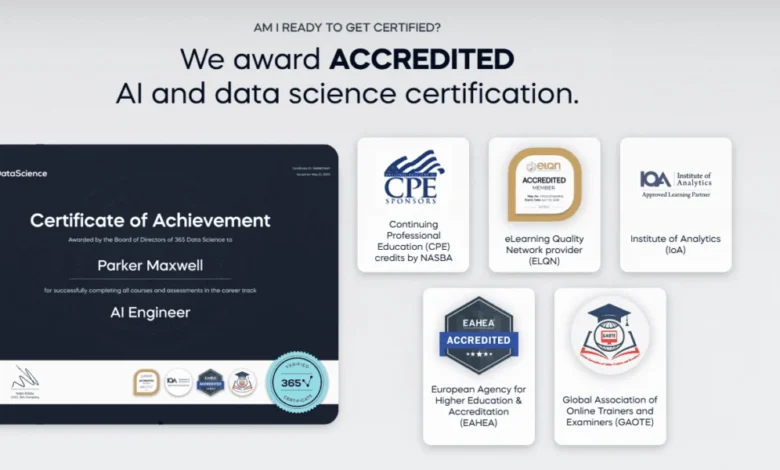
In a competitive labor market, the value of a certification often lies in its ability to signal competence to recruiters and automated applicant tracking systems. The certificates issued by 365 Data Science are designed to be shareable, verifiable credentials that can be integrated into digital resumes and professional profiles.
The significance of these certificates is magnified by the current instability in the tech job market. As companies become more selective, candidates are looking for ways to distinguish themselves from the crowd. Earning a certificate in a specific, high-demand niche—such as AI integration or data-driven decision-making—provides a quantifiable metric of a candidate’s commitment and capability. Furthermore, these credentials are CPE (Continuing Professional Education) accredited, ensuring that the knowledge gained remains relevant for professionals seeking to maintain their status in regulated industries.
Planning for the Future: Access and Participation
The three-week window from November 5 to November 20 is intended to be an intensive sprint. To maximize the benefit, 365 Data Science suggests that participants use the first few days to map out their learning goals, utilizing the platform’s structured career paths to avoid information overload.
For those planning to participate, the process is straightforward: registration is available directly through the official website. Because the platform includes content ranging from beginner-friendly introductions to highly technical modules, it is suited for a wide audience—from students currently enrolled in university programs to mid-career professionals looking to transition into the burgeoning field of AI.
The initiative serves as a reminder that the barrier to entry for the tech industry is becoming increasingly porous. While a traditional university degree remains a standard, the rise of accessible, high-quality online education has created a parallel path for those who are self-motivated. By providing free access, 365 Data Science is facilitating a form of "open innovation" where the speed at which one learns is limited only by their own initiative, rather than their access to capital.
Conclusion: Preparing for an AI-Driven Economy
The convergence of massive amounts of data and the democratization of AI tools is fundamentally altering the global workforce. As organizations across the world look to automate processes and derive insights from their internal metrics, the individuals who possess the skills to manage these systems will be the primary architects of the next economic cycle.
The 2026 Free Access Initiative by 365 Data Science provides a rare, low-risk opportunity to gain the expertise required to navigate this landscape. By prioritizing accessible, high-quality instruction and emphasizing practical, project-based learning, the organization is contributing to a more capable global workforce. For those looking to secure a foothold in the future of work, the period between November 5 and November 20 represents a strategic window to invest in the most valuable asset in the modern economy: specialized technical knowledge.
As the deadline approaches, the platform encourages all interested parties to finalize their registration early to maximize their time within the learning environment. Whether the goal is a career pivot or professional advancement, the resources provided during this initiative offer a comprehensive roadmap to achieving success in an increasingly complex, data-centric world.