Scaling Automated Visual Quality Inspection: A Modern MLOps Blueprint for Fleet-Wide Edge Deployment

Managing computer vision models across a sprawling industrial fleet presents severe logistical challenges that typically emerge only after a successful proof of concept. While deploying a single machine learning model to a solitary camera feed is relatively straightforward, scaling that same architecture across dozens of production lines—each equipped with multiple cameras capturing unique environments—introduces profound technical complexity. Factors such as varying physical angles, dynamic ambient lighting conditions, and unpredictable surface glares mean that a single generalized model trained on pooled footage invariably underperforms on individual units. Consequently, modern industrial deployments frequently require dedicated, fine-tuned models for every individual camera lens across the manufacturing floor. The core engineering hurdle shifts from training a single high-performing algorithm to automating the training, evaluation, versioning, and distribution of thousands of distinct models simultaneously without continuous human intervention.
To address these enterprise-scale demands, cloud architecture teams have released an updated reference framework leveraging the Amazon SageMaker Python SDK v3, replacing deprecated utilities like SageMaker Edge Manager with Amazon SageMaker Neo. Designed to streamline automated visual quality inspection at the edge, the newly updated pattern utilizes a dual-branch Amazon SageMaker Pipeline that trains both an anomaly detector and a defect classifier for each specific camera. Rigorous quality gates actively block underperforming iterations before they reach production, while in-pipeline compilation steps ensure that every registered asset is optimized directly for its destination edge hardware. Orchestrated by AWS Step Functions and deployed via the AWS Cloud Development Kit (AWS CDK), the entire pipeline offers a cost-effective development framework, executing full runs on synthetic data for approximately seven cents in compute costs.
The Evolution of Industrial MLOps and Edge Optimization
Historically, scaling machine learning pipelines across distributed manufacturing hardware suffered from fragmented tooling and heavy manual overhead. Early iterations of edge MLOps struggled to bridge the gap between heavy cloud-based training environments and resource-constrained edge devices operating on the factory floor. The transition to Amazon SageMaker Python SDK v3 modularizes the development framework, dividing core functionalities into specialized packages including sagemaker-core, sagemaker-train, sagemaker-serve, and sagemaker-mlops. This structural refinement allows machine learning engineers to pass typed configuration objects directly to training classes, significantly reducing configuration errors and standardizing hyperparameter tuning across disparate production lines.
Furthermore, integrating Amazon SageMaker Neo directly into the pipeline workflow resolves long-standing compatibility hurdles between training frameworks and hardware-specific edge runtimes. By compiling trained models into device-optimized shared libraries executed via the DLR runtime, systems can achieve maximum inference speed without sacrificing model accuracy. This native compilation step guarantees that an asset cannot be registered as an approved production model unless it has been successfully verified against the target hardware specifications, thereby eliminating runtime failures on the factory floor.
Architecture and Fleet Orchestration Mechanics
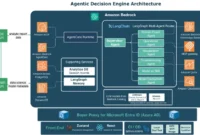
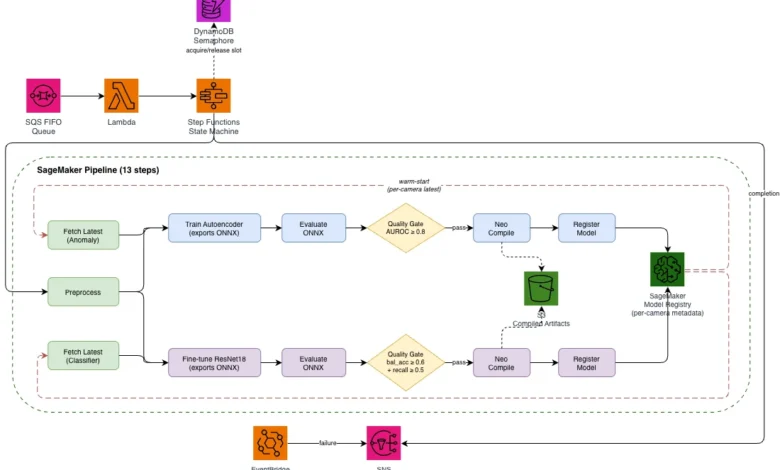
The architecture of a fleet-wide computer vision pipeline relies on a sophisticated interplay between event-driven queuing, concurrency control, and automated execution steps. When a camera requires re-training, the request enters an Amazon SQS FIFO queue. An AWS Lambda function subsequently initiates an AWS Step Functions state machine, which governs the execution flow. To prevent network congestion and respect account-level service quotas on concurrent SageMaker training jobs, the orchestration layer utilizes an Amazon DynamoDB semaphore. This atomic counter restricts the system to a predefined number of simultaneous pipeline executions—typically capped at five by default—ensuring that large operational bursts drain at a steady, manageable rate rather than overwhelming available cloud computing resources.
Once a slot is secured, the system triggers a 13-step SageMaker Pipeline parameterized specifically for the requesting camera ID. The workflow begins with three parallel entry steps: data preprocessing, fetching the latest approved anomaly detector, and retrieving the latest approved defect classifier. By filtering historical registry data using customer metadata properties containing the unique camera ID, the pipeline ensures that incremental re-training always resumes from the specific historical baseline of that exact lens. This warm-start capability drastically reduces training time and computational overhead, making frequent, iterative updates economically viable for industrial enterprises managing hundreds of distinct viewpoints.
Rigorous Quality Gates for Highly Imbalanced Production Data
A critical innovation within this modernized MLOps architecture is its approach to model evaluation, which guards against the inherent statistical challenges of manufacturing defect data. In typical industrial settings, high-quality production outputs dominate datasets, often accounting for roughly 90 percent of captured imagery, while true defects remain scarce. Under such extreme class imbalance, standard evaluation metrics like overall accuracy become misleading; a model that indiscriminately classifies every part as "good" will achieve a 90 percent accuracy score while completely failing to detect defective units.
To mitigate this vulnerability, the pipeline enforces strict multi-metric evaluation gates operating directly on exported Open Neural Network Exchange (ONNX) artifacts rather than in-memory training states. The anomaly detection branch evaluates performance using the Area Under the Receiver Operating Characteristic (AUROC) curve, requiring a threshold of at least 0.8. Meanwhile, the defect classifier branch employs a dual-gate condition requiring a balanced accuracy of at least 0.6 alongside a minimum defect recall of 0.5. Because the pipeline utilizes a ConditionStep that logically combines these requirements, both criteria must be satisfied simultaneously for a model package to receive approval. If either metric falls below the required threshold, a FailStep halts the promotion process, ensuring that defective or degraded models never infiltrate the production registry. Concurrently, training scripts leverage weighted random samplers with inverse class frequencies to counteract data skew without over-correcting the underlying loss functions.
Deployment, Verification, and Economic Implications
Deploying the complete reference architecture is facilitated through the AWS Cloud Development Kit, allowing infrastructure-as-code automation across AWS accounts. To accommodate the strict validation protocols of the SageMaker Python SDK v3—which evaluates execution roles against live Identity and Access Management (IAM) policies during synthesis—deployments follow a structured, multi-phase procedure. An initial bootstrapping pass establishes necessary roles, Amazon S3 buckets, and Amazon ECR repositories, after which the pipeline configuration synthesizes successfully.
For validation purposes, the sample architecture includes a synthetic data generator that populates production line imagery, enabling full end-to-end testing without requiring proprietary datasets. Organizations seeking to test the pipeline against real-world distributions can utilize built-in downloaders for publicly available benchmarks, such as the BCCD blood smear dataset, which maps microscopic anomalies to manufacturing defect profiles. Execution costs remain exceptionally low; standard validation runs utilizing ml.m5.xlarge instances complete in approximately 15 minutes at a nominal compute expense of roughly $0.07 per run, while orchestration overhead stays well under ten dollars monthly at baseline operational scales.
Strategic Implications and Future Outlook
The release of this modernized reference architecture marks a significant maturation in edge AI deployment methodologies. By addressing the operational friction inherent in managing thousands of distinct camera models, the framework offers a scalable alternative to generalized pooled-footage models that fail in variable factory environments. Industry analysts note that as manufacturing facilities accelerate their digital transformation initiatives, standardized MLOps pipelines that decouple cloud training from edge inference will become foundational to industrial automation.
Organizations operating complex physical infrastructure are increasingly encouraged to adopt these modular design principles. Beyond computer vision applications, the core architectural tenets—such as enforcing multi-metric quality gates tailored to skewed datasets, validating portable interchange formats like ONNX prior to registry submission, and implementing atomic concurrency controls—offer a robust template for enterprise machine learning operations. Teams looking to implement similar frameworks can access the complete open-source implementation via the official AWS samples GitHub repository, providing an extensible foundation for custom industrial automation deployments worldwide.