Deploying Multi-Agent AI Workflows on Amazon Bedrock AgentCore Runtime Instances: A Comprehensive Guide to Persistent Compute Architecture

Enterprise adoption of artificial intelligence has transitioned rapidly from basic, single-purpose conversational chatbots to sophisticated multi-agent systems designed to handle complex, long-running business workflows. While early AI implementations relied heavily on serverless execution environments characterized by short-lived compute sessions, these ephemeral architectures frequently struggle when multiple autonomous agents must collaborate over extended periods, build iteratively on shared outputs, and maintain continuous contextual awareness across days or even weeks. Addressing these architectural limitations, Amazon Web Services (AWS) has introduced advanced infrastructure paradigms via Amazon Bedrock AgentCore. This managed service provides dual compute options designed to support diverse operational requirements, bridging the gap between rapid, consumption-based serverless tasks and persistent, resource-intensive enterprise automation pipelines.
Understanding the Compute Paradigm: MicroVMs Versus Runtime Instances
To appreciate the architectural shift required for complex multi-agent orchestration, organizations must evaluate the fundamental differences between Amazon Bedrock AgentCore’s two core compute options: MicroVMs and Runtime Instances. Both models share a unified API framework, integrate seamlessly with modern Model Context Protocol (MCP) and Agent-to-Agent (A2A) communication standards, and support popular custom agent frameworks including CrewAI, LangGraph, LlamaIndex, and Strands Agents. However, their underlying compute models diverge significantly in capacity, duration, and resource management.
MicroVMs serve as the serverless, fully AWS-managed option, prioritizing rapid cold starts, strict session isolation, and consumption-based billing. They are exceptionally well-suited for single-purpose tasks where an isolated runtime hosts a single agent within a session capped at eight hours. Conversely, Runtime Instances introduce AWS-managed Amazon Elastic Compute Cloud (EC2) infrastructure tailored for persistent, long-running workflows. These instances extend session durations up to 14 days, incorporate high-performance graphical processing units (GPUs) on supported instance families, utilize persistent block storage via Amazon Elastic Block Store (Amazon EBS), and allow multiple agent runtimes to colocate on a single EC2 instance in a one-to-many configuration.
By leveraging a shared capacity provider and routing invocations through a unified runtime session identifier, organizations can ensure that multiple distinct agents land on the exact same underlying hardware instance. This colocation enables direct filesystem sharing, eliminating the latency and overhead associated with transferring large artifacts across disparate network storage endpoints.
Architectural Design of a Collaborative Multi-Agent Pipeline
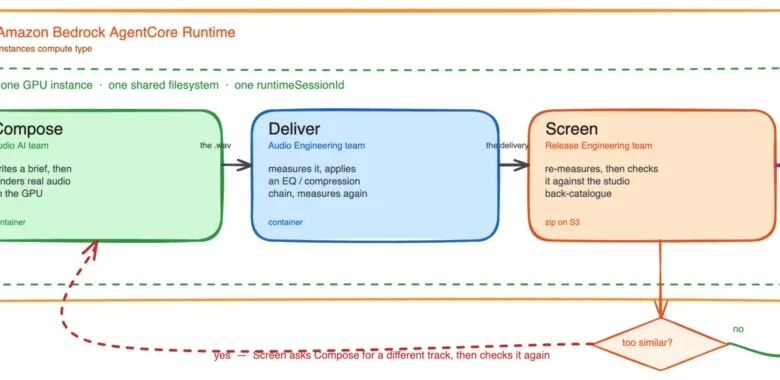
To demonstrate the practical application of Runtime Instances, enterprise architects frequently examine multi-step workflows that demand heavy computational resources, persistent storage, and strict quality assurance protocols. A prime example is an automated music production and compliance pipeline comprising three specialized agents: a composition agent, a delivery agent, and a compliance screening agent.
In this architectural pattern, the workflow initiates when a human producer submits a descriptive prompt for a musical composition. The composition agent, powered by advanced foundation models such as Claude Sonnet 4.6, translates the request into a detailed musical brief and executes a generative audio model directly on the host instance’s assigned GPU, rendering a high-fidelity audio file onto a shared persistent volume.
Once the composition file is written, the delivery agent accesses the shared filesystem to evaluate the raw audio against broadcast or streaming standards, such as ITU-R BS.1770-4 loudness metrics. Utilizing programmatic digital signal processing (DSP), the delivery agent applies targeted equalization bands, compression ratios, and normalization algorithms to optimize the track for specific platforms like Spotify or Apple Music. Following the optimization pass, the delivery agent performs a secondary measurement to mathematically verify that the output meets precise target specifications before finalizing the file.
The final stage of the pipeline involves the compliance agent, which independently re-measures the finished audio artifact, verifies the delivery claims, and screens the track for harmonic and structural similarity against the studio’s proprietary back catalog. If the compliance screening identifies potential copyright overlaps or similarity flags, the compliance agent initiates an automated callback to the composition agent, requesting specific tonal or melodic alterations. The workflow ultimately yields a fully playable, broadcast-ready audio file accompanied by three comprehensive audit reports documenting every algorithmic decision made throughout the multi-day production lifecycle.
Step-by-Step Implementation and Configuration Workflow
Implementing this advanced architecture requires a structured, multi-phase deployment process spanning environment preparation, capacity provisioning, agent runtime deployment, session orchestration, and independent updates.
Prerequisites and Environment Setup
Before deploying the pipeline, developers must configure an AWS account with appropriate permissions, provision an Amazon Elastic Container Registry (ECR) repository for custom container images, and establish secure IAM roles. Specifically, administrators must configure two distinct IAM roles trusting the bedrock-agentcore.amazonaws.com service principal: an operator role for the capacity provider to provision and manage underlying EC2 infrastructure, and an execution role for the agent runtimes to access necessary AWS resources, S3 buckets, and model endpoints.
Step 1: Defining the Agent Runtimes
AgentCore Runtime Instances support any agent framework written in Python or packaged via container images. Utilizing the Strands Agents framework, developers must construct agent applications with careful attention to implementation details. Specifically, handler functions must correctly capture the execution context parameter to extract the runtime session identifier, which agents require to locate shared files and communicate with peer runtimes. Furthermore, agent instances must be initialized dynamically within the request handler rather than at module scope to prevent re-entrant invocation errors during concurrent workloads. Historical context and conversational state are maintained persistently across days using file-based session managers mapped directly to the attached storage volumes.
Step 2: Creating a Capacity Provider
The capacity provider acts as the blueprint defining the underlying compute infrastructure provisioned by AgentCore. Administrators specify preferred EC2 instance families—such as GPU-accelerated g6.xlarge or g5.xlarge instances—alongside Virtual Private Cloud (VPC) subnets, security groups, and persistent storage configurations. Persistent storage is provisioned via Amazon EBS volumes formatted for high throughput and encryption, ensuring that large working directories and machine learning model weights remain intact across session pauses and restarts.
Step 3: Deploying Agent Runtimes
With the capacity provider active, administrators deploy each specialized agent as an independent runtime. Runtimes are linked to the shared capacity provider and configured with specific filesystem mount paths corresponding to the provisioned EBS volumes. This decoupled deployment methodology allows individual teams to update their respective agent logic without disrupting peer runtimes operating on the same physical infrastructure.
Step 4: Orchestrating Multi-Agent Collaboration via Shared Sessions
Execution of the pipeline relies on passing a consistent runtime session identifier across sequential agent invocations. When multiple runtimes share a capacity provider and receive the same session ID, AgentCore intelligently routes the requests to the identical EC2 instance. The initial invocation incurs a standard provisioning and stack-preparation delay—such as loading CUDA PyTorch libraries and model weights into GPU memory—while subsequent calls execute instantaneously against the warm instance.
Empirical benchmarks conducted on live g6.xlarge instances demonstrate high operational efficiency: initial model stack preparation completes in approximately 239 seconds, back-catalog rendering finishes in 66 seconds, audio generation executes on the NVIDIA L4 GPU in under 10 seconds, and subsequent DSP delivery adjustments and compliance screenings finalize in 41 and 28 seconds, respectively.
Step 5: Independent Agent Lifecycle Management
A critical enterprise advantage of the AgentCore Runtime Instances architecture is the capability to perform continuous deployment and maintenance on individual agents without system-wide downtime. For instance, when an engineering team releases an upgraded version of the composition agent, they simply rebuild the container image, push the update to ECR, and execute an update command targeting the specific composition runtime identifier. The delivery and compliance agents continue uninterrupted, eliminating complex coordination overheads and reducing deployment risk.
Resource Lifecycle and Cost Optimization
Efficient cost management is paramount when operating GPU-accelerated infrastructure. When workloads conclude, administrators can invoke session termination commands to deprovision underlying EC2 instances, network interfaces, and ephemeral resources, halting compute charges immediately.
Furthermore, AgentCore supports automatic idle timeouts, causing instances to scale down when inactive. When sessions are resumed within the 14-day window, AgentCore reattaches the persistent Amazon EBS volumes. Because EBS volumes are Availability Zone (AZ)-locked, enterprise deployments utilizing persistent volumes should implement AZ-pinned On-Demand Capacity Reservations (ODCRs) or storage snapshots to ensure seamless recovery even if initial AZ capacity fluctuates during restart operations.
Broader Industry Implications and Future Outlook
While the music production pipeline serves as an illustrative vehicle, the underlying architectural patterns demonstrated by Amazon Bedrock AgentCore Runtime Instances offer profound implications for enterprise computing across diverse industrial sectors. The ability to coordinate multiple autonomous agents over extended temporal windows, leverage dedicated GPU acceleration, and maintain persistent state across distributed workflows directly addresses longstanding bottlenecks in advanced AI automation.
Organizations in sectors such as pharmaceutical research, aerospace engineering, complex financial modeling, and automated media post-production frequently encounter workloads that require iterative multi-agent collaboration, heavy parallel computation, and rigorous compliance auditing. By standardizing these capabilities within a managed AWS framework, enterprises can accelerate the transition from experimental agent prototypes to robust, production-grade automated systems capable of executing multi-day business processes with verifiable precision and enterprise-grade security.