Spark Connect on Amazon EMR on EKS: Bridging the Gap Between Local Development and Scalable Cloud Compute


The introduction of Spark Connect support for Amazon EMR on EKS marks a significant milestone in the evolution of cloud-native data engineering. Starting with EMR release 7.14, which integrates Apache Spark 3.5.8, and the emr-spark-8.1 release featuring Apache Spark 4.1.1, developers are no longer required to choose between the convenience of local IDEs and the power of distributed cloud infrastructure. This update allows data professionals to execute, test, and debug complex Spark applications directly from environments such as VS Code, PyCharm, and Amazon SageMaker Unified Studio, while offloading the heavy computational lifting to managed Amazon Elastic Kubernetes Service (Amazon EKS) clusters.
The Evolution of Distributed Computing Workflows
Historically, the development lifecycle for large-scale data processing has been plagued by the "environment mismatch" problem. Engineers would write code on local machines with limited memory and CPU cores, only to face runtime errors, dependency conflicts, or performance bottlenecks when deploying that same code to production clusters. This discrepancy often forced teams to adopt cumbersome workflows, such as constantly syncing code to remote instances or relying on costly, long-running dev clusters that mirrored production environments.
Spark Connect addresses this by introducing a decoupling of the application client from the Spark driver. By utilizing a thin client-server architecture, the developer’s local environment acts as a gateway. When a command is issued—such as a Spark SQL query or a DataFrame transformation—it is transmitted over a gRPC channel to the remote Spark cluster. The cluster processes the data, and only the results are returned to the client. This architectural shift ensures that the code running on a laptop is fundamentally the same as the code running in the cloud, effectively eliminating the "it works on my machine" phenomenon that has long slowed down data engineering velocity.
Technical Architecture and Operational Efficiency
The integration on Amazon EMR on EKS is designed to be seamless for existing infrastructure. When a user initializes a Spark Connect session, EMR on EKS automatically provisions the necessary server-side components as pods within the Kubernetes cluster. These pods leverage the existing node groups, container images, and security policies already configured by the organization.
A critical component of this deployment is the introduction of a shared Envoy authentication-proxy router and a Secret Agent service. These elements are provisioned during the first use of Spark Connect on a cluster. The router handles traffic management, ensuring that multiple developers or automated CI/CD pipelines can connect to the same cluster without stepping on each other’s toes, while the Secret Agent manages the security tokens required for authenticated access. Because these components are persistent and shared, subsequent connections are established in under a minute, providing a near-instant feedback loop for interactive development.
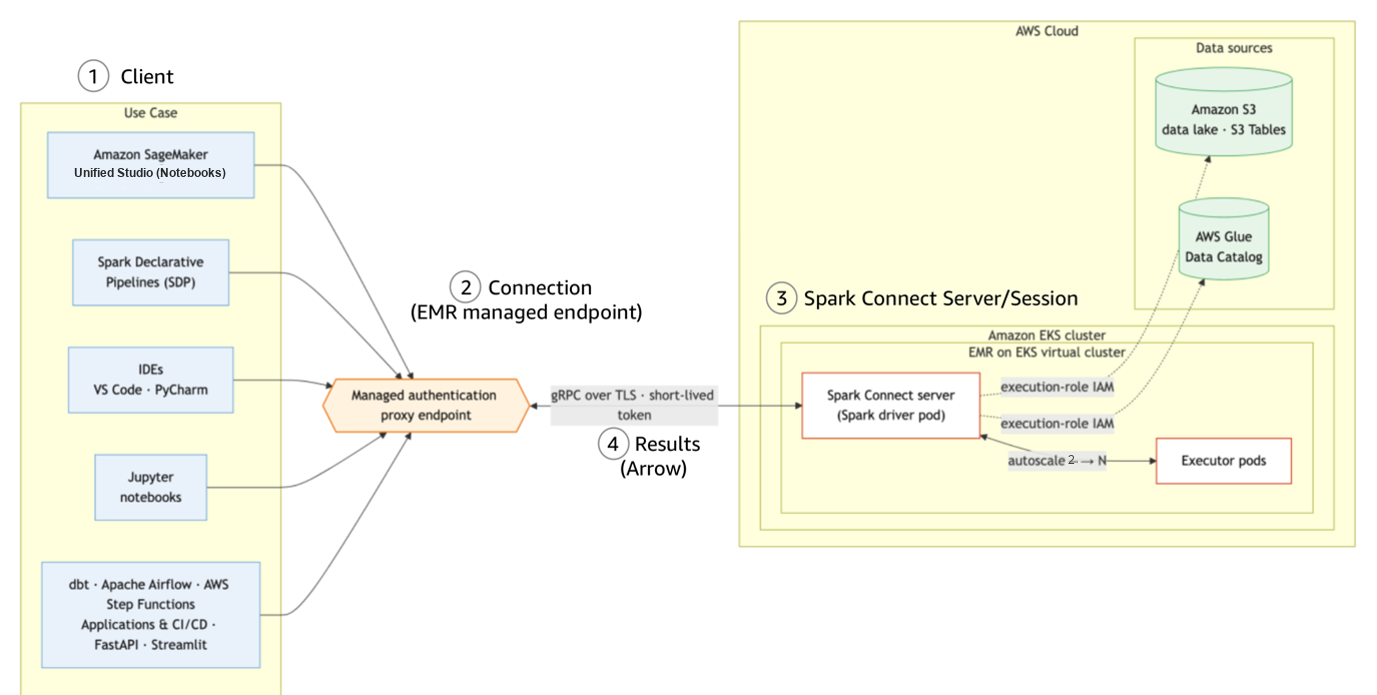
From an administrative perspective, this approach is highly efficient. Because each session is isolated via IAM execution roles and Kubernetes namespaces, security teams can enforce strict governance. Organizations can apply resource quotas and limit ranges at the virtual cluster level, preventing a single runaway process or an overly ambitious query from starving other applications of resources.
Strategic Implications for Data Teams
The move toward a unified development and production environment has broad implications for enterprise data strategy. By enabling interactive development on shared Kubernetes clusters, organizations can maximize their existing hardware investments. Rather than maintaining separate "development" and "production" clusters—a common source of idle capacity and wasted expenditure—teams can use the same EKS infrastructure for both.
Furthermore, the ability to embed Spark Connect into web services and dashboards creates new possibilities for self-service analytics. Business users can now interact with data via custom web interfaces that trigger Spark jobs on the backend, without the need for the business user to have any knowledge of Kubernetes or cluster management. This democratization of data access, coupled with the granular cost-tracking features—which allow for chargeback reporting based on user, project, and session tags—makes it easier for data leaders to manage budgets and measure ROI on their data projects.

Scaling and Performance at the Edge
For large enterprises, the ability to operate across multiple AWS regions and accounts is essential. Spark Connect simplifies this by removing the requirement for direct network connectivity between the developer’s client and the underlying data storage (such as S3 or the AWS Glue Data Catalog). Since the Spark Connect server handles the data access within the EKS cluster, the client only needs to communicate with the Spark endpoint. This decoupling facilitates hybrid and multi-region architectures, allowing teams to orchestrate data processing across geographically dispersed locations without the complexities of managing VPNs or peering connections for every individual developer’s machine.
Security and Governance Framework
Security is a primary concern for any organization migrating to a distributed architecture. With Spark Connect on EMR on EKS, every session is wrapped in a TLS-encrypted communication channel. Authentication tokens are short-lived, with a default lifespan of 15 minutes, significantly reducing the attack surface in the event of credential leakage.
The integration with AWS Identity and Access Management (IAM) is particularly noteworthy. By assigning specific execution roles to Spark Connect sessions, administrators can ensure that developers only have access to the data sets required for their specific tasks. This implementation adheres to the principle of least privilege, a cornerstone of robust cloud security. Moreover, because these sessions are logged and monitored through standard Kubernetes observability tools—such as Prometheus, Grafana, and Amazon CloudWatch Container Insights—compliance teams can maintain a clear audit trail of who accessed what data and when.

Chronology of Implementation and Future Outlook
The release of EMR 7.14 and the corresponding Spark Connect support represents the culmination of a broader industry trend toward "Serverless-like" experiences on top of containerized infrastructure. The timeline for adoption for most enterprises will likely follow a three-phase approach:
- Phase 1: Pilot Programs. Data engineering teams begin replacing local Spark environments with Spark Connect endpoints, validating that their existing container images and dependencies function correctly in the remote Spark environment.
- Phase 2: Integration. Organizations move their interactive notebook workflows (Jupyter, SageMaker) to the Spark Connect architecture, consolidating their compute resources and utilizing the shared Envoy router for multi-user access.
- Phase 3: Production Automation. The final phase involves shifting CI/CD pipelines and embedded application services to use Spark Connect, fully realizing the cost-efficiency gains by eliminating dedicated development clusters.
As Apache Spark 4.1 continues to gain traction, the performance enhancements built into the Spark Connect protocol—such as improved serialization and reduced data transfer overhead—will likely make this the standard for how data is processed in the cloud.
Conclusion
The integration of Spark Connect with Amazon EMR on EKS is more than just a feature update; it is a fundamental shift in how Spark applications are built and managed. By aligning the developer experience with the realities of production-scale Kubernetes infrastructure, AWS has provided a path for teams to move faster, reduce operational overhead, and improve security posture simultaneously. As data-driven decision-making becomes increasingly central to business strategy, the ability to iterate rapidly without compromising on security or cost will become a key differentiator for organizations. For teams already invested in the EMR on EKS ecosystem, this update provides a powerful new set of tools to optimize both their human capital and their cloud infrastructure.