Open Source Maintainers Face Unprecedented Strain as AI-Generated Code Contributions Surge Across Global Repositories

The morning routine for thousands of open-source software maintainers around the world has undergone a dramatic transformation over the past year. What once began with reviewing carefully crafted pull requests and engaging in community-led discussions has increasingly turned into an exercise in crisis management. Open-source repositories are experiencing a historic influx of code contributions, driven largely by the widespread availability of generative artificial intelligence tools. While these technologies have empowered millions of developers to write code faster, they have simultaneously created an administrative bottleneck for the small, often underfunded teams responsible for maintaining the foundational infrastructure of the global internet.
The scale of this shift is difficult to overstate. According to usage metrics released by major code hosting platforms, global repository activity spiked exponentially over a compressed window of several months. A substantial portion of this automated and semi-automated output is landing directly on the doorsteps of core maintainers who were already operating under significant strain, balancing full-time employment, family responsibilities, and unpaid maintenance duties. The resulting wave of pull requests—frequently comprising thousands of lines of code submitted without prior discussion or issue creation—has pushed several prominent open-source projects to their breaking point.
The Anatomy of the Maintainer Burden
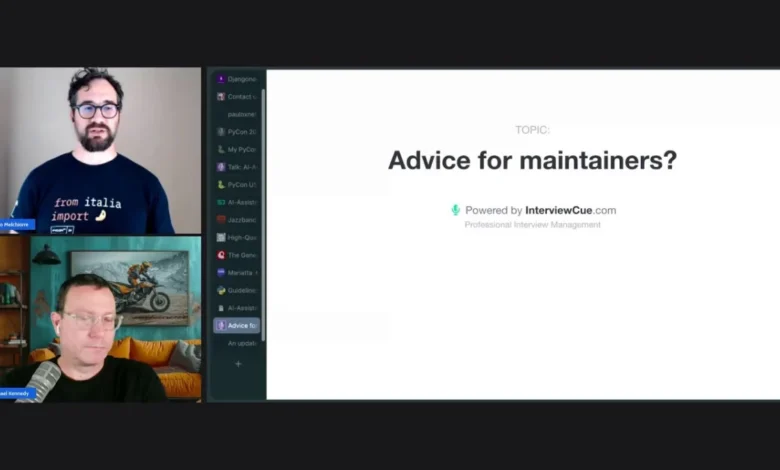
To understand the reality from the receiving end of these contributions, one must look inside the maintainer’s chair. Paolo Melchiorre, a director of the Django Software Foundation, an organizer of PyCon Italy, and a seasoned Python developer, spent the past year documenting how generative AI is reshaping open-source contributions. Presenting his findings at PyCon US within the dedicated AI track, Melchiorre highlighted both the opportunities and the hidden costs of AI-assisted software development.
Melchiorre characterizes artificial intelligence not as a new kind of independent contributor, but rather as an amplifier. Much like a powerful acoustic amplifier, AI magnifies whatever signals are fed into it—both positive and negative. For developers who understand software architecture, testing, and community standards, AI tools serve as a productivity multiplier. However, for less experienced programmers or individuals seeking quick rewards through automated contributions, the technology enables the rapid generation of low-quality code, speculative bug reports, and massive, unreviewable pull requests.
This dynamic was vividly illustrated in late 2024 and early 2025 when major projects began reporting unprecedented anomalies. In one notable incident within the OCaml ecosystem, a contributor submitted a pull request containing over 13,300 added lines of code with virtually no prior discussion or issue filing. The sheer volume of changes rendered manual code review practically impossible, ultimately forcing maintainers to lock the discussion thread and close the submission. Similar patterns emerged in other critical infrastructure projects, altering the day-to-day responsibilities of maintainers from engineering leaders into aggressive gatekeepers and triage officers.
The Breakdown of Trusted Ecosystems
The consequences extend far beyond isolated pull requests. Even long-standing, highly organized community projects have felt the shockwaves. Jazzband, a collaborative hosting collective famous for managing vital Django ecosystem utilities such as pip-tools and the Django debug toolbar, encountered what its maintainers described as an existential "apocalypse." The overwhelming influx of AI-generated noise and administrative overhead accelerated the sunsetting of several projects within the collective.
Similarly, the renowned curl bug bounty program, managed by Daniel Stenberg, found its security operations severely disrupted. The program, designed to incentivize human security researchers to uncover genuine vulnerabilities in critical data transfer software, was suddenly inundated with high-frequency, low-quality submissions generated by automated tools. While some automated analyses occasionally pointed to real edge cases, the sheer volume of noise buried genuine security research, forcing project leadership to reevaluate financial rewards and reporting structures to preserve the integrity of the bounty system.
These developments highlight a vulnerable reality in modern software engineering: the "Single Maintainer in Nebraska" phenomenon. Much of the global digital infrastructure—powering everything from financial institutions to cloud infrastructure—relies on critical packages maintained by solitary developers or micro-teams who receive little to no corporate compensation. When these projects are targeted by automated code generation tools, the human cost becomes unsustainable.
Institutional Responses and Evolving Guidelines
As the magnitude of the issue became apparent, open-source foundations and project governance boards began formulating official policies to address AI-assisted contributions. A comprehensive study conducted by Redmonk in early 2026 analyzed the generative AI policies across 86 open-source foundations and prominent projects, including the Linux Foundation, the Apache Software Foundation, and the Python Software Foundation.
The findings revealed a fragmented landscape. While roughly 55 percent of evaluated foundations adopted a permissive stance—allowing AI-assisted contributions under specific conditions—about 25 percent implemented restrictive measures or outright bans, while the remainder remained undecided. The primary driver behind these policy decisions was not merely philosophical opposition to artificial intelligence, but rather practical concerns regarding code quality, maintainer workload, and intellectual property provenance.
Major Python governance bodies have moved quickly to establish clear boundaries. CPython released updated guidelines addressing AI-assisted contributions, establishing a foundational principle: the human submitting an issue or pull request remains entirely responsible for its content, regardless of the tools used in its creation. The guidelines emphasize that while generative AI can accelerate output, core principles such as rigorous testing, code clarity, critical thinking, and well-scoped pull requests remain mandatory. Projects like CPython explicitly discourage unneeded code churn and require contributors to demonstrate a thorough understanding of the code they submit.
Path Forward: Preserving the Human Element in Open Source
Industry leaders and maintainers agree that banning AI outright is rarely a sustainable long-term solution, as the tools have become deeply embedded in modern software development workflows. Instead, the focus has shifted toward technological mitigation and cultural adaptation. Projects are increasingly experimenting with automated AI-driven triage bots to pre-screen pull requests, enforce coding standards, and verify test suites before human review begins.
Furthermore, community-driven initiatives are doubling down on human connection as the ultimate defense against automated noise. Programs like the Djangonauts Space mentorship initiative, regional sprints, and localized workshops aim to train the next generation of contributors not just in syntax, but in the cultural norms, collaborative etiquette, and architectural empathy required to work within large-scale open-source codebases.
Ultimately, the open-source community is navigating a transition period reminiscent of earlier technological shifts, such as the commercialization of software in the late twentieth century. As maintainers adapt to an environment reshaped by generative tools, the overarching consensus remains clear: while artificial intelligence can synthesize code and scale output, it cannot replicate the human trust, collaborative governance, and community stewardship that form the bedrock of open-source software.