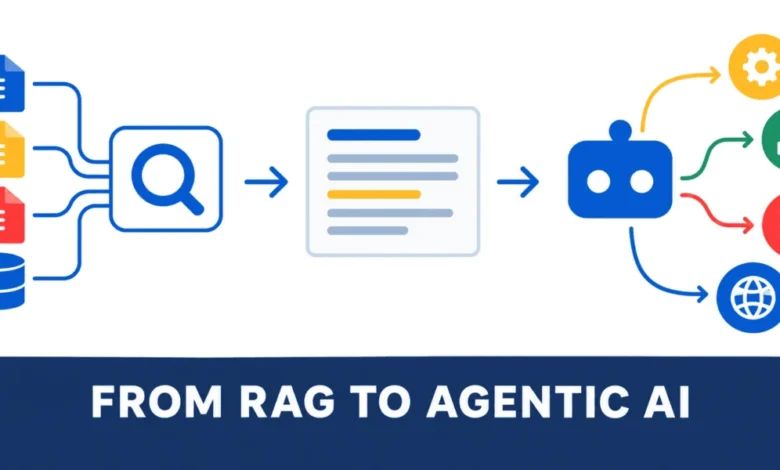
The landscape of enterprise artificial intelligence is undergoing a significant architectural shift. For the past two years, Retrieval-Augmented Generation (RAG) has served as the industry-standard framework for grounding large language models (LLMs) in proprietary corporate data. By retrieving relevant documents and injecting them into a prompt, RAG mitigated the "hallucination" risks associated with pre-trained models. However, as organizations transition from proof-of-concept prototypes to mission-critical infrastructure, the inherent limitations of static RAG pipelines have become increasingly apparent. The industry is now pivoting toward "Agentic AI"—a paradigm defined by autonomous reasoning, multi-step planning, and rigorous self-correction.
The Limitations of First-Generation RAG
Early enterprise AI deployments relied on a straightforward retrieve-then-generate workflow. While effective for simple Q&A tasks, these systems frequently fail under the weight of complex, domain-specific requirements. According to recent performance audits in the enterprise sector, standard RAG pipelines often stumble when faced with three specific challenges: linguistic ambiguity, semantic drift, and a lack of confidence-based filtering.
When a user submits a query involving specialized internal jargon or acronyms with multiple valid meanings, standard vector-based retrieval often misinterprets the intent. Furthermore, vector similarity—the mathematical distance between embeddings—is not always a proxy for factual relevance. In many cases, critical documents using synonymous phrasing are excluded, while unrelated documents containing similar keywords are erroneously prioritized. Most critically, standard systems lack a "calibration layer," often presenting a hallucinated answer with the same linguistic confidence as a grounded one. This lack of transparency has hindered the adoption of generative AI in high-stakes environments, such as legal compliance, financial auditing, and medical diagnostics.
Evolution of Retrieval: From Hybrid Models to GraphRAG
The industry’s response to these failures has been a modular evolution of retrieval techniques, moving from simple vector search to sophisticated, multi-layered architectures.
The Hybrid Retrieval Standard
The first major transition involved the integration of hybrid retrieval methods. By combining dense vector search (which captures conceptual meaning) with sparse keyword search (such as BM25), developers have achieved higher recall in environments saturated with unique product codes and specific technical nomenclature.
Engineering teams have found that the success of these systems hinges on the implementation of Reciprocal Rank Fusion (RRF). Introduced by researchers at the University of Waterloo, RRF allows for the combination of heterogeneous scoring systems without the need for complex normalization. When executed asynchronously, these hybrid pipelines can reduce retrieval latency by up to 40%, a critical factor in maintaining user engagement.
The Advent of GraphRAG
As organizations realized that document chunks are not isolated islands, they began integrating Knowledge Graphs (KG) into the retrieval layer. Unlike traditional RAG, which treats all text as unstructured, GraphRAG maps entities and their relationships. This provides a structured ontology that allows the system to understand that two disparate documents may actually refer to the same underlying corporate entity or process.
Industry data suggests that moving away from LLM-based entity extraction toward deterministic, rule-based NLP techniques is a crucial optimization for production systems. Rule-based extraction, while technically more rigorous, offers near-zero marginal cost and eliminates the non-determinism inherent in LLM-based parsing, providing a stable foundation for regulated environments.
The Rise of Agentic Architectures
The current frontier in enterprise AI is the shift toward Agentic systems. Unlike the static "retrieve-then-generate" loop, an agentic system acts as a reasoning engine. It decomposes a user’s complex request into a sequence of sub-tasks, evaluates the required tools for each, and executes them in a logical workflow.
This architecture is essential for multi-hop reasoning. For example, if a user requests a comparison between two internal manufacturing processes, an agentic system will:
- Decompose the request into distinct information-gathering tasks.
- Select the appropriate tool (e.g., searching a vector database for procedures, then querying a SQL database for performance metrics).
- Synthesize the findings into a coherent response.
- Verify the response against organizational safety guardrails.
Safety and Governance as Architectural Boundaries
In the enterprise, safety cannot be an afterthought or a "post-processing" filter. Industry experts, including AI scientists at firms like Dell Technologies, have argued that safety and privacy must be baked into the "execution graph" of the AI system.
By implementing hard architectural boundaries, developers can ensure that queries containing sensitive PII (Personally Identifiable Information) or proprietary data are intercepted before they reach external LLM endpoints. This "Safety First" design philosophy is rapidly becoming a prerequisite for enterprise-grade deployment.
Confidence Scoring and Self-Correction
One of the most significant advancements in modern AI systems is the shift toward conservative confidence scoring. Rather than relying on a single output confidence score, advanced systems use multiplicative scoring across the entire pipeline—planning, retrieval, and generation. If any component in the chain returns a low confidence signal, the system triggers a "self-correction" loop.
During this loop, the agent performs a reflection step: it critiques its own intermediate output, identifies the source of the uncertainty, and adjusts its strategy. This ability to "self-reflect" represents a marked departure from the "blind" generation of early-stage RAG, allowing the system to eventually return an "I don’t know" response rather than a hallucinated one. This distinction is vital for maintaining organizational trust.
Broader Implications and Industry Trajectory
The implications of this shift toward agentic, reasoning-based AI are far-reaching. By standardizing on architectures like the Model Context Protocol (MCP), developers are creating systems that are not only more capable but also more interoperable.
A key takeaway for industry stakeholders is the prioritization of determinism over total generative flexibility. In a production environment, the ability to reproduce a failure is more valuable than the raw creativity of the model. By utilizing deterministic logic for routing, entity extraction, and tool selection, organizations can build systems that are auditable and robust.
As we look toward the next 18 to 24 months, the focus is shifting toward "multi-agent orchestration." In this model, specialized agents—each optimized for a specific domain or data source—will dynamically discover and coordinate with one another to solve cross-departmental problems. This collaborative intelligence will enable firms to bridge the gap between siloed internal systems and a unified, intelligent enterprise knowledge base.
For organizations currently stuck in the "RAG-only" phase, the roadmap is clear: the path to production-ready enterprise AI requires moving beyond simple retrieval and embracing the structural, deterministic, and agentic principles that allow for reliable, scalable, and safe intelligent systems. The tools for this transition—knowledge graphs, hybrid retrieval, and agentic orchestration—are no longer experimental; they are the new infrastructure of the intelligent enterprise.