The Stateless Limitation of Modern AI
The foundational architecture of contemporary language models is inherently stateless. Each request to an LLM is treated as an isolated event; the model processes the input, generates a response, and then effectively resets, possessing no inherent recollection of previous interactions or intermediate findings. While this architecture is highly efficient for transactional queries, it presents a significant obstacle for autonomous agents. An agent tasked with researching a market trend, for instance, cannot inherently "remember" the sources it consulted an hour ago or the specific constraints provided by a user in an earlier session without a dedicated, external memory architecture.
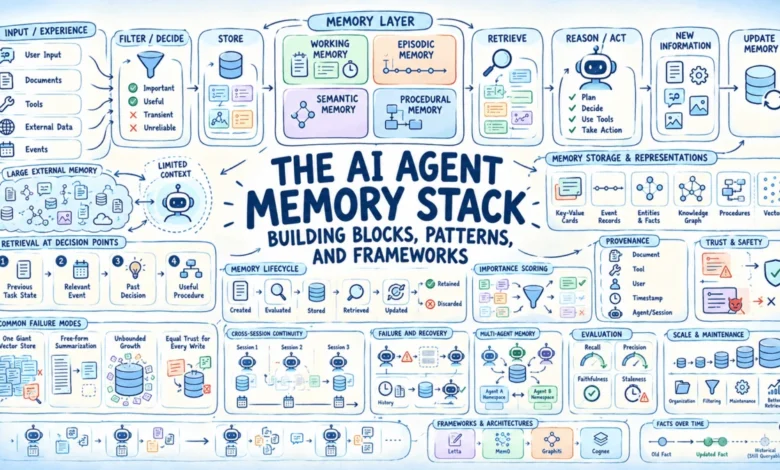
This gap has catalyzed the development of the "AI Agent Memory Stack," a structured approach to data persistence that allows agents to retain context, user preferences, and historical task data. By decoupling the model’s processing capabilities from its data storage, developers are now creating agents that can sustain long-term operations, refine their performance based on past failures, and operate with a higher degree of consistency.
Chronology of Memory Evolution
The progression of AI memory has evolved in three distinct phases:
- The Context Window Era (2022–2023): Early implementations relied almost exclusively on expanding the context window—the amount of text an LLM can process at once. While effective for short sessions, this approach was limited by high latency, significant computational costs, and the "lost in the middle" phenomenon, where models struggle to retrieve information buried in long prompt sequences.
- The Vector Database Integration (2023–2024): With the rise of Retrieval-Augmented Generation (RAG), developers began storing data in vector databases. This allowed agents to query vast document sets, transforming raw data into semantically searchable information. However, this remained largely static; it provided information but did not inherently evolve as the agent "learned."
- The Agentic Memory Stack (2025–Present): We are currently in the era of persistent, multi-modal memory. Modern frameworks now distinguish between different memory types—working, episodic, semantic, and procedural—allowing for dynamic updates, entity tracking, and long-term state management that mimics a more human-like cognitive workflow.
Taxonomy of Agent Memory
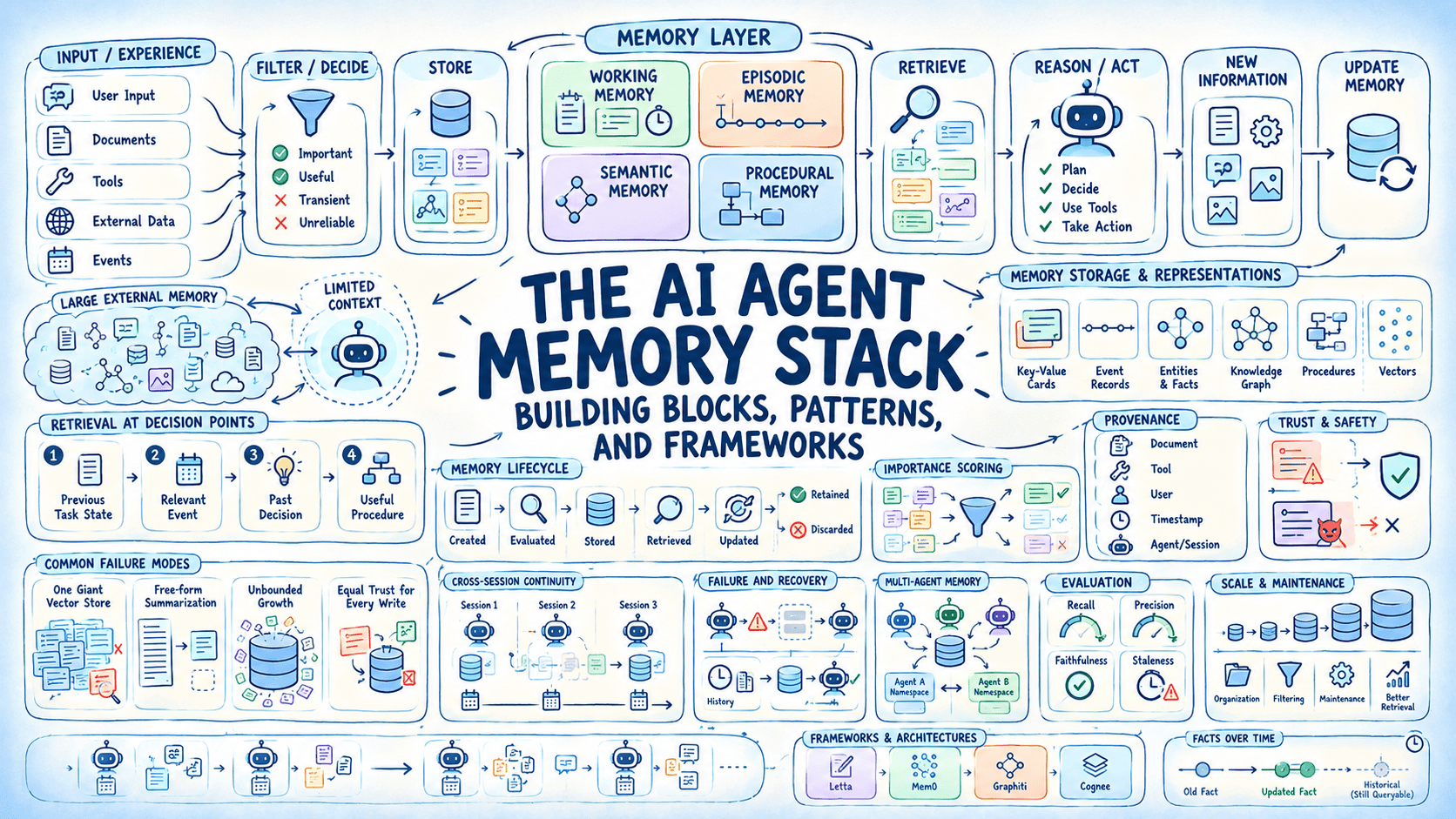
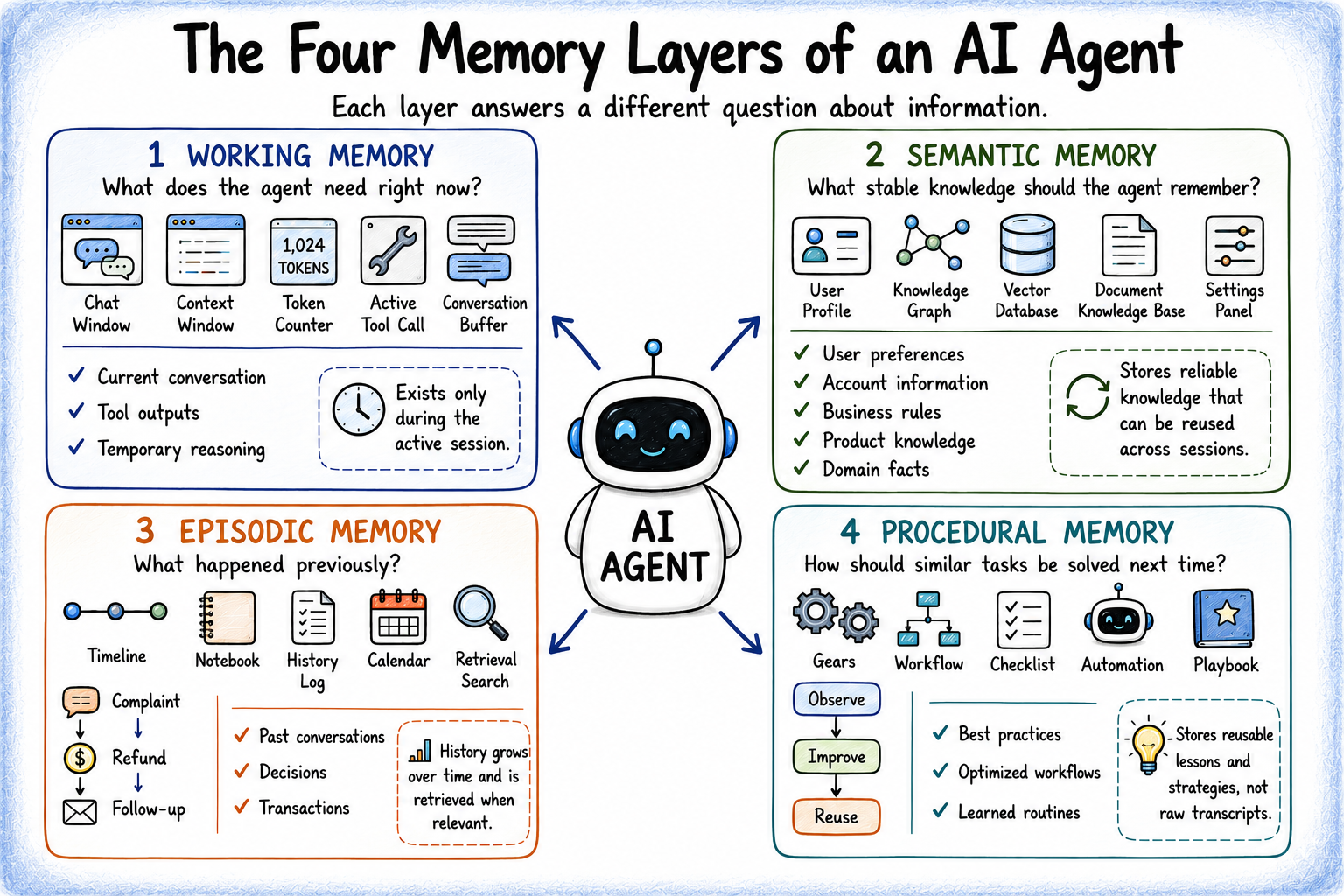
Industry standards now categorize agent memory into four functional types, each serving a unique role in the agent’s operational lifecycle:
- Working Memory: Functioning similarly to human short-term memory, this layer holds active task states, scratchpad calculations, and intermediate results. It is typically stored in low-latency key-value stores to ensure immediate access for the next decision-making step.
- Episodic Memory: This acts as the agent’s autobiographical record. It tracks the chronological sequence of past interactions, the specific tools utilized, and the outcomes of previous attempts. This data is usually indexed via vector stores to enable the agent to query "What happened when I tried this before?"
- Semantic Memory: Unlike episodic data, semantic memory stores generalized facts, user preferences, and established rules. It is designed for entity-aware retrieval, ensuring the agent maintains a consistent understanding of facts that remain true across different sessions.
- Procedural Memory: This encompasses the "how-to" knowledge of the agent. It stores successful action patterns and identifies recurring failure modes, allowing the agent to refine its internal logic and decision-making pathways over time.
Technical Challenges and Failure Modes
While the implementation of these systems has improved, industry data suggests that scaling memory remains a significant engineering challenge. A common pitfall for early-stage development is "memory pollution." When agents treat every piece of information as equally valuable, the memory store becomes bloated with redundant or irrelevant data.
Furthermore, "memory poisoning"—where an agent stores false or adversarial information that it later trusts as fact—has emerged as a major security concern. Researchers at leading AI labs have noted that without rigorous validation layers, an agent can be manipulated into overwriting its own core instructions with malicious data.
Current best practices dictate a tiered approach to storage:
- Metadata Tagging: Every piece of information must be tagged with the context of its creation, including the tool used and the session ID.
- Importance Scoring: Agents should be programmed to assign "weight" to data. Temporary observations that do not lead to a successful outcome should be discarded, while high-impact decisions should be promoted to permanent semantic storage.
- Contradiction Resolution: Advanced systems now employ logic checkers to identify when new information contradicts existing data, preventing the agent from becoming disoriented by conflicting inputs.
Frameworks Leading the Landscape
The architectural market is currently fragmented among several key frameworks, each offering a unique value proposition. Letta has gained traction for its "self-editing" capabilities, where the agent has the authority to rewrite its own memory blocks when it detects inconsistencies. Mem0 has prioritized entity-aware retrieval, making it highly effective for personal assistants that need to track complex user relationships. Graphiti utilizes a bi-temporal knowledge graph approach, which is particularly useful for enterprise environments where maintaining a record of how information has changed over time is a regulatory requirement. Finally, Cognee offers a modular pipeline that automatically builds graph, vector, and relational layers from raw data, catering to organizations that require a multi-dimensional view of their information.
Broader Implications for Enterprise AI
The shift toward memory-aware agents signals a transition from "AI as a tool" to "AI as a coworker." An agent that can remember a project’s history, recall a manager’s specific preferences, and avoid repeating previous mistakes is exponentially more valuable than a stateless chatbot.
However, this increased capability brings increased responsibility. As agents become more persistent, the privacy implications of their memory stores grow. If an agent retains a user’s entire history, the security of that data becomes a primary concern for IT departments. Furthermore, the reliance on long-term memory requires new evaluation metrics. Industry experts are now shifting focus toward "Agent Memory Benchmarking," which measures how accurately an agent can recall information after long intervals and how effectively it can update its internal knowledge without manual intervention.
Ultimately, the development of the AI Agent Memory Stack represents a fundamental move toward long-term autonomy. By mastering the storage, retrieval, and maintenance of information, developers are building systems that are not only faster and more accurate but also capable of the kind of continuous improvement necessary to handle the complexities of the modern digital landscape. As these frameworks continue to mature, the focus will likely shift from simply storing information to reasoning across it, marking the next frontier in the development of intelligent, agentic systems.