The Myth of Pure Objectivity: Why Researchers Must Embrace Data Storytelling and Perspective

The ongoing debate surrounding the intersection of statistical analysis and narrative communication reached a focal point recently during a professional development workshop centered on data literacy and visualization. When an attendee—a professional working closely with academic researchers and institutional statisticians—raised concerns regarding the application of storytelling techniques to empirical data, it sparked a broader industry conversation about methodology, bias, and professional responsibility. The core objection voiced by the participant was fundamental: does the act of constructing a narrative inherently force a perspective, thereby introducing bias into what should be a strictly empirical presentation of facts?
This skepticism is widespread across scientific, academic, and corporate analytical sectors. Many professionals operate under the assumption that the most objective approach to communicating data is to present raw numbers and charts, allowing audiences to independently derive their own conclusions. However, communication experts, data strategists, and researchers increasingly argue that this perspective misunderstands both the nature of data analysis and the definition of storytelling. Far from compromising objectivity, refusing to provide a clear narrative framework often results in outsourced interpretation, leaving critical insights vulnerable to misinterpretation, confirmation bias, or misuse.
The Evolution of Data Communication and the Stigma of the "Story"
To understand the current resistance among researchers and statisticians, one must examine the traditional frameworks of academic and technical reporting. For decades, training in quantitative fields has emphasized detachment, neutrality, and the strict presentation of descriptive and inferential statistics. In these environments, terms like "story" or "narrative" are frequently associated with marketing, journalism, or persuasion—disciplines where emotional resonance and framing can occasionally overshadow empirical precision.
This apprehension is compounded by common misconceptions about what data storytelling entails. Critics often equate storytelling with the manufacturing of drama, the selective omission of contradictory evidence, or the embellishment of findings to fit a predetermined agenda. Consequently, technical professionals often dismiss the concept entirely, categorizing it as incompatible with rigorous scientific inquiry.
Industry analysts point out that this binary mindset—framing the issue as a choice between rigorous objectivity and subjective storytelling—creates a false dichotomy. In practice, the collection, cleaning, modeling, and visualization of data involve hundreds of human decisions long before any presentation is ever delivered.
Anatomy of an Analysis: The Inescapable Presence of Perspective
The argument that data can ever be presented in a purely neutral, uninfluenced state does not withstand methodological scrutiny. From the inception of a project to its final dissemination, human choice permeates every phase of the research lifecycle.
Consider the sequence of decisions inherent in any analytical project:
- Formulation: Determining which research questions to ask and what specific phenomena to study.
- Operationalization: Deciding what variables to measure and establishing the methodologies for data collection.
- Processing: Cleaning the dataset, handling missing values, and determining which anomalies warrant investigation or exclusion.
- Modeling: Selecting statistical frameworks, defining parameters, and deciding which comparisons are statistically and practically significant.
- Visualization: Choosing which specific metrics, charts, and summary statistics to display while omitting dozens of alternative analytical cuts.
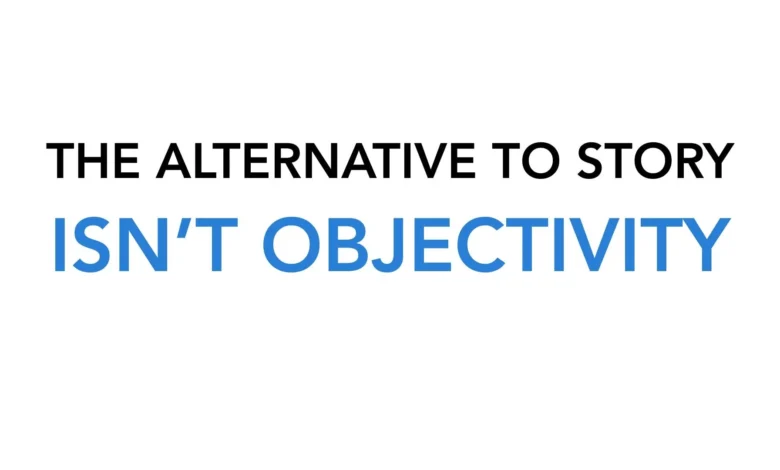
Because these choices actively shape what an audience ultimately observes, the notion that simply showing a graph equates to absolute objectivity is mathematically and philosophically untenable. As data communication specialists frequently emphasize, the alternative to an intentional narrative is not unbiased neutrality; it is the abdication of interpretive responsibility.
The Risks of Passive Reporting and Outsourced Interpretation
When researchers and analysts choose to remain passive—refusing to guide their audience through the implications of the data—they create an interpretive vacuum. In professional environments, decision-makers, stakeholders, and the public rarely possess the time or specialized expertise required to thoroughly interrogate complex datasets.
If the primary subject matter expert declines to interpret the findings, the audience is forced to construct their own narrative. This approach carries substantial institutional and communicative risks:
- Misinterpretation: Stakeholders may draw erroneous conclusions from complex visualizations, missing crucial caveats or confounding variables.
- Cherry-Picking: Without a clear, authoritative synthesis provided by the analyst, opportunistic actors may selectively extract isolated data points to support preconceived agendas or policy positions unsupported by the broader evidence.
- Analysis Paralysis: Excessive caution can lead to reports that are so heavily qualified and devoid of actionable insight that they fail to inform policy, business strategy, or operational decisions.
Empirical studies on organizational communication consistently demonstrate that data which lacks a clear, contextualized narrative framework is significantly less likely to be understood, remembered, or acted upon. By withholding their perspective, analysts do not protect their work from bias; instead, they surrender control over how that work is interpreted and applied in the real world.
Reconciling Rigor with Narrative: Frameworks for Technical Communicators
For researchers and statisticians seeking to bridge the gap between empirical rigor and effective communication, experts recommend reframing the concept of "storytelling" around the more palatable and precise framework of "perspective."
Rather than inventing a dramatic arc, analysts can ground their narrative in the deep contextual understanding they have gained through prolonged engagement with the data. Because the analyst has spent weeks or months exploring anomalies, testing hypotheses, and understanding limitations, they are uniquely positioned to answer fundamental questions for their audience:
- What patterns or trends in the data warrant immediate attention?
- What are the plausible interpretations of these findings, and what evidence supports each?
- What are the clear limitations, margins of error, and alternative explanations that must be kept in mind?
- What concrete decisions or organizational conversations should this information inform?
Flexibility is essential in this process. In exploratory research settings, storytelling does not need to manifest as a singular, definitive recommendation. Instead, a rigorous narrative can take the form of structured optionality—presenting multiple hypotheses supported by the data, outlining trade-offs, and raising critical questions for future inquiry.
Broader Implications for Data-Driven Organizations
As institutions across sectors—ranging from public health and academic research to corporate governance and finance—increasingly rely on data to drive policy and strategy, the standards for data communication are evolving. The traditional model of the isolated analyst handing over dense tables of figures is being replaced by expectations for collaborative, transparent, and accessible insight generation.
Industry observers note that effective data storytelling does not dilute scientific or statistical rigor; rather, it enhances it by making complex methodologies transparent and actionable. Organizations that successfully train their technical staff to communicate with clear perspective are better equipped to foster data-driven cultures, mitigate the risks of misinformation, and ensure that empirical research translates into meaningful, evidence-based action.
Ultimately, the debate serves as a reminder that data does not speak for itself. It requires human expertise, intellectual honesty, and deliberate framing to be understood. Refusing to tell a story with data does not eliminate perspective; it merely ensures that the narrative will be written by someone else.
Related posts: