Marimo Pair Bridges the Gap Between AI Coding Agents and Stateful Data Science Environments

The landscape of software development has been fundamentally altered by the emergence of autonomous coding agents, yet a significant divide has persisted between traditional file-based programming and the stateful, iterative nature of data science. While agents have become proficient at scoping features, editing files, and running tests on disk, they have historically lacked visibility into the live memory state of a running program—a critical component of data analysis. Marimo, the developer of a reactive Python notebook environment, has addressed this limitation with the release of Marimo Pair, a specialized agent skill designed to integrate AI assistants directly into active Python kernels. By allowing agents to access in-memory variables, schemas, and live charts, the tool transforms the computational notebook into a shared canvas for human-AI collaboration.
The Evolution of Computational Notebooks and the Reactive Shift
To understand the significance of Marimo Pair, it is necessary to examine the evolution of the environments where data science occurs. For over a decade, Project Jupyter and its .ipynb file format have served as the industry standard. These notebooks operate on a linear execution model where the state of the kernel depends entirely on the order in which a user manually runs individual cells. This often leads to "hidden state" problems, where a variable’s value in memory does not match the code visible on the screen, creating reproducibility issues that are notoriously difficult for both humans and AI to debug.
Marimo entered the market as a "reactive" alternative to Jupyter. Unlike traditional notebooks, Marimo tracks the dependencies between cells using a directed acyclic graph (DAG). When a variable is updated in one cell, Marimo automatically re-executes all descendant cells, ensuring the entire notebook remains in a consistent state. Furthermore, Marimo stores its notebooks as pure Python (.py) files rather than complex JSON structures. This design choice was intended to make notebooks more compatible with traditional software engineering tools like Git, but it also laid the groundwork for better AI integration.
The Technical Barrier: Disk-Based Agents vs. Stateful Data Work
The primary challenge addressed by Marimo Pair is the fundamental difference between how an AI agent "sees" code and how a data scientist "experiences" data. Standard coding agents, such as Claude Code, Cursor, or GitHub Copilot, primarily interact with the file system. They read scripts, suggest edits, and execute terminal commands. This works effectively for web development or systems programming where the source code is the ultimate truth.
However, data work is inherently stateful. A data scientist loads a dataset into memory, inspects its distributions, runs a cell, observes the visual output, and decides the next step based on those live results. Until now, if an agent were asked to analyze a dataset within a notebook, it could only see the static code or the cached outputs in a file. It could not "reach out" and ask the Python kernel for the current shape of a dataframe, the data types of specific columns, or the result of a complex in-memory transformation without re-running the entire process from scratch. This lack of "live sight" resulted in high token consumption, frequent errors, and a disjointed user experience where the human had to manually copy-paste outputs to provide the agent with context.
Architecture and Capabilities of Marimo Pair
Marimo Pair functions as an "agent skill"—a set of packaged instructions and tools that teach an LLM how to interact with a specific environment. The architecture relies on a semi-private API within the Marimo editor known as "Code Mode." This API allows the agent to execute Python code directly within the user’s active session.
The tool provides the agent with several high-level primitives:
- Variable Inspection: The agent can list all variables currently held in the Python memory and inspect their types and values.
- Schema Discovery: For data-intensive tasks, the agent can automatically determine the columns, row counts, and distributions of dataframes (Pandas, Polars, Ibis, etc.) without requiring the user to describe them.
- Notebook Mutation: The agent can create, edit, and delete cells within the Marimo UI, allowing it to build up an analysis incrementally.
- Multimodal Feedback: In integrated environments like VS Code, the agent can receive visual feedback, such as screenshots of generated plots, allowing for a "closed-loop" where the AI can verify if a chart looks correct before presenting it to the user.
By providing the agent with a "Run Python" tool that hooks into the live kernel, Marimo Pair effectively turns the AI into a first-class participant in the interactive programming loop. This reduces the cognitive overhead for the developer, who no longer needs to act as a bridge between the kernel’s state and the agent’s context window.
Distribution Models and the Fragmented AI Ecosystem
The release of Marimo Pair highlights the increasing fragmentation of the AI tooling market. Recent data from industry analysts, including reports from The Pragmatic Engineer, suggest a rapid shift in developer preferences. While Microsoft’s GitHub Copilot maintains a large footprint due to enterprise approvals and its inclusion in Microsoft 365 subscriptions, specialized tools like Claude Code and Cursor have seen a surge in adoption among high-end software engineers.
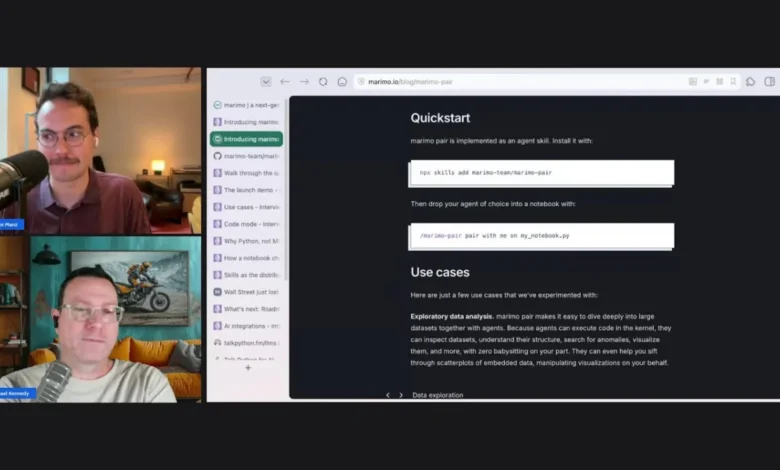
Marimo has opted for a decoupled distribution strategy to remain agnostic in this "agent war." Marimo Pair is distributed as a markdown-based skill that can be installed via npm or the Python package manager uv. This allows it to be used across various "agent harnesses":
- Claude Code: The terminal-based CLI from Anthropic.
- Codex: A popular agent framework.
- OpenCode: An emerging tool that allows developers to use open-source models or various API providers.
- VS Code/Cursor: Through Marimo’s native extension, which is being updated to allow these editors’ internal chat panels to drive notebook execution.
This strategy ensures that as subscription models and model performance fluctuate, the Marimo environment remains a constant, useful tool. Trevor Manz, a lead developer at Marimo, noted that by moving the control logic into a skill, the team can update the Marimo editor’s capabilities without forcing users to constantly re-sync their agent configurations.
Impact on Workflow: From Vibe Coding to Verified Analysis
One of the most significant implications of Marimo Pair is the move away from what is colloquially known as "vibe coding"—a process where an agent generates a large block of code that the user hopes will work. In a stateful notebook environment, Marimo Pair encourages an incremental, verified approach.
Because the agent has access to the kernel, it can perform "sanity checks" at each step. For instance, if asked to load an Excel file and plot its contents, the agent can first run code to inspect the sheet names, then run code to validate that the data was parsed correctly, and only then proceed to generate the plotting code. If a library is missing or a column name is misspelled, the agent receives an immediate error from the kernel and can self-correct before the user even sees the final output.
This workflow is particularly beneficial for complex data ingestion tasks. In the podcast transcript, Manz shared an anecdote regarding the difficulty of parsing bespoke Excel files. Traditionally, a developer would spend an hour writing and debugging a parser. With Marimo Pair, the user can simply drag the file into the environment and ask the agent to "find the tables and load them." The agent uses its live access to explore the file structure and build the dataframes, allowing the human to focus on the higher-level analysis.
Chronology of Development and Future Roadmap
The development of Marimo Pair follows a series of milestones in the reactive notebook space:
- Late 2023: Marimo launches its reactive Python notebook, emphasizing .py file compatibility and deterministic execution.
- Early 2024: The rise of coding agents like Claude 3.5 Sonnet and Cursor changes developer expectations for IDE integration.
- June 2024: Marimo records Episode 555 of "Talk Python To Me," detailing the internal "Code Mode" and the transition from a built-in chat bar to an external agent skill.
- Late 2024 (Projected): Marimo plans to ship tighter integration with the VS Code native notebook editor, allowing the VS Code Copilot/Chat to drive Marimo kernels directly.
- 2025 and Beyond: The roadmap includes real-time collaboration features, where multiple human users and multiple AI agents can interact within a single "MoLab" (Marimo’s cloud-hosted infrastructure) session.
Broader Implications for the Python Ecosystem
The introduction of Marimo Pair represents a broader trend of "multimodal" and "stateful" AI. As models become more capable of processing images and complex data structures, the text-only terminal is becoming an insufficient interface for data work. By bridging the gap between the agent and the Python kernel, Marimo is positioning the notebook not just as a place to write code, but as an operating system for data exploration where the AI has "hands" to manipulate objects and "eyes" to see the results.
This development also challenges the dominance of the .ipynb format. The fact that Marimo notebooks are valid Python scripts makes them inherently easier for agents to parse and edit compared to the verbose JSON of Jupyter. As AI becomes the primary author of much of the world’s data science code, the underlying file formats and execution models will likely evolve to favor environments that provide the highest degree of feedback and the lowest degree of ambiguity.
For the developer community, the call to action is clear: the era of "copy-pasting to the chatbot" is ending. Tools like Marimo Pair suggest a future where the AI is an ambient presence within the development environment, fully aware of the data in memory and capable of executing verified, reproducible analyses with minimal human intervention. As this technology matures, it will likely lower the barrier to entry for complex data tasks while simultaneously increasing the productivity of seasoned data scientists.