Sound-Dampening Innovations Redefine Modern Open-Plan Workspaces Through Acoustic Pods and Panels

The modern office landscape has undergone a profound transformation over the past decade, shifting away from rigid, cellular layouts toward expansive open-plan environments designed to encourage collaboration, flexibility, and spatial efficiency. However, this architectural preference for openness
has introduced a persistent challenge: excessive ambient noise and a lack of acoustic privacy. To counteract these distractions and maintain productivity, workplace designers and architects increasingly rely on specialized sound-dampening products. Ranging from sophisticated work pods and modular booths to ceiling-mounted systems and textured wall panels, these innovations are reshaping how companies approach interior acoustics. Recent additions to the architectural design sector showcase a growing emphasis on high-performance materials, environmental sustainability, and deep user customisation, reflecting a maturing market responding to the evolving demands of the hybrid workforce.
The Evolution of Workplace Acoustics
The necessity for effective acoustic management in the workplace is rooted in decades of productivity research. Studies consistently demonstrate that high noise levels—ranging from ringing telephones and general office chatter to impromptu meetings near workstations—are among the primary sources of workplace stress and employee dissatisfaction. In an open-plan office, chronic noise exposure can reduce cognitive performance, hinder focus, and elevate cortisol levels among staff.
Historically, employers attempted to solve these issues with basic cubicle partitions or rudimentary acoustic ceiling tiles, which often proved inadequate for mitigating low-frequency sounds or providing true speech privacy. As offices evolved to accommodate hybrid working models—where employees primarily come into the office for collaborative tasks, team workshops, and confidential discussions—the demand for adaptable, high-performance acoustic infrastructure has skyrocketed. Modern acoustic solutions are no longer viewed merely as functional afterthoughts; they are integral components of interior architecture that directly influence employee well-being, spatial organisation, and corporate culture.
Modular Work Pods and Meeting Booths
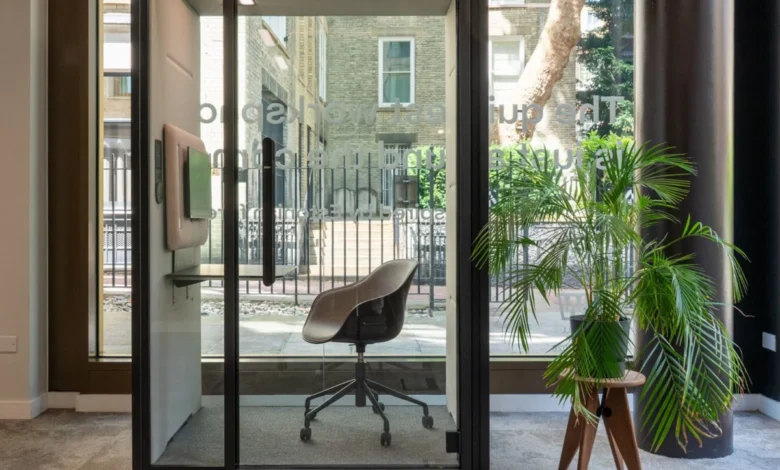
One of the most significant product categories addressing the open-plan noise dilemma is the self-contained acoustic work pod. Designed to offer isolated environments for individual focus or small-group video conferences, these booths have become ubiquitous in contemporary office design. Recent product developments highlight a strong focus on modularity, improved ventilation, and aesthetic customisation.
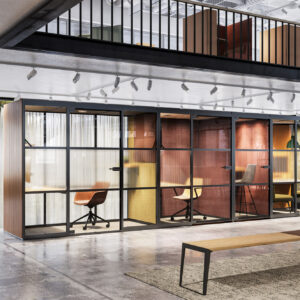
British furniture manufacturer Boss Design has addressed these requirements with its Mews pods collection. Comprising 11 distinct size formats, the range offers versatile solutions for various spatial configurations within an open-plan layout. The Mews pods incorporate ribbed privacy glass alongside adjustable lighting, noise-attenuation features, and integrated ventilation levels. These adjustable parameters empower users to curate a comfortable micro-environment tailored to their specific working needs, thereby balancing personal autonomy with overall office harmony.
Similarly, Estonian office pod specialist Silen has advanced the category with its Space Gen 2 collection. Built upon a pioneering cassette system, the pods feature a 50-per-cent-recycled-aluminium frame engineered to withstand multiple disassemblies, relocations, and reassemblies—a crucial feature for modern companies navigating frequent office relocations or layout redesigns. The Space Gen 2 collection also introduces a signature "floating roof" design, which enhances internal air flow while maintaining the high acoustic isolation required for confidential calls and intensive work sessions.
Spanish workplace furniture manufacturer Actiu has similarly evolved its QYOS acoustic pod lineup to offer heightened customisation and control. The updated QYOS pods provide an extensive selection of exterior finishes, integrated planters, and interior configurations, including choices between soft or hard seating, variable table heights, and specialized screen mounts. By pairing these ergonomic options with precise climate and acoustic controls, manufacturers are ensuring that pods function as comfortable extensions of the primary workspace rather than isolated, utilitarian boxes.
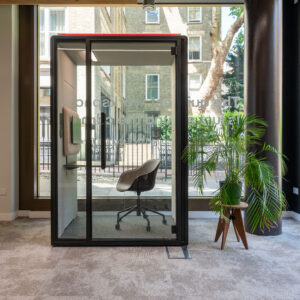
Further expanding this sector, office furniture brand Mute has updated its Jetson acoustic pod range. The latest iteration of the Jetson booths focuses heavily on architectural integration, offering an expanded array of wall configurations that transition seamlessly from predominantly glazed partitions to solid, opaque walls. Available in 24 distinct colorways, these pods allow designers to either make the acoustic booths bold architectural statements or subtle, harmonious elements within the broader interior scheme.
Surface Solutions: Ceilings and Walls
While standalone pods excel at providing localized refuge, comprehensive acoustic design requires treating the broader architectural surfaces of a room—namely, ceilings and walls—to control reverberation times and absorb ambient sound waves.
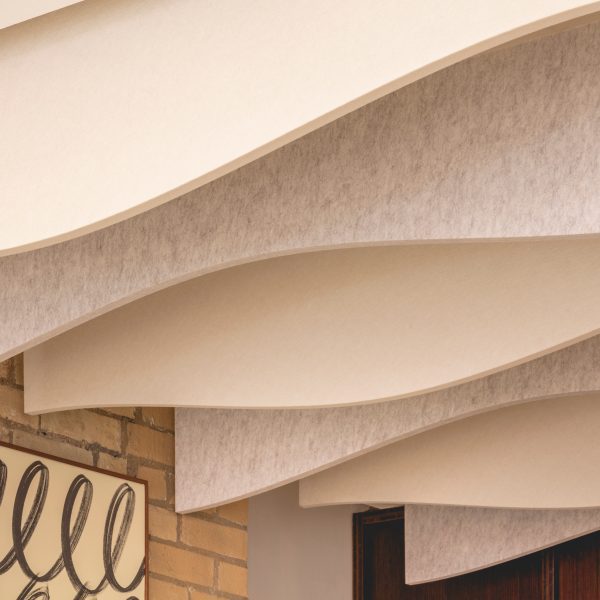
British firm The Collective has addressed overhead acoustic management with its Collective RailLock ceiling system. Combining aesthetic appeal with functional sound dampening, the system features slabs and fins constructed from PET felt paired with aluminium fixings. Available in a diverse range of shapes and colorways, Collective RailLock enables interior designers to integrate acoustic performance directly into the ceiling plane without compromising the visual identity of a commercial space. PET felt, derived largely from recycled plastic materials, has emerged as a preferred medium in sustainable design, offering excellent sound-absorption properties alongside a lightweight, durable profile.
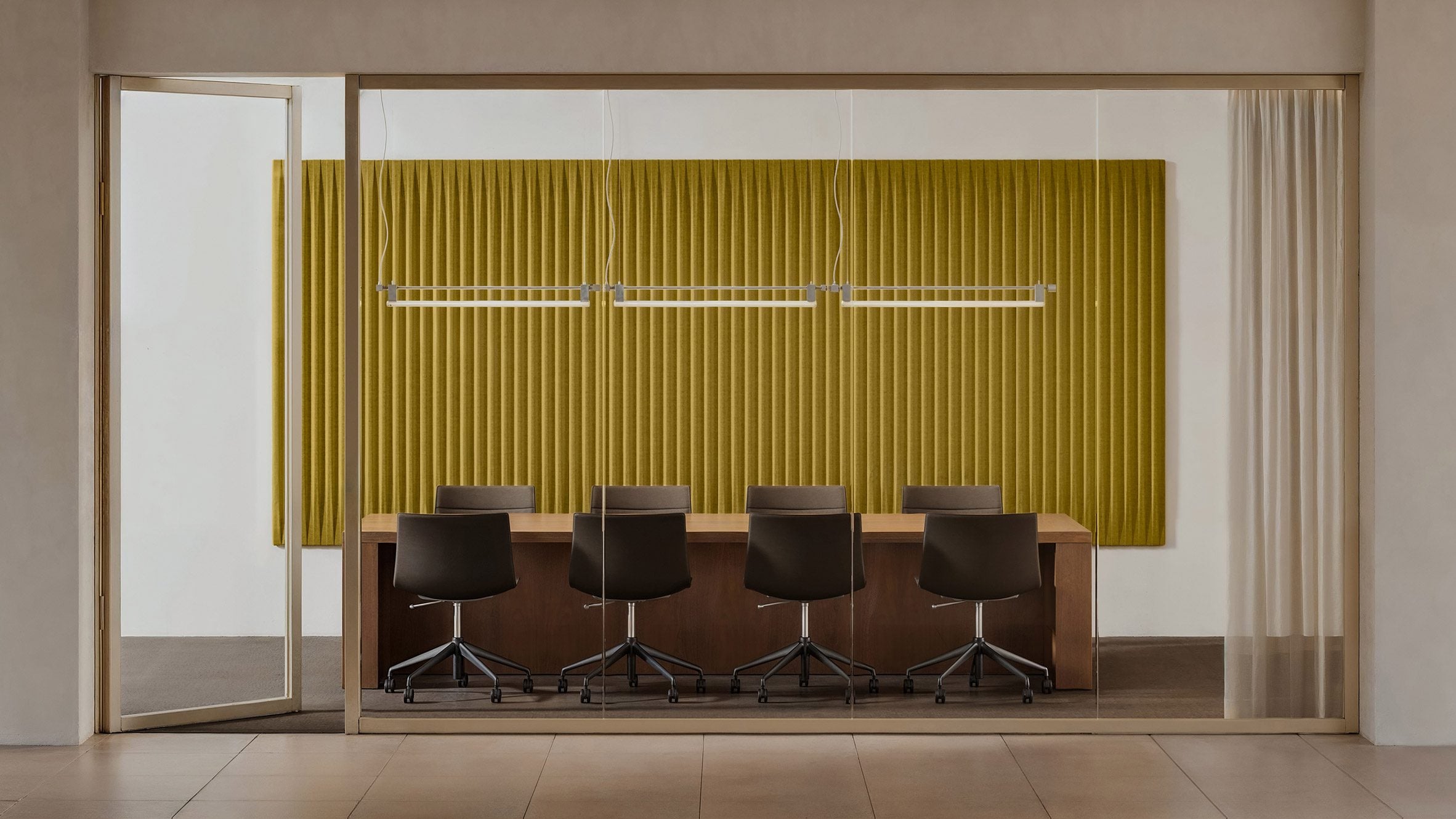
To address vertical surfaces, acoustic solutions brand Zilenzio collaborated with Studio Stockholm to develop the Zonify Wall and matching Zonify Table. The Zonify Wall is a large, wall-mounted acoustic panel designed to absorb sound across expansive vertical areas, while the Zonify Table features a smaller, side-lit screen that functions effectively as a desk backboard. Both products utilize pleated fabric surfaces, creating a dimensional texture that interacts dynamically with natural and artificial light. This interplay of light, shadow, and sound absorption transforms flat, utilitarian room dividers into engaging architectural features that contribute to a calmer, more visually sophisticated indoor environment.
Sustainability and Future Implications
The recent influx of advanced acoustic products underscores a broader industry-wide shift toward sustainability, circularity, and user-centric design. As corporate clients face mounting pressure to reduce their carbon footprints and achieve rigorous environmental building certifications—such as LEED, BREEAM, and WELL—manufacturers are increasingly transparent about material sourcing. The widespread adoption of recycled aluminium frames, PET felt components, and modular designs that facilitate repair and repurposing highlights a commitment to a circular economy within the contract furniture sector.
Furthermore, the integration of smart technologies—such as occupancy sensors, automated climate control, and programmable LED lighting within modern acoustic pods—points toward a future where workplace furniture actively adapts to individual physiological needs. Industry analysts observe that as hybrid working models continue to mature, the demand for adaptable, high-performance acoustic solutions will remain robust. Architects and interior designers are expected to increasingly specify products that not only solve noise pollution in open-plan offices but also contribute tangibly to indoor environmental quality, sustainability goals, and the psychological well-being of the modern workforce.