The software development ecosystem is undergoing a quiet, high-performance revolution, driven not by the creation of an entirely new paradigm, but by the strategic integration of Rust into the Python programming language. For decades, Python has maintained its dominance as the lingua franca for data science, scripting, and web application development, largely due to its expressive syntax and expansive ecosystem. However, Python’s dynamic nature and runtime overhead have historically introduced performance bottlenecks. Enter Rust, a systems programming language celebrated for its memory safety, zero-cost abstractions, and blazing-fast execution speeds. Today, Python developers are experiencing the benefits of Rust across multiple layers of their daily tooling, reshaping what is possible in enterprise-grade applications.
To understand the magnitude of this shift, one need only look at developer tooling. Tasks that once required lengthy interruptions are now completed in the blink of an eye. For instance, linting the entire CPython codebase from scratch using modern Rust-backed tooling takes a mere 0.3 seconds. This dramatic acceleration has captured the attention of software architects worldwide, transforming Rust from an academic curiosity into an indispensable asset for mainstream developers.
The Three Pillars of Rust Integration in Python
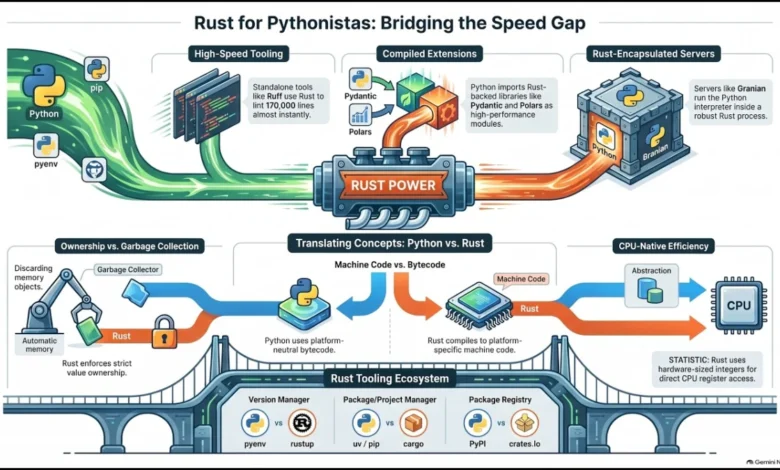
The integration of Rust into the Python ecosystem is not monolithic; rather, it manifests in three distinct ways that cater to different aspects of software engineering. First, Rust is being utilized to build standalone tools that happen to be written in Rust, serving Python developers without requiring them to write a single line of Rust code. Second, developers are importing high-performance Python libraries that leverage Rust under the hood for intensive data crunching and validation. Third, modern web application and API servers are increasingly being built in Rust while securely executing Python code internally.
This multifaceted adoption strategy allows Python developers to reap the performance dividends of a compiled systems language without sacrificing the rapid prototyping capabilities of Python. Tools like Ruff, Pydantic, Polars, uv, and Granian exemplify this trend. By replacing traditional, slower Python-based linters, package managers, and data frames with Rust-engineered counterparts, projects of all sizes are experiencing orders-of-magnitude performance increases. For instance, processing data frames in Polars or validating data models via Pydantic harnesses native machine-level optimization, bypassing the memory-allocation overhead traditionally associated with interpreted languages.
Bridging the Memory Management Gap
The convergence of Python and Rust introduces developers to fundamentally different philosophies of memory management. Python abstracts memory allocation and deallocation entirely through its built-in garbage collector, allowing developers to pass values around freely without manually tracking references. Rust, by contrast, enforces memory safety at compile time through its rigorous ownership model and borrow checker.
Under Rust’s core rule, a variable or value can only have one owner at a time. When that owner goes out of scope, the memory is immediately dropped without the runtime overhead of a garbage collector. Attempting to pass variables around with the abandon permitted in dynamic languages will result in explicit, unyielding compiler errors. While this paradigm shift can initially present a steep learning curve for developers coming exclusively from dynamic backgrounds, it effectively eradicates entire classes of runtime bugs, such as null pointer dereferences, buffer overflows, and data races.
Furthermore, Rust’s compiler is renowned for providing exceptionally descriptive and helpful error messages. Rather than failing obscurely at runtime, Rust guides the developer toward structural correctness during compilation, suggesting precise syntax or ownership adjustments that are accurate in the vast majority of use cases. This strictness encourages developers to think more critically about memory allocation, resulting in cleaner, more deliberate code architectures.
The Mechanics of Interoperability: Py03 and Maturin
Integrating Rust into existing Python workflows has been dramatically streamlined by community-driven projects such as Py03 and Maturin. Py03 provides a robust framework for binding Rust code to Python, allowing developers to expose native Rust functions, structs, and classes as standard Python modules. By adhering closely to Python’s Application Binary Interface (ABI), Py03 bridges the gap between high-level Python scripts and low-level Rust execution.
Maturin complements this process by handling the complex orchestration of building and packaging mixed-language projects. It automates the compilation of Rust code into dynamic shared libraries (such as .so or .dll files) and packages them neatly alongside Python wrappers into standard wheel formats. Consequently, end-users can install these hybrid packages seamlessly via standard package managers like pip or uv, often entirely unaware that performance-critical routines are being executed by compiled machine code rather than the standard Python interpreter.
Economic and Strategic Implications for Enterprises
The widespread adoption of Rust-powered tools has profound implications for enterprise software engineering, particularly regarding operational costs and infrastructure efficiency. In large-scale production environments, execution speed directly translates to CPU utilization, server provisioning requirements, and cloud computing expenditures. By offloading resource-intensive tasks—such as massive data frame transformations, JSON parsing, and static analysis—to Rust-backed extensions, organizations can significantly reduce their cloud infrastructure footprint.
Moreover, the predictability of compiled binaries simplifies deployment pipelines. Unlike Python applications that often require complex runtime environments, dependency resolution trees, and virtual environment management, Rust binaries compile down to platform-specific machine code. This enables straightforward distribution models where a single compiled binary can execute reliably without depending on an external interpreter runtime.
Looking Ahead: The Harmonious Future of Hybrid Programming
The ongoing synergy between Python and Rust represents a pragmatic maturation of the software industry. Rather than engaging in dogmatic language wars, the developer community is increasingly adopting a hybrid approach—leveraging Python for its unmatched readability, rapid development velocity, and extensive ecosystem, while deploying Rust to fortify performance-critical bottlenecks and developer tooling.
As educational resources, such as specialized courses on transitioning from Python to Rust, continue to proliferate, the barrier to entry is lowering. Developers are discovering that learning enough Rust to inspect third-party libraries, write custom performance extensions, or understand compiler feedback fundamentally improves their overall programming acumen. Ultimately, the fusion of Python’s expressive power with Rust’s uncompromising speed and safety has established a new gold standard for modern application architecture, ensuring that both languages will remain foundational pillars of software development for decades to come.