Amazon SageMaker Introduces Hardware-Isolated GPU Partitioning to Optimize Enterprise AI Inference Costs and Maximize Utilization

For years, organizations deploying machine learning models to graphics processing unit (GPU) endpoints have faced a rigid architectural constraint: the smallest unit of high-performance computing hardware you can request is one whole physical accelerator. This monolithic allocation model has long forced enterprise engineering teams into a financial and operational dilemma.
When deploying multiple models to an instance like the Amazon EC2 ml.p4d.24xlarge—which houses eight NVIDIA A100 accelerators—teams are limited to hosting precisely eight models, regardless of whether a specific model requires 40 gigabytes of memory or a mere 14 gigabytes. Furthermore, as concurrency metrics climb and prompt lengths expand, developers find themselves trapped between outdated hardware that can no longer handle traffic spikes and bleeding-edge accelerators whose capacity vastly outstrips the needs of smaller fine-tuned models, embedding networks, or classification guardrails. Consequently, infrastructure administrators are routinely forced to choose between under-serving their applications or purchasing expensive compute capacity that sits idle.
To resolve these longstanding inefficiencies, Amazon Web Services (AWS) has officially announced native support for GPU partitioning within Amazon SageMaker AI. Leveraging NVIDIA Multi-Instance GPU (MIG) technology, this newly deployed capability divides a single physical GPU into fully independent hardware partitions. Each allocated partition receives a dedicated share of the GPU’s compute units alongside an isolated block of high-bandwidth memory (HBM). Because the hardware itself enforces these boundaries, memory leaks, resource contention, and cross-model interference are eliminated at the silicon level.
This technological leap fundamentally reshapes deployment economics. Enterprise AI teams can now host multiple distinct models on a single accelerator while precisely rightsizing compute units to match specific application profiles. Rather than making an all-or-nothing choice between generations of hardware, machine learning engineers can deploy fractional slices of advanced accelerators, balancing cost and throughput with unprecedented precision.
The Limitations of Legacy AI Deployment Strategies
Before the introduction of native GPU partitioning on managed platforms, infrastructure architects relied on a trio of imperfect workarounds to maximize hardware utilization, each carrying distinct operational liabilities.
The first approach involved running fewer, vastly larger endpoints backed by aggressive batching strategies. While this method successfully elevated hardware utilization metrics, it only functioned when workloads were functionally interchangeable. For enterprises managing diverse portfolios of fine-tuned model variants, per-tenant models, or distinct task-specific pipelines, forced consolidation proved unviable.
A second common strategy relied on multi-model endpoints. These configurations dynamically load and unload models from a shared GPU pool on demand, rendering them attractive for sparse, bursty traffic profiles. However, because these models share the underlying device without hardware isolation, a resource-intensive query directed at one model can severely degrade the latency of its neighbors. Moreover, models that are not actively resident in memory incur an unavoidable latency penalty during their initial invocation.
To achieve true hardware-level GPU partitioning, enterprises historically had to bypass managed cloud services entirely and migrate their infrastructure to self-managed Kubernetes clusters running the NVIDIA MIG stack. While effective, this DIY approach forced platform engineering teams to shoulder significant maintenance overhead. Maintaining driver version compatibility, configuring complex partition layouts, managing device plugins, and keeping Kubernetes scheduling consistent across massive computing fleets consumed valuable engineering cycles—work that did little to accelerate core product delivery.
Integration with Amazon SageMaker Inference Components
The newly launched GPU partitioning feature integrates directly into Amazon SageMaker inference components, the native architectural construct designed to host multiple models on a single endpoint while defining distinct compute resource boundaries for each workload.
By building upon inference components, AWS has streamlined the adoption curve. Administrators do not need to learn an entirely new API paradigm, configure separate resource types, or provision complex AWS Identity and Access Management (IAM) actions. Instead, requesting a partition is as straightforward as declaring an optional AcceleratorPartitionType parameter within an inference component specification, right alongside existing parameters for host CPU cores and system memory.
It is important to note that this capability is specifically tailored for real-time inference endpoints utilizing inference components. Single-model endpoints, serverless configurations, and heterogeneous instance pools remain outside the scope of direct GPU partitioning. Furthermore, because asynchronous inference cannot natively address individual inference components, async pipelines are similarly excluded from initial deployment support.
Under the Hood: How NVIDIA MIG Technology Operates
NVIDIA Multi-Instance GPU (MIG) technology physically subdivides a single monolithic GPU into as many as seven distinct instances, depending on the underlying silicon architecture. Each hardware partition operates with dedicated streaming multiprocessors (SMs), a dedicated L2 cache slice, separate memory controllers, and isolated memory bandwidth.
Because this partitioning occurs at the hardware level rather than through software time-slicing, the performance guarantees surpass those of traditional virtualization methods. A rogue process consuming maximum compute capacity within one partition cannot starve or disrupt workloads executing in neighboring partitions.
However, hardware-level partitioning introduces structural boundaries that engineers must account for during the design phase. The maximum allowable number of partitions varies by accelerator model, capping at seven partitions for NVIDIA A100 and H100 devices. Because MIG requires partitions to remain completely idle during layout modifications, partition schemas must be established at the moment the endpoint configuration is created. Dynamic, on-the-fly resizing of active production partitions is not supported. Additionally, models that genuinely require the full throughput of a multi-accelerator configuration—such as massive frontier foundation models—must continue to utilize unpartitioned, whole-device allocations.
Streamlined API Implementation and Provisioning
Implementing GPU partitioning requires minimal adjustments to existing infrastructure-as-code templates or API payloads. Two optional fields govern the entire configuration process: AcceleratorPartitionLayouts and AcceleratorPartitionType.
The AcceleratorPartitionLayouts field is declared within the production variant of a CreateEndpointConfig API call. This parameter dictates how every physical accelerator within the instance fleet is systematically divided. For example, an organization utilizing an ml.p4d.24xlarge instance equipped with eight NVIDIA A100 accelerators can declare a layout that divides each GPU into three distinct partitions—such as a mig-4g.20gb, a mig-2g.10gb, and a mig-1g.5gb profile. This configuration instantly provisions twenty-four total partitions across the instance fleet without altering the underlying instance footprint.
Once the layout is established, the individual models are deployed using inference components enriched with the AcceleratorPartitionType parameter. If an organization needs to scale a high-concurrency, lightweight summarization model, operators simply increase the CopyCount parameter within the inference component configuration. This action automatically populates additional copies of the model onto any available, unassigned partitions of the requested type within the endpoint.
Provisioning a partitioned endpoint adds approximately 17 seconds of initialization overhead to account for hardware carving during startup. Once the endpoint reaches the InService state, accelerators are fully partitioned and ready to receive model artifacts. Client applications continue to invoke models via standard InvokeEndpoint operations utilizing the inference component name, meaning downstream client code remains entirely unaffected by the underlying hardware topology.
Supported GPU Families and Partition Profiles
Hardware partitioning profiles are strictly determined by the specific GPU architecture integrated into the underlying Amazon EC2 instance family. Engineers must cross-reference their chosen hardware against official NVIDIA MIG specifications to ensure compatibility.
Supported instance families span a wide spectrum of enterprise compute infrastructure:
- P4d Instances (NVIDIA A100, 40GB VRAM): Supports up to 7 partitions per GPU across profiles ranging from
mig-1g.5gbup tomig-7g.40gb. (Note: Utilizing themig-1g.10gbprofile requires updating the inference AMI version to support newer NVIDIA driver lines). - P5 Instances (NVIDIA H100, 80GB VRAM): Supports up to 7 partitions per GPU, offering high-density configurations including
mig-1g.10gb,mig-2g.20gb, andmig-7g.80gb. - G7 Instances (NVIDIA RTX PRO 4500 Blackwell, 32GB VRAM): Supports up to 2 partitions, including
mig-1g.16gbandmig-2g.32gbprofiles. - G7e Instances (NVIDIA RTX PRO 6000 Blackwell Server Edition, 96GB VRAM): Supports up to 4 partitions, featuring high-capacity profiles such as
mig-1g.24gb,mig-2g.48gb, andmig-4g.96gb.
Every profile identifier clearly communicates its resource allocation: the numerical prefix preceding the ‘g’ denotes the proportional share of compute units, while the suffix indicates dedicated GPU memory. For instance, the widely utilized mig-3g.40gb profile allocates three of the seven available compute slices alongside 40 gigabytes of high-bandwidth memory.
Strategic Workload Design: Balancing Compute and Memory
Choosing the correct partition profile requires a nuanced understanding of how inference workloads consume hardware resources. Compute units and memory blocks govern entirely different phases of the text generation lifecycle.
Compute units dictate performance during the prefill phase, during which the model ingests the incoming prompt and constructs its internal representations. This phase is heavily compute-bound, scaling directly with the number of streaming multiprocessors and total TFLOPs assigned to the partition. Long input prompts and high prompt arrival rates demand robust compute allocations to minimize time-to-first-token (TTFT) latency.
Conversely, memory units and memory bandwidth govern the decode phase, where tokens are generated sequentially. Because the model must re-read its parameter weights from memory on every generated token, decode speed is constrained by memory bandwidth rather than raw compute capability. Furthermore, memory allocation dictates the maximum capacity of the Key-Value (KV) cache, directly limiting maximum context windows and concurrent sequence capacity.
Engineers must carefully calculate total memory requirements before committing to a partition profile. A partition must comfortably house three distinct elements: the model weights (e.g., approximately 16 gigabytes for an 8-billion-parameter model running in FP16 precision), the dynamic KV cache sized for anticipated concurrency and context length, and an additional 1 to 2 gigabytes of runtime overhead for CUDA contexts and serving frameworks. Sizing a partition exclusively to fit model weights often results in out-of-memory errors under peak production load or unexpected truncation of long-context windows.
Industry Validation and Enterprise Response
Early validation of Amazon SageMaker’s GPU partitioning feature has drawn enthusiastic support from major enterprise technology partners. Salesforce, a leading adopter of hyperscale AI infrastructure, collaborated closely with AWS during the initial requirements definition and validation phases.
"NVIDIA MIG partitions a single GPU into multiple isolated instances, each with dedicated compute and memory resources," said Richard Chang, Software Engineering Architect at Salesforce. "Salesforce sees this as an important capability because many inference workloads do not require an entire GPU. MIG would allow us to consolidate workloads safely, significantly improve GPU utilization, reduce inference costs, and maintain predictable performance and strong isolation."
Chang emphasized that the capability directly addresses enterprise demands for scalable, cost-effective AI deployment across diverse functional use cases. Following successful internal validation, Salesforce is preparing to test the architecture against representative production workloads in partnership with AWS.
Performance Benchmark: Fractional Newer Hardware vs. Whole Older Hardware
A critical advantage of GPU partitioning is the ability to deploy models onto fractional slices of advanced, high-performance accelerators rather than being forced to choose between older whole-device hardware and overpowered modern chips.
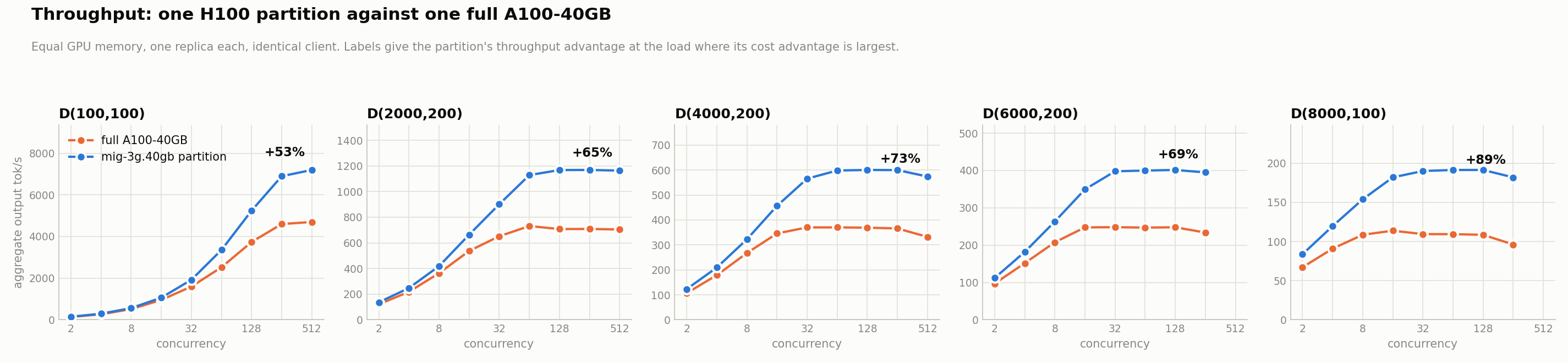
To quantify the practical benefits of this flexibility, engineering benchmarks compared a single mig-3g.40gb partition residing on an NVIDIA H100 accelerator against a whole, uncarved NVIDIA A100-40GB GPU. Both endpoints were configured with identical production containers running Llama-3.1-8B-Instruct on Amazon SageMaker real-time endpoints, utilizing native OpenAI-compatible invocation routes. Load testing was executed using genai-bench across five distinct traffic profiles encompassing varying input-to-output token ratios and concurrency ladders ranging from 2 to 512 active requests.
The empirical data revealed distinct operational crossover points:
- For high-concurrency workloads featuring long input contexts, the fractional H100 partition decisively outperformed the whole A100 accelerator in both raw output tokens per second and cost efficiency per million tokens.
- Conversely, for low-concurrency or extremely short-prompt applications, whole-device older hardware occasionally maintained an economic advantage.
These findings underscore that GPU partitioning is not a universal panacea, but rather an expanded matrix of sizing options. By treating individual partition profiles as discrete GPU types, machine learning teams can empirically match hardware footprints to precise application demands rather than defaulting to costly over-provisioning.
Geographic Availability and Deployment Considerations
At launch, GPU partitioning on Amazon SageMaker is available across seven key AWS Regions: US East (N. Virginia), US East (Ohio), US West (Oregon), Asia Pacific (Singapore), Asia Pacific (Tokyo), Europe (Frankfurt), and Europe (Ireland). Organizations must verify instance availability within their target Region and ensure their account quotas adequately support the selected instance families.
Billing structures remain anchored to the underlying GPU instance hourly rate rather than individual partitions; partitioning simply maximizes the operational yield and throughput derived from each instance hour. Once deployed, partition configurations remain immutable for the lifespan of the inference component, meaning portfolio adjustments require planned component updates or traffic migrations.
As enterprise AI adoption matures from experimental prototyping to scaled production deployment, the ability to eliminate hardware waste becomes paramount. By bridging the gap between raw silicon capabilities and managed cloud convenience, Amazon SageMaker’s GPU partitioning capability provides organizations with the granular control necessary to build sustainable, high-performance, and cost-efficient generative AI platforms.