Web Scraping 10,000 Pages in Under 25 Minutes: A Technical Analysis of Batch Processing Efficiency

The demand for high-volume, reliable web data extraction has surged alongside the rapid expansion of large-scale artificial intelligence models and enterprise-grade market intelligence platforms. As organizations pivot from small-scale manual scraping to massive, automated data pipelines, the primary challenge has shifted from mere connectivity to maintaining consistent throughput, data integrity, and verifiable results. Recent performance testing using the Olostep Batch API reveals a compelling case for the viability of managed infrastructure in handling large-scale web harvesting tasks. By processing 10,000 URLs in a single batch, developers are now able to achieve substantial data collection speeds, though the nuance of "completed" status vs. "successfully retrieved" remains a critical bottleneck for data engineers.
The Evolution of Web Data Infrastructure
Traditionally, scraping 10,000 pages required developers to manage complex, multi-threaded local environments or distributed systems to prevent IP blocking and manage rate limits. The overhead involved in maintaining proxies, handling JavaScript rendering, and ensuring the stability of thousands of concurrent network requests often resulted in significant latency and high failure rates.
The emergence of the Batch API model, as exemplified by platforms like Olostep, marks a structural shift toward "Scraping-as-a-Service." Instead of managing local request queues, users offload the execution to a cloud-native backend that manages the infrastructure, concurrency, and error handling. This shift allows enterprise users to focus on downstream data ingestion rather than the mechanics of the HTTP handshake.
Performance Chronology: The 10,000-Page Benchmark
To understand the efficacy of this approach, a controlled experiment was conducted using the Olostep Python SDK (version 1.2.2) and Python 3.13.15. The objective was to scrape 10,000 unique URLs from the Mozilla Developer Network (MDN) documentation, converting each into a structured Markdown format.
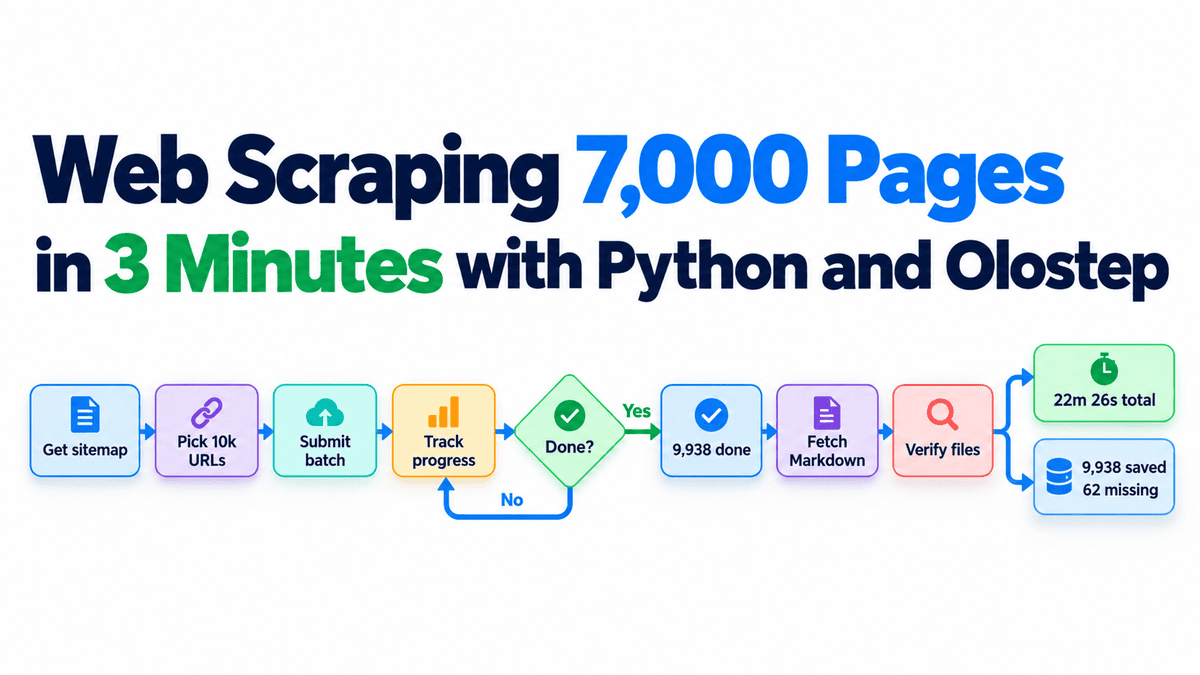
The process followed a strict chronological sequence:
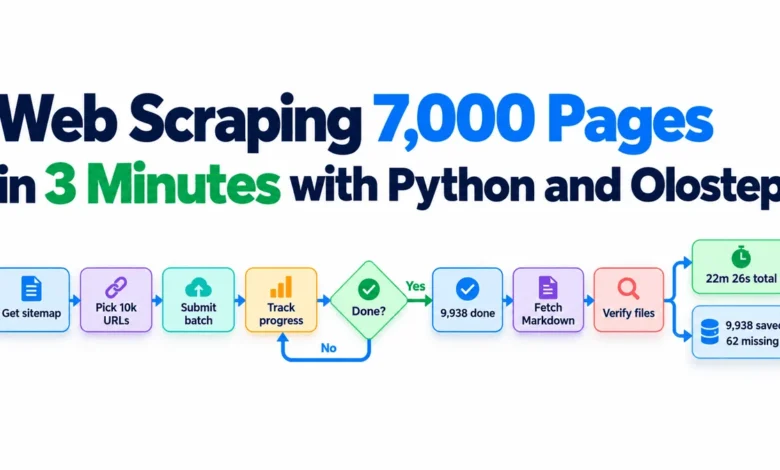
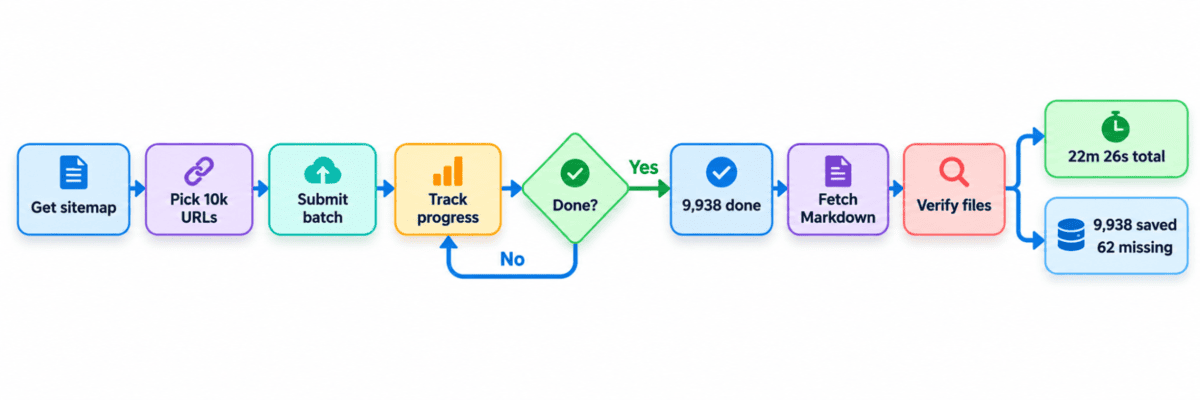
- Environment Setup and URL Selection: Utilizing the MDN sitemap, 10,000 unique documentation URLs were extracted and verified. This initial step ensured the integrity of the dataset before any network traffic was initiated.
- Batch Submission: The entire dataset was pushed to the API in a single request, creating a batch ID for tracking purposes.
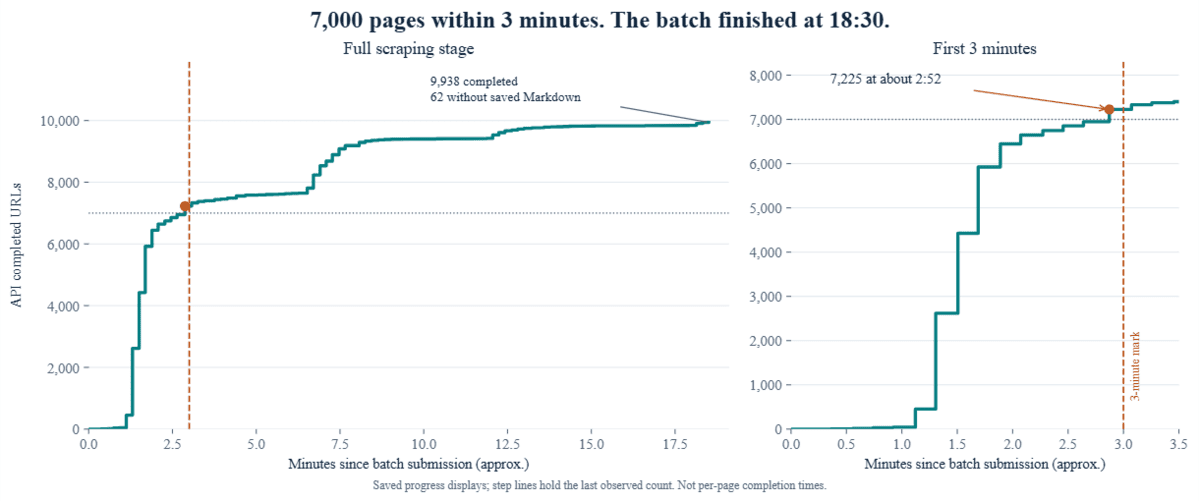
- The Rapid Acceleration Phase: Within the first three minutes of the operation, the platform successfully processed 7,225 pages. This represents a high-velocity throughput, suggesting that the initial allocation of resources by the provider is optimized for quick response times.
- Saturation and Processing Tail: As the job progressed beyond the 7,000-page threshold, the velocity decreased. The remaining 2,775 pages required an additional 15 minutes and 30 seconds to reach the 9,938-page completion mark.
- Data Retrieval and Verification: The final phase involved the systematic downloading and local storage of the retrieved Markdown content. This stage, handled with an asynchronous semaphore limit of 96 concurrent requests, took approximately 2 minutes and 25 seconds.
- Validation: A final audit determined that 9,938 files were successfully saved, leaving 62 pages—or 0.62%—unaccounted for due to various network or processing errors.
Data Analysis and Throughput Dynamics
The total time recorded for the entire lifecycle of the 10,000-page task was 22 minutes and 26 seconds. While the "three-minute" milestone for the first 7,000 pages is a marketing-friendly metric, the holistic data suggests a more complex reality regarding infrastructure scaling.
The degradation in speed after the initial burst is a common characteristic of distributed systems. It is likely that as the batch progresses, the system encounters "tail latency"—the time taken for the slowest nodes or the most complex, high-latency URLs to resolve. Furthermore, the 0.62% failure rate is an important figure for data architects. In enterprise environments, a 99.38% success rate is generally acceptable, but it necessitates robust error-handling logic, such as the implementation of retry mechanisms and manifest files to track the status of individual URLs.
Institutional Perspectives on Enterprise Scraping
Industry leaders in data infrastructure argue that the value of such platforms lies in their ability to provide "observability." The ability to track the status of a batch, monitor progress via API endpoints, and resume interrupted downloads is what distinguishes professional-grade tools from open-source script-based solutions.
According to representatives from the developer community, the primary concern for companies is not just the speed of the scrape, but the reliability of the output for LLM (Large Language Model) training. If a training set is missing 0.6% of its data, the impact on model performance can be non-trivial. Consequently, the integration of verification steps—checking file sizes, content existence, and validity—is now considered a mandatory component of any professional scraping pipeline.
Broader Implications for AI and Market Research
The ability to pull 10,000 high-quality documentation pages into a usable format in under 25 minutes has profound implications for several industries:
- AI Model Fine-tuning: Developers building RAG (Retrieval-Augmented Generation) systems require constantly updated, fresh documentation. High-speed, high-volume scraping ensures that models remain current without requiring excessive manual intervention.
- Competitor Intelligence: Real-time monitoring of product catalogs and pricing pages requires the same level of velocity. The batch-processing model allows companies to monitor thousands of SKUs across multiple competitors simultaneously.
- Market Research: Analysts can aggregate vast swaths of unstructured web data into structured formats, enabling sentiment analysis and trend tracking that were previously too time-consuming to execute at scale.
Technical Recommendations for Large-Scale Operations
Based on the results of this benchmark, professionals looking to implement similar workflows should adhere to a few best practices:
- Always Implement Checkpoints: As shown in the experiment, storing the batch ID and the URL manifest locally allows for the resumption of tasks. This prevents the loss of progress if a network connection drops or the script fails.
- Prioritize Verification over Velocity: The raw speed of the API is secondary to the reliability of the retrieved data. Always implement a post-process verification script to cross-reference the requested URLs against the successfully stored files.
- Manage Concurrency Wisely: During the download phase, matching the concurrency limits (such as the 96-request semaphore used here) to the network and disk I/O capabilities of the local machine prevents bottlenecks and timeouts.
- Expect and Handle Failure: No scraping operation is 100% successful. Plan for a margin of error and ensure that your system can log failures to a
failures.csvor similar output for later manual auditing.
Conclusion
The transition toward API-managed batch scraping represents a maturing of the web data industry. While the 10,000-page test proves that massive data collection is becoming increasingly commoditized, it also highlights that the human element of data engineering—verification, error management, and pipeline orchestration—remains vital.
The 22-minute, 26-second total execution time for 10,000 pages stands as a testament to the power of modern cloud infrastructure. As businesses continue to rely on external web data to power their intelligence engines, the integration of tools that offer both high-throughput performance and deep visibility into the extraction process will remain a significant competitive advantage. The future of this technology lies not just in how fast one can scrape, but in how effectively one can manage the reliability of the entire data lifecycle.