Pablo Bronstein explores the intersection of imperial history and decorative arts in his latest exhibition Clocks at Olney Gleason in New York

The Chelsea district of New York City, long established as a global epicentre for contemporary art, is currently hosting an exhibition that challenges the traditional perception of timekeeping. Pablo Bronstein, the Buenos Aires-born and London-based artist, has unveiled a new series of works titled Clocks at the Olney Gleason gallery. Through a collection of eight meticulously rendered drawings, Bronstein examines the mantel clock not merely as a utilitarian instrument, but as a vessel of historical allegory, colonial power, and aesthetic excess. The exhibition, which remains on view through 17 October 2026, represents a significant evolution in Bronstein’s ongoing inquiry into how decorative arts serve as proxies for geopolitical dominance.
The Anatomy of an Allegory
In the works currently on display, Bronstein deliberately divorces the clock from its primary function. Many of the timepieces depicted in his acrylic and ink compositions lack hands, are rendered in impossible miniature scales, or are integrated into fantastical architectural structures that defy the constraints of horology. For Bronstein, the appeal of the 19th-century mantel clock—a period from which he draws much of his inspiration—lies in the tension between the "flat symbolic clarification of the moment" represented by the dial and the ornate, often aggressive, craftsmanship of the case.
This duality is central to the artist’s methodology. By placing the cold, objective numbers of a clock face alongside elaborate, historically loaded ornamentation, Bronstein highlights a "jog" between intellectual sophistication and the physical object. His process involves deep research into his own extensive library, where he draws upon historical archives to construct these visual narratives. Working primarily with pencil outlines before building up layers of ink, he allows the final composition to emerge through an intuitive dialogue with the historical motifs he studies.
Historical Context and Chronology of the Artist’s Work
Bronstein’s fascination with the allegorical weight of historical objects is not a new development, but rather a trajectory that has gained focus over the last decade. His 2024 exhibition at the Palazzo Bentivoglio in Bologna served as a critical precursor to his current New York show. In Bologna, Bronstein presented four antique clocks on pedestals, stripping them of their domestic context to force an engagement with their design and historical baggage.
That exhibition provided the foundational research for his current series. Where the Bologna show dealt with the physical presence of the object, the current drawings at Olney Gleason move into the realm of architectural fantasy. The progression from collecting physical antiques—a passion that originated with a gift from his Argentine grandmother—to the creation of two-dimensional renderings suggests a shift toward a more critical, meta-commentary on the decorative arts. By sketching these objects, Bronstein exercises the freedom to manipulate their proportions, effectively "queering" their original intent by exaggerating their features until they become caricatures of the empires that once commissioned them.
Analysis of Key Works
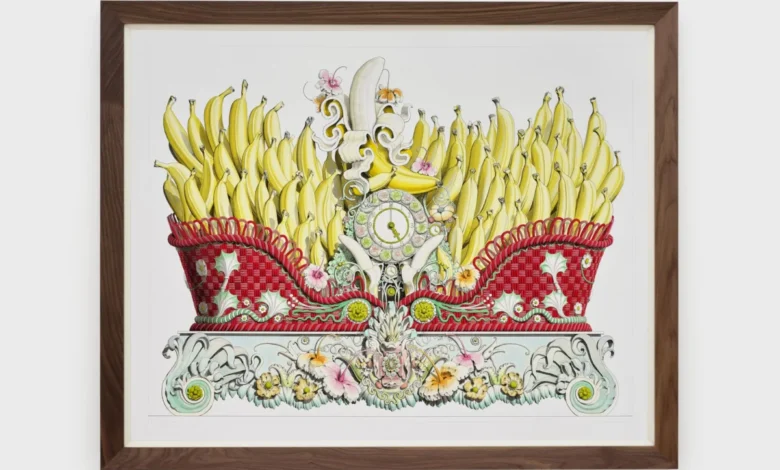
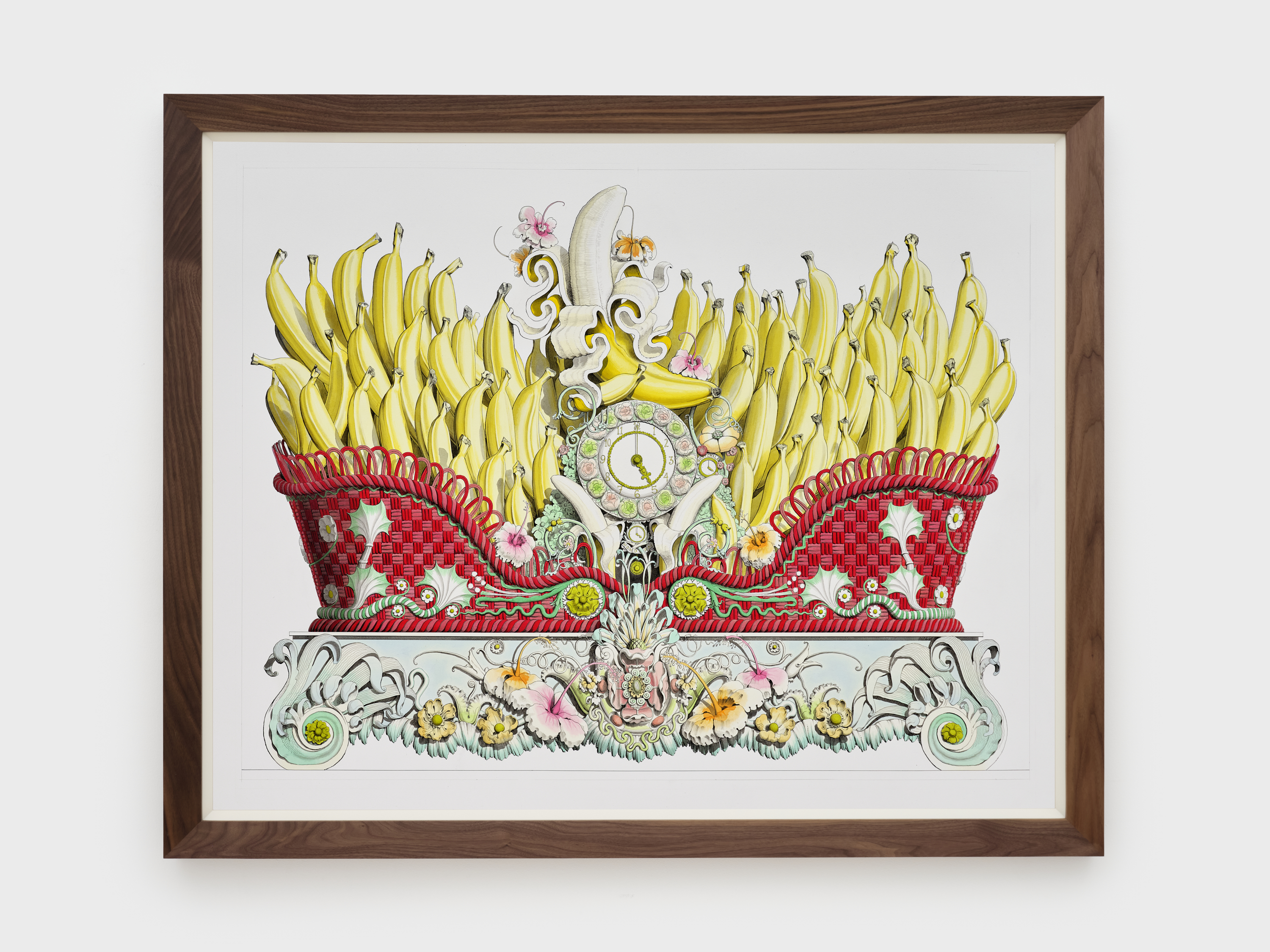
The exhibition features eight distinct drawings, each functioning as a dense repository of historical references. Among the most striking is Banana Basket, which serves as a pointed critique of the United Fruit Company and the subsequent geopolitical coining of the term "banana republic." The drawing features a basket overflowing with yellow fruit, centered around a clock set to Boston time—a geographical tether that highlights the colonial exploitation of Latin American resources for the benefit of Northern corporate entities.
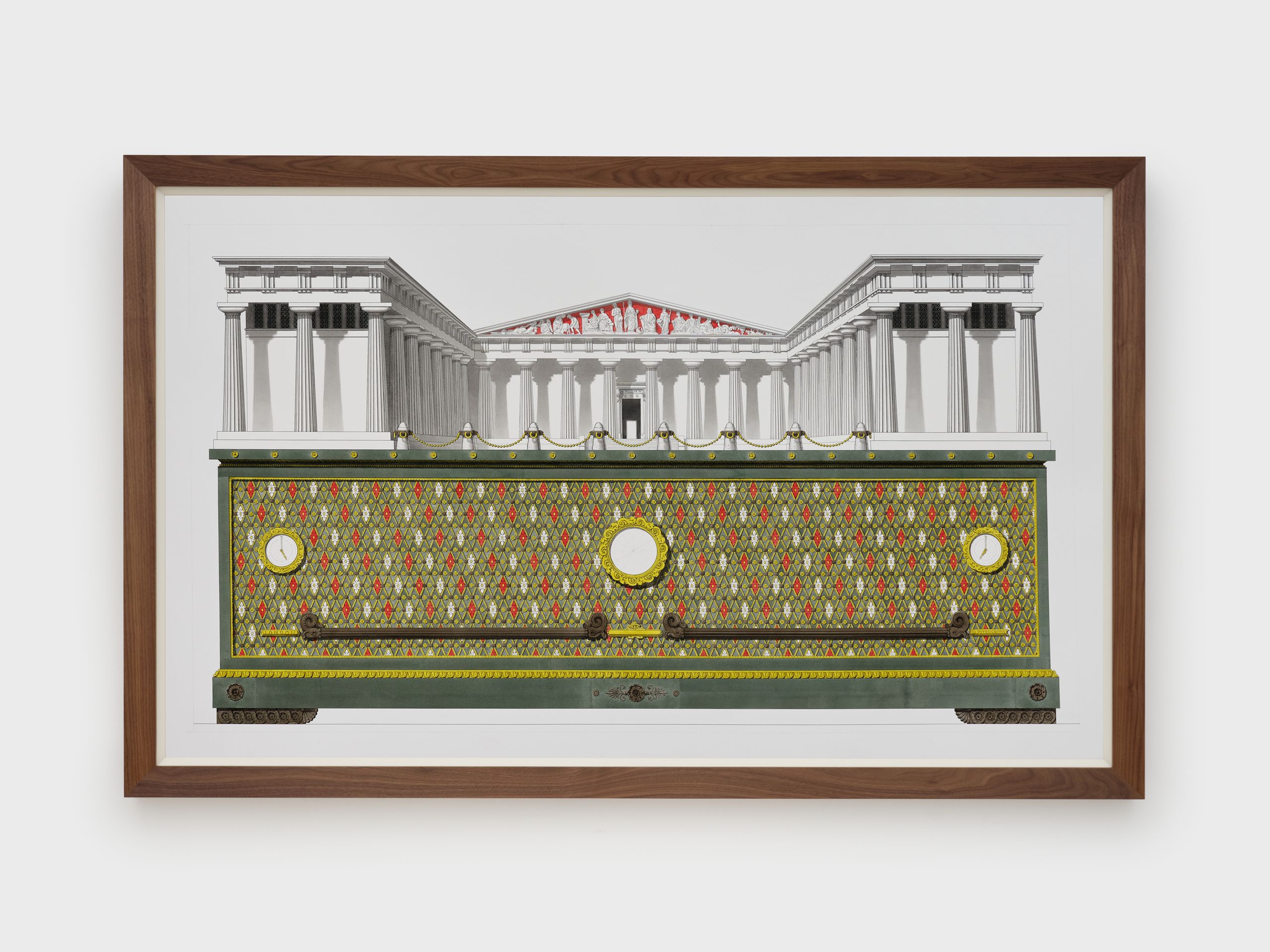
In Classical Triumphant, Bronstein tackles the resurgence of Neoclassicism in contemporary political aesthetics. The work spans nearly two meters in width and depicts a Greek Revival structure perched atop a pedestal of intricate, clock-filled masonry. The inclusion of a blank clock face in the center of the structure acts as a silence in a composition otherwise screaming with architectural symbols of "purity" and "perfection." Bronstein has noted that the use of these classical signifiers is often a calculated, aggressive move in the modern culture war, designed to evoke a sense of historical legitimacy that is often historically inaccurate or revisionist.

Other works in the show, such as those featuring a clock-biting alligator or a lion-riding angel hauling coal, draw inspiration from diverse sources ranging from the brutalist architecture of Lower Manhattan’s AT&T Long Lines building to decorative fireplace ornaments. These juxtapositions are deliberate, designed to force the viewer to confront the "drama" inherent in inanimate objects.
Queer Aesthetics and the Subversion of Power
A recurring theme in Bronstein’s work is the application of a "queer lens" to traditional aesthetic structures. He argues that queer culture possesses a unique capacity to reconcile extremes—for instance, by inflating trivial details into massive dramas or by using humor to subvert traumatic histories.
"Queer culture is good at pulling extremes together," Bronstein stated in a recent interview. "It allows me to worm my way into two different places at the same time." This approach is evident in how he handles the aesthetics of colonial power. Rather than rejecting the ornate, imperial style of the 19th century, he adopts it fully, only to push it to the point of absurdity. By doing so, he exposes the fragility of the power structures that these objects were meant to uphold. His work suggests that if one looks closely enough, the symbols of empire are just as likely to be crumbling as they are to be standing tall.
Implications for the Decorative Arts
The exhibition at Olney Gleason has prompted broader discussions within the art community regarding the role of the decorative arts in contemporary discourse. Historically, the decorative arts have often been sidelined in favor of "fine" arts such as painting or sculpture, viewed as subservient to the functions of daily life. Bronstein’s work argues for a reevaluation of this hierarchy. By elevating the clock to the status of a primary historical text, he forces an engagement with the economic and labor histories embedded in every filigree and gear.
Furthermore, the exhibition highlights the changing role of the gallery space in an era of globalized digital art. The physical, tactile nature of Bronstein’s drawings—the smell of the paper, the precision of the ink, the sheer scale of the 2-meter wide compositions—provides a counter-narrative to the ephemeral, pixelated experience of modern image consumption.
Institutional and Gallery Response
Olney Gleason’s decision to host Bronstein’s work aligns with a growing trend among New York galleries to curate exhibitions that marry aesthetic beauty with rigorous historical critique. While the gallery has maintained an objective stance, the critical reception of the exhibition has been largely focused on the intellectual labor required to decode each piece. Collectors and critics alike have noted that the exhibition demands a high level of viewer participation, rewarding those who take the time to investigate the references to the United Fruit Company, Greek Revival architecture, and the specific 19th-century French clock-making traditions that Bronstein cites.
The exhibition is also a testament to the endurance of the "cabinet of curiosities" model, updated for the 21st century. Bronstein’s collection of 19th-century clocks, which remains a personal reference point for his artistic practice, suggests that the private study of objects remains a vital component of public artistic output.
Conclusion
Pablo Bronstein’s Clocks is a profound meditation on the passage of time and the weight of history. By transforming the clock from a tool of measurement into an instrument of inquiry, the artist has created a series of works that are as visually arresting as they are intellectually demanding. As the exhibition continues through the autumn in Chelsea, it stands as a reminder that the objects we surround ourselves with are never merely decorative; they are the silent witnesses to the rise and fall of empires, the shifts in global trade, and the ever-evolving nature of human power. Whether through the lens of colonial history or the queer subversion of architectural norms, Bronstein successfully turns the act of looking at a clock into an exercise in historical reckoning.