The rapid proliferation of artificial intelligence tools in software development and product design has introduced a paradoxical challenge: while AI can generate functional prototypes and user interfaces in seconds, the consistency, accessibility, and overall quality of these outputs frequently fall short of production standards. This friction typically stems from minor inconsistencies scattered throughout a design system—undocumented design decisions, unpurged hard-coded values, and an over-reliance on large language models (LLMs) to accurately interpret ambiguous mock-ups or complex user flows without explicit guidelines.
To address these systemic bottlenecks, product design and engineering teams are shifting their focus toward foundational context engineering. Drawing from recent insights published by industry practitioners—such as Hardik Pandya of Atlassian and interface experts like Vitaly Friedman—the discourse surrounding AI integration has evolved from raw prompt generation to the deliberate structuring of design systems specifically for machine consumption. By treating design infrastructure as code and implementing rigorous auditing pipelines, organizations are discovering methods to significantly minimize AI drift, reduce errors, and elevate automated prototyping to enterprise standards.
The Core Problem: Ambiguity in AI Prototyping
When product teams first experiment with AI-driven prototyping tools, the initial results often appear promising. However, deeper inspection usually reveals pervasive design debt. An LLM tasked with building a user interface based purely on an image or a loose textual prompt must make thousands of micro-decisions: Which color token applies to this surface? What is the correct spacing scale for this container? Does this interactive component meet modern accessibility standards?
Without explicit constraints, AI models inevitably fall back on statistical probabilities or generic assumptions rather than adhering to an organization’s specific brand guidelines or design tokens. This results in "design drift"—a gradual accumulation of visual and functional discrepancies across generated screens.
Industry analysts note that expecting an LLM to magically interpret design intent from raw visual assets is an inefficient approach. Instead of treating AI as an autonomous designer that requires no oversight, leading teams are discovering that the quality of AI output is directly proportional to the structural integrity of the input data and human guidance provided.

Treating Design Decisions as Infrastructure
A foundational shift required for AI-ready design systems is the elevation of design decisions to the status of core infrastructure. Traditionally, design documentation lives in fragmented wikis, design files, or tribal knowledge shared among team members. When an AI agent attempts to generate a prototype, it rarely has access to the implicit rationale behind these choices.
To bridge this gap, organizations are adopting a practice where every major product decision—ranging from color palettes and typography scales to prioritization matrices and accessibility rules—must be systematically documented in structured formats. This documentation acts as an authoritative source of truth that can be directly parsed and referenced by LLMs during generation workflows.
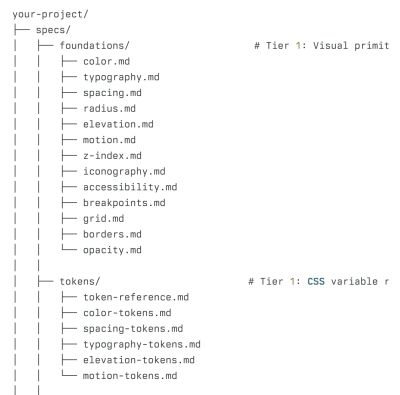
By codifying these decisions into structured Markdown files, teams create a predictable environment where the AI does not have to guess values ad hoc. Instead, the model queries a predefined specification sheet, ensuring that every generated component aligns with established institutional standards.

Implementing the Three-Layer Framework: Specs, Tokens, and Auditing
The practical methodology for making a design system AI-ready relies on a three-tier architecture: structured spec files, a centralized token layer, and automated auditing scripts.
-
Structured Spec Files: These are organized directories containing Markdown documents that outline design principles, spacing guidelines, typography rules, component usage instructions, and accessibility requirements. Because these files are lightweight text documents, they are exceptionally cost-effective for LLMs to ingest and process compared to heavy visual assets. Furthermore, extending existing code via spec-driven instructions consistently yields more reliable results than generating interfaces purely from scratch.
-
The Token Layer: Design tokens serve as the single source of truth for visual design attributes. In an AI-ready system, the token layer ensures that the model can only select variables from a closed, predefined set of named values. This eliminates rogue color codes, arbitrary pixel dimensions, and misaligned margins.
-
Automated Auditing: Even with robust spec files and tokens, AI models occasionally introduce errors. To catch these discrepancies early, engineering teams implement automated audit scripts and plugins. Tools such as FigmaLint allow designers to audit tokens, verify interactive states, check accessibility compliance, detect detached instances, and clean up hard-coded values directly within design environments. In an automated pipeline, these auditing tools can flag non-compliant code or UI elements, feeding corrections back into the workflow before the prototype reaches final review.
Furthermore, as design systems undergo regular iterations and updates, synchronization routines ensure that outdated spec files are automatically deprecated or updated. This prevents AI agents from operating on legacy guidelines, safeguarding the long-term maintainability of generated artifacts.
Broader Industry Implications and Future Outlook
The transition toward AI-ready design systems highlights a broader evolution in the roles of product designers and software engineers. As automated prototyping matures, the value of manual pixel-pushing is diminishing, while the importance of systems thinking, information architecture, and context engineering is rapidly growing.

Organizations that invest time in structuring their design tokens and creating comprehensive spec files are experiencing measurable efficiency gains. They report fewer revision cycles, faster time-to-market for new features, and significantly reduced technical and design debt. Conversely, organizations that neglect documentation find themselves spending more time correcting AI-generated errors than they would have spent building the interfaces manually.
This operational shift also impacts third-party vendor relationships. As companies increasingly rely on external component libraries and multi-vendor design systems, the demand for standardized, machine-readable documentation has intensified. Vendors who fail to provide AI-ready specifications risk becoming obsolete as internal engineering teams prioritize libraries that integrate seamlessly with automated tooling.
Ultimately, artificial intelligence cannot inherently resolve pre-existing organizational disorganization or underlying technical debt. The success of AI-generated prototypes remains tethered to the clarity of human guidance, the precision of design principles, and the rigor of supporting infrastructure. As product teams continue to refine these workflows over the coming years, context engineering will undoubtedly become a foundational competency across the software development lifecycle, redefining how digital products are conceptualized, built, and maintained.