Reclaiming Agency in the Era of Algorithmic Recruitment: A New Paradigm for Job Seekers

The contemporary job search has undergone a radical, technology-driven transformation, shifting from a process of human-to-human networking to a high-stakes, opaque interaction between candidates and automated systems. As corporations increasingly rely on Artificial Intelligence to filter, rank, and evaluate potential employees, the burden of navigating this digital infrastructure has fallen almost exclusively on the applicant. Job seekers are now expected to master complex tools, adapt their professional histories to suit inscrutable algorithms, and often pay for subscription-based third-party platforms just to maintain a competitive footing in a labor market that is theoretically designed to be equitable.
This shift toward automated hiring pipelines has introduced a systemic phenomenon known as AI self-preferencing, a bias that poses significant risks to the diversity and fairness of the modern workplace. A landmark 2025 paper titled “AI Self-preferencing in Algorithmic Hiring” provides empirical evidence of this trend, detailing how large language models (LLMs) demonstrate a distinct tendency to favor resumes that mirror the stylistic and structural output of their own training data. The study reports a self-preference bias ranging between 68% and 88%, suggesting that the current reliance on automated screening tools may be inadvertently penalizing candidates who possess legitimate human-centric writing styles or unique professional backgrounds.
The Rise of the Algorithmic Gatekeeper
To understand the current crisis, one must look at the rapid timeline of AI integration in human resources. Beginning around 2018, enterprise-level Applicant Tracking Systems (ATS) began incorporating basic natural language processing to parse keywords from resumes. By 2023, the integration of generative AI transformed these systems from simple filtering tools into sophisticated evaluators.
According to the 2025 research, when simulated hiring pipelines were tested across 24 distinct occupations, candidates who utilized the same LLM as the evaluator were 23% to 60% more likely to be shortlisted than equally qualified individuals whose resumes were written without AI assistance. This discrepancy creates a paradox: to be considered "qualified" by a machine, a candidate must often rewrite their professional experience to conform to a machine-generated standard, thereby stripping their narrative of its authentic human nuance.
This creates a feedback loop where the AI-filtered pool becomes increasingly homogenous. If an organization uses a specific model to scan applicants, the candidates who happen to use that same model to write their resumes gain an artificial advantage, not because they are better performers, but because they are "speaking the language" of the evaluator. This trend raises profound questions regarding the ethics of hiring and the potential for long-term stagnation in workplace innovation.
The Professional Burden of Digital Compliance
The expectation for candidates to "decode the algorithm" has led to a burgeoning industry of resume-optimization services. Job seekers are forced to treat their professional identities as SEO (Search Engine Optimization) campaigns, prioritizing keyword density over the substance of their accomplishments. This administrative overhead consumes significant time and mental energy—resources that could otherwise be spent on skill development or networking.
For many, the cost of participation in the digital labor market has become prohibitive. Beyond the time investment, there is an increasing trend of "pay-to-play" models, where job seekers pay monthly fees to platforms that promise to "AI-proof" their resumes or guarantee visibility in an ATS. These services are often marketed as essential survival tools, further marginalizing candidates from lower socioeconomic backgrounds who cannot afford to participate in the subscription economy of job hunting.
A Pivot Toward Local-First Solutions
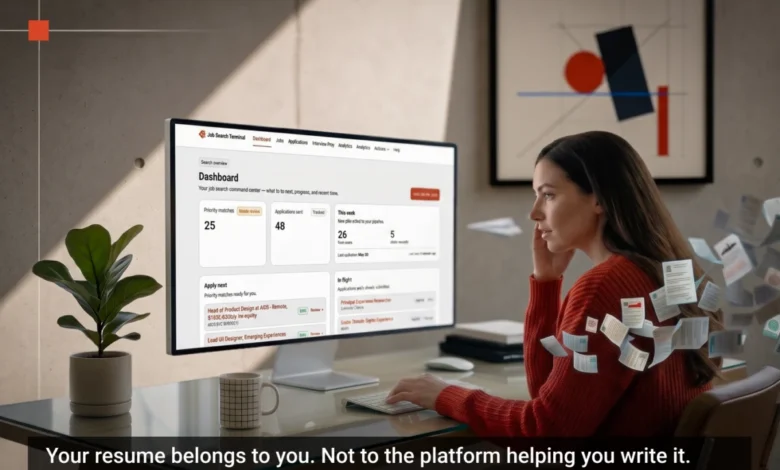
In response to the growing opacity of these systems, developers and technologists are beginning to build alternative infrastructures designed to restore agency to the user. One such initiative is the Job Search Terminal, a project designed to move away from the "black-box" model of commercial hiring platforms. Unlike cloud-based services that harvest candidate data to improve their own models or sell insights to recruiters, this tool operates on a local-first architecture.
The philosophy behind this approach is rooted in the belief that personal professional data—including work history, career objectives, and sensitive contact information—should remain under the exclusive control of the applicant. By running locally on the user’s hardware, the software eliminates the need for cloud databases and recurring subscription fees, providing a transparent interface where the human remains the final arbiter of all outputs.
Technical Implications of Local-First Architecture
The move toward local-first software is not merely a preference for privacy; it is a tactical response to the risks associated with centralized data aggregation. In a typical hiring app, the platform acts as a middleman, collecting information that could potentially be used to profile or track the candidate’s behavior. By contrast, a local-first tool ensures that the AI components—such as those used to parse job descriptions or draft cover letters—operate as extensions of the user’s own machine.
This architecture requires a higher level of user engagement. Users are expected to provide their own API keys, ensuring that they are aware of the costs and the models being utilized. This shift moves the candidate from a passive user of a proprietary service to an active operator of their own productivity stack. While this requires a slightly steeper learning curve, it prevents the candidate from becoming "locked in" to a specific platform, ensuring that their professional data remains portable and private.
The Role of Human Judgment in the Loop
Critics of AI-integrated job searching often argue that delegating resume drafting to technology diminishes the sincerity of the application. However, the proponents of this new wave of tools argue that the technology is intended to act as an assistant, not an autopilot. In a typical workflow using a tool like the Job Search Terminal, the human remains in charge of the following stages:
- Parsing and Contextualization: The AI analyzes the job description to identify core requirements, but the candidate determines which of their past experiences are truly relevant.
- Strategic Drafting: The AI suggests language to improve clarity and readability, but the user must verify the accuracy of every claim.
- Refinement and Editing: The candidate reviews the final output to ensure it reflects their professional voice, preventing the "hallucinations" or sterile, repetitive prose often associated with unedited AI generation.
- Final Submission: The user maintains total control over where and when their information is sent, bypassing the automated "apply-to-all" features that often lead to spam-like behavior.
By limiting the AI’s role to repetitive, data-heavy tasks, candidates can reclaim the time necessary to exercise judgment. They can focus on qualitative aspects of the search, such as researching company culture, preparing for interviews, and determining whether a role aligns with their long-term career trajectory.
Broader Implications for the Labor Market
The emergence of these tools highlights a growing divide between two types of hiring ecosystems: the centralized, algorithmic, and opaque; and the decentralized, human-centric, and transparent. The former seeks to automate the human out of the equation for the sake of efficiency, while the latter seeks to leverage technology to empower the human to remain visible in an increasingly crowded digital landscape.
As the 2025 research suggests, the current state of automated hiring is not sustainable without a serious reevaluation of how algorithms are trained and audited. Until regulatory bodies establish standards for algorithmic fairness, the onus remains on the individual to navigate these systems. The rise of open-source, free, and local-first tools suggests that the tech community is beginning to recognize this, shifting from a focus on "optimizing for the machine" to "optimizing for the candidate."
This transition marks a critical point in the history of employment. If the goal of a job search is to find the right match between an organization and an individual, then transparency must be the baseline. When algorithms prioritize their own output, the match-making process fails. By utilizing tools that prioritize user ownership and human oversight, candidates can begin to challenge the current status quo, ensuring that their professional stories are heard on their own terms, rather than interpreted by an unseen, biased machine.
Looking Ahead: The Future of Transparent Hiring
The development of these tools is, by admission of their creators, a work in progress. The current landscape of job searching is fraught with anxiety, and no single application can resolve the fundamental power imbalance between employers and applicants. However, by providing practical, free, and accessible alternatives, these projects offer a blueprint for a more equitable future.
The ultimate objective of these initiatives is not to "beat" the AI, but to bridge the gap created by it. By focusing on utility, data sovereignty, and human-led decision-making, the next generation of job seekers may be able to regain the agency lost in the rush toward automation. As more individuals adopt these decentralized methods, the pressure on larger platforms to improve their own transparency and fairness may eventually follow. In the meantime, the ability to control one’s own data and maintain the integrity of one’s professional narrative remains the most powerful asset a job seeker can possess.