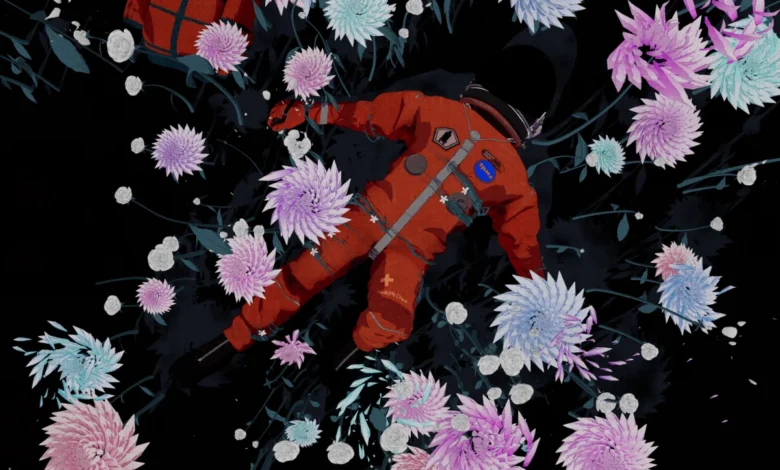
The intersection of classic Japanese artistic traditions and cutting-edge web graphics has yielded a groundbreaking interactive visualization titled Still. Developed by digital artist Ming Jyun Hung, the project represents the third chapter in an ongoing real-time web-based astronaut narrative. Released ahead of the inaugural Three.js Conference in Paris, the digital experience demonstrates the advanced rendering capabilities of modern WebGPU technology, bridging cinematic animation techniques with the aesthetics of classical Japanese folding screens and cell animation.

Background Context of the Project
Ming Jyun Hung’s episodic web series began with Drift, followed by False Earth, a project previously featured on web development platform Codrops. Each successive installment has pushed the technical boundaries of browser-based rendering while advancing a continuous narrative. In Still, the protagonist—an astronaut lost and perpetually journeying through sterile synthetic environments—finally succumbs to exhaustion. Lying down between wakefulness and sleep, the character experiences a surreal convergence where the ground, his protective suit, and surrounding flora melt into a singular, dreamlike continuum.

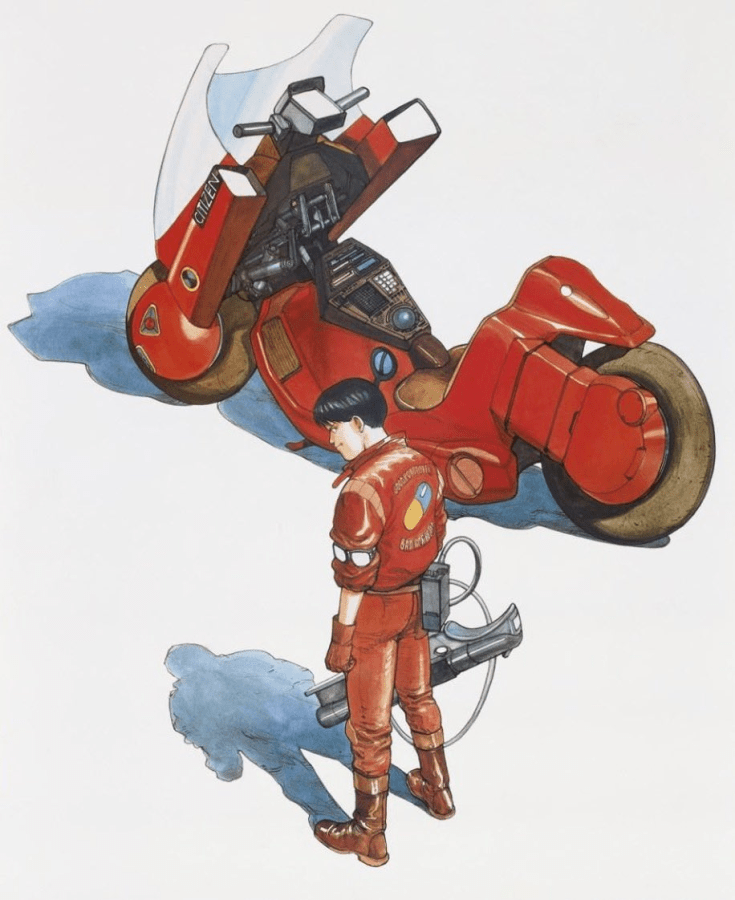
This narrative premise served as the creative springboard for a complex aesthetic experiment. Hung sought to evoke the melancholic atmosphere and bold visual language of Katsuhiro Otomo’s iconic 1988 anime film Akira alongside the composition, textile textures, and subdued palettes of traditional Japanese ink-wash paintings and Edo-period folding screens created by masters like Sakai Hōitsu and Ogata Kenzan. Translating these two-dimensional historical and cinematic references into an interactive, real-time three-dimensional environment required a radical rethinking of traditional shaders and geometry management.
Technical Architecture and Art Direction

Achieving the distinct aesthetic of a woodblock print or hand-painted scroll within a real-time WebGPU environment demanded custom graphics programming. Hung engineered a specialized toon shading pipeline to maintain broad planes of color and clean silhouettes across both character models and procedural vegetation. By evaluating surface normals against light directions and applying controlled thresholds combined with world-space noise, the rendering engine avoids the overly smooth gradients typical of standard 3D graphics, instead favoring the quantized shadows and crisp ink lines characteristic of traditional print media.
For the ground plane, the artist looked directly at promotional poster art from Akira, where characters sit atop flat fields grounded by soft, uneven ink-wash shadows. Utilizing WebGPU shadow maps, Hung inverted and smoothed depth data, running it through procedural noise functions to generate mottled, organic shadows that mimic ink bleeding into porous paper. Furthermore, a procedural silk-weave shader was applied across the entire frame. By algorithmically generating warp and weft coordinates with calculated irregularities and simulated stains, the simulation imparts a tactile fabric quality to the digital canvas.
Procedural Flora and Lifecycle Simulation
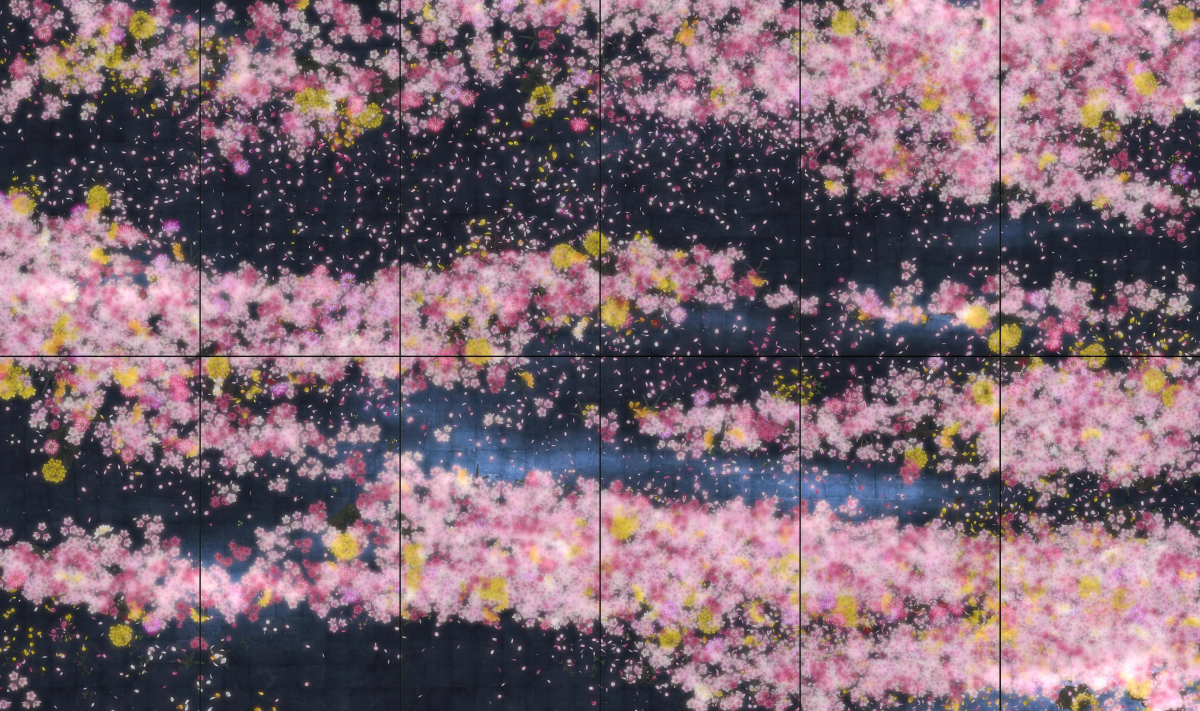
A central challenge in constructing the digital garden was balancing visual density with computational efficiency. Hung developed a comprehensive procedural plant model featuring stems, leaves, flowers, and lifecycle progression rules. Rather than relying on static assets, the system utilizes Vertex Animation Textures (VAT) derived from Blender geometry nodes to orchestrate complex blooming motions and natural petal shedding, drawing thematic inspiration from teamLab’s renowned interactive digital art installation Flowers and People.

The plants adhere to a strict four-stage biological timeline: delay, growth, maintenance, and decay. Individual instances calculate their own age and structural progress, allowing a field of hundreds of distinct plants to exist in varying phases of maturity simultaneously. Stems are constructed dynamically using Catmull-Rom curves that taper and bend based on procedural parameters, while leaves and petals unfold sequentially along calculated attachment points.
Field Distribution and Generative Tendrils

To distribute the flora naturally around the resting astronaut without creating a monotonous digital carpet, Hung implemented a probability-based distribution system. Four primary anchor points corresponding to the character’s anatomy—the hip, hand, boot, and backpack—drive local density maps, which are further distorted by noise to produce organic clustering and deliberate open gaps of bare ground. Bounding Volume Hierarchies (BVH) ensure that plants and procedural tendrils interact accurately with the character’s posed geometry without causing visual clipping.
The tendril system acts as a biological bridge between the synthetic astronaut and the surrounding organic growth. Utilizing surface graphs and geometric raycasting, tendrils emerge from the ground, wind around the suit’s contours, and terminate at specific flower-head anchor points. This interconnected network scales in real-time based on downstream load, revealing itself smoothly through root-to-tip growth algorithms that unify the entire scene into a single living organism.
Implications and Future Outlook
The debut of Still arrives at a pivotal moment for web-based 3D graphics, coinciding with the first global gathering of Three.js developers and creators in Paris. As WebGPU gradually succeeds WebGL as the standard for high-performance browser graphics, projects like Still illustrate the medium’s capacity to handle heavy computational loads—such as instanced mesh rendering, real-time shadow mapping, and complex vertex animations—while maintaining high frame rates.

Industry analysts and developer communities have lauded the project for its successful synthesis of narrative storytelling and advanced shader programming. By proving that historical art styles and cinematic aesthetics can be accurately and dynamically translated into browser-based environments, Hung’s work establishes a new benchmark for artistic expression in web development. As the developer community explores the broader adoption of WebGPU, the techniques demonstrated in Still are expected to influence a new wave of immersive, browser-native artistic experiences, signaling a mature evolution for interactive digital storytelling.