
Guide To Cardiff Castle Wales

Cardiff Castle: A Comprehensive Guide to Wales’ Iconic Historic Landmark
Cardiff Castle, a majestic blend of Norman fortress, Victorian Gothic fantasy, and Roman foundations, stands as a paramount historical and architectural treasure in the heart of Wales’ capital city. This comprehensive guide delves into the multifaceted history, intricate architecture, and compelling attractions of Cardiff Castle, providing essential information for visitors seeking to understand and experience its enduring legacy. From its strategic military origins to its opulent transformation into a romantic aristocratic residence, the castle offers a unique journey through centuries of Welsh and British history, making it an indispensable stop for any discerning traveler. Its central location within Cardiff, easily accessible by public transport and within walking distance of numerous amenities, further enhances its appeal as a must-visit destination.
The origins of Cardiff Castle trace back to the Roman occupation of Britain. Around 75 AD, the Romans established a permanent fort on the very site where the castle now stands. This strategic location, commanding views over the Bristol Channel and controlling a vital river crossing, made it an ideal defensive position. Evidence of this Roman past is still visible today, most notably in the impressive earthwork ramparts, which formed the outer walls of the original fort. Archeological excavations have unearthed a wealth of Roman artifacts, including pottery, coins, and military equipment, offering tangible links to this ancient period. The layout of the Roman fort, a near-perfect square, significantly influenced the subsequent development of the medieval castle that would later be constructed upon its foundations. Visitors can explore these Roman remains, gaining a deeper appreciation for the strategic foresight of the Roman engineers and the enduring military significance of the site. The contrast between the rough, functional earthworks and the later elaborate structures highlights the castle’s evolving history and the changing priorities of its inhabitants over millennia.
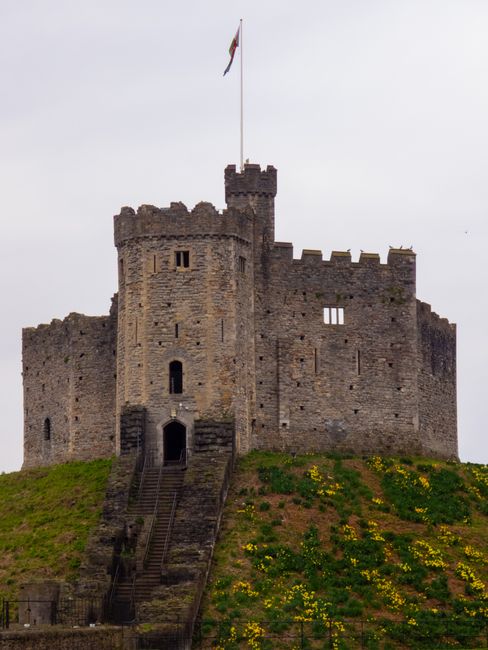
Following the departure of the Romans, the site remained strategically important, and by the late 11th century, after the Norman conquest of England and Wales, a Norman motte-and-bailey castle was erected. This early fortification, built by William the Conqueror’s appointee, Robert Curthose, Duke of Normandy, was a typical Norman military structure designed for dominance and control. The imposing motte, a large artificial mound of earth, supported a wooden keep, offering a commanding defensive position. The bailey, an enclosed courtyard, housed barracks and outbuildings. While much of the original Norman timberwork has long since vanished, the surviving stone walls and the imposing mound serve as a testament to its formidable military purpose. The castle’s primary function during this era was to subdue the local Welsh population and to assert Norman authority in the region. The strategic placement of the Norman castle directly on top of the Roman foundations was a deliberate choice, leveraging existing defensive advantages and symbolizing a transfer of power. Exploring the remnants of the Norman keep allows visitors to visualize the stark, utilitarian nature of these early fortifications.
The medieval period saw Cardiff Castle undergo significant stone upgrades, transforming it from a wooden structure into a more robust stone fortress. The most notable additions were the curtain walls and the iconic South Gatehouse, built in the 12th century. These additions were crucial for strengthening the castle’s defenses against increasingly sophisticated siege tactics. The castle served as the administrative center for the powerful de Bohun family, who held considerable influence in Glamorgan. Over the centuries, various noble families held sway, each leaving their mark on the castle’s architecture and its role in regional governance. The castle’s strategic importance continued throughout the Wars of the Roses and other periods of conflict, with its defenses being tested and, at times, breached. The sheer scale of the medieval stonework, evident in the thick walls and imposing towers, speaks to the immense labor and resources invested in its construction and maintenance. Walking through the grounds, one can easily imagine the bustling activity of a medieval stronghold.
The most dramatic and visually striking transformation of Cardiff Castle occurred in the Victorian era under the ambitious patronage of John Crichton-Stuart, the 3rd Marquess of Bute, and his renowned architect, William Burges. Driven by a fervent passion for Gothic Revival and medieval romance, the Marquess commissioned Burges to undertake an extensive and opulent reconstruction and embellishment of the castle, turning it from a somewhat derelict fortress into a magnificent Victorian Gothic palace. This ambitious project, spanning decades from the 1860s to the 1880s, was not about military utility but about creating a breathtaking residential fantasy. The results are nothing short of spectacular, with lavish interiors adorned with intricate murals, stained glass, gilded ceilings, and richly carved stonework. The iconic Clock Tower, a towering, fantastical structure, became the symbol of this Victorian rebirth, housing exquisitely decorated rooms.
The interior of the castle is where the Victorian vision truly comes alive, offering a journey into a world of opulent fantasy. The Banqueting Hall, with its soaring ceilings and elaborate murals depicting scenes from the life of St. David, the patron saint of Wales, is a testament to Burges’s artistic genius. The Chaucer Room, named after Geoffrey Chaucer, features stunning frescoes inspired by "The Canterbury Tales." Perhaps the most breathtaking is the Arab Room, a Turkish-inspired chamber adorned with intricate mosaics and stained glass, reflecting the Marquess’s fascination with the exotic East. Each room is a meticulously crafted work of art, showcasing the highest levels of craftsmanship and artistic imagination. The attention to detail in every mosaic tile, every carved motif, and every painted panel is astounding. Guided tours are highly recommended to fully appreciate the stories and symbolism embedded within these magnificent interiors.
Beyond the grand interiors, Cardiff Castle offers several distinct attractions that contribute to its visitor experience. The Castle Walls and Roman Remains allow visitors to trace the site’s earliest history, walking along the impressive ramparts and viewing the remnants of the Roman fort. The Norman Keep, though largely ruined, provides a sense of the castle’s early military strength and offers panoramic views of the city. The extensive Castle Grounds and Gardens, though a more recent addition to the reconstructed elements, provide a tranquil escape and a beautiful setting for leisurely strolls. The modern interpretation center, often located within the castle, offers valuable context and historical information through interactive displays and artifacts. These elements collectively create a layered understanding of the castle’s evolution, from its defensive origins to its romantic reimagining.
The Clock Tower, a prominent feature of the Victorian reconstruction, is a masterpiece of Gothic Revival architecture. Its intricate detailing and soaring spire dominate the castle’s skyline. Inside, the apartments within the tower, such as the Heir’s Room and the Duke’s Rooms, are equally spectacular, filled with Burges’s signature decorative style. The Astronomical Clock, a later addition to the Clock Tower, is a marvel of Victorian engineering and artistry, depicting scenes from the life of St. John the Baptist. The sheer ambition of the Victorian project is evident in every facet of the Clock Tower, a monument to the Marquess’s wealth and Burges’s extraordinary design capabilities.
Cardiff Castle hosts a variety of events throughout the year, adding another dimension to its appeal. These can range from historical re-enactments and medieval banquets to open-air concerts and theatrical performances. Checking the castle’s official website for an up-to-date events calendar is highly recommended for visitors planning their trip, as these events can offer a unique and immersive way to experience the historic setting. The castle’s grounds are also an ideal location for family outings, with plenty of space for children to explore and imagine themselves as knights and princesses. The open-air nature of many events means that visitors can enjoy the castle in a different, often more dynamic, way than a standard visit.
For those planning a visit, practical information is essential. Cardiff Castle is centrally located in Cardiff city center, easily accessible by car, bus, and train. Numerous car parks are available nearby, though can be expensive. The nearest train station is Cardiff Central, a short walk from the castle. Various ticket options are available, including general admission, guided tours, and special event tickets. It is advisable to book tickets in advance, especially during peak tourist seasons, to avoid disappointment. The castle is generally open daily, but opening hours can vary seasonally, so checking the official website for the most up-to-date information is crucial. The castle is largely accessible for visitors with mobility issues, although some areas, particularly within the older sections, may present challenges. Information on accessibility can be found on the castle’s website.
Cardiff Castle is more than just a collection of old stones; it is a living testament to the ebb and flow of Welsh history, a canvas of architectural innovation, and a testament to the power of imagination. Its Roman foundations, Norman military might, and Victorian romantic splendor converge to create an unparalleled visitor experience. From the echoes of Roman legions to the opulent fantasies of a Victorian Marquess, the castle offers a captivating journey through time, solidifying its position as one of Wales’ most significant and unforgettable landmarks. A visit to Cardiff Castle is an essential exploration for anyone seeking to understand the rich tapestry of Welsh heritage and architectural grandeur.


