Dash Creative Unveils Rebranded Digital Identity with "Magnetic Commerce" Concept and Innovative Web Technologies

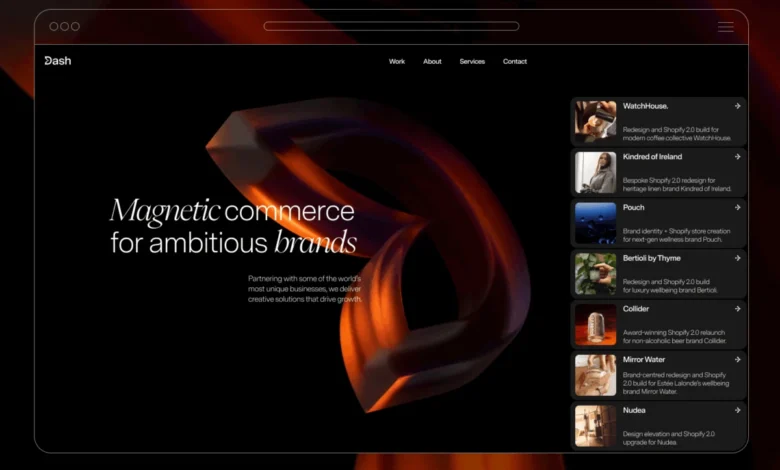
Dash Creative has officially launched its revamped digital presence, centered around a compelling new brand identity dubbed "Magnetic Commerce." This strategic rebranding effort, the culmination of months of dedicated work, aims to redefine how users interact with digital experiences, emphasizing attraction and engagement over passive consumption. The new website showcases a sophisticated integration of design principles and cutting-edge web technologies, including custom WebGL, GSAP, and Webflow, to deliver a seamless and captivating user journey.
The impetus for the rebrand, according to internal discussions, stemmed from a desire to forge a stronger, more distinctive market position. "A rebrand had been on the cards for a while. We wanted something that helped us stand out. Not just look different, but own what we actually do," a spokesperson for Dash Creative stated, reflecting the company’s strategic imperative to articulate its core value proposition more effectively. This led to the conceptualization of "Magnetic Commerce," a philosophy that posits that exceptional digital experiences possess an inherent ability to draw users in, fostering deeper engagement and connection.
This guiding principle is visibly embodied in the agency’s new logo. The emblem features a stylized ‘D’ with a portion seemingly pulled inward by an unseen force, visually representing the concept of magnetic attraction. This core design element served as the foundational inspiration for subsequent design decisions across the entire website. The interactive capabilities of the logo itself further underscore this theme, with a dynamic 3D rendering that reacts to cursor movement, pulling and distorting as a user navigates over it. This immediate, tactile feedback sets the tone for the site’s overall approach to motion and user interaction.
Beyond the logo, the design team drew inspiration from iOS interface conventions, particularly in their treatment of interactive cards and calls-to-action (CTAs). Project cards are designed to evoke the familiarity and tactile quality of iOS notifications, offering a subtly unexpected yet intuitive user experience within the context of a professional website. This deliberate design choice, coupled with a stringent adherence to newly established brand guidelines, proved instrumental in maintaining focus and driving a more cohesive and considered outcome. The brand guidelines acted not as a limitation, but as a catalyst for refined decision-making, ensuring that every element served the overarching "Magnetic Commerce" narrative.
The project timeline spanned several months, with the core conceptualization of "Magnetic Commerce" achieved relatively early in the process. The subsequent phases, focused on content refinement and meticulous animation development, consumed the majority of the allocated time. This phased approach highlights the agency’s commitment to not only innovative design but also to the robust execution of those designs in a production environment.
Technological Backbone: A Synergy of Modern Web Tools
The successful implementation of the new Dash Creative website is a testament to the strategic utilization of a robust technology stack. Figma served as the primary design tool, facilitating systematic organization of type, spacing, and components, while allowing for agile iteration and exploration of design concepts. The defined brand guidelines were meticulously maintained within Figma, ensuring consistency across all visual assets.

For the website’s build, Webflow was the platform of choice. This decision underscores Dash Creative’s confidence in Webflow’s capabilities, utilizing their own website as a live demonstration of its potential for prospective clients. A significant portion of the site’s intricate animations and interactions were natively implemented within Webflow’s animation system, showcasing the platform’s advanced features.
To push the boundaries of what Webflow’s native interactions could achieve, particularly for more nuanced cursor-driven behaviors and complex sequencing, the team leveraged GSAP (GreenSock Animation Platform). This powerful JavaScript animation library enabled the fine-tuning of animations, ensuring a fluid and responsive user experience that met the high standards set by the "Magnetic Commerce" concept.
The most visually striking element, the hero background, was realized through custom WebGL. This advanced graphics technology was essential for creating the dynamic, distortion-driven visual effect that forms the centerpiece of the website’s initial impression. The custom WebGL implementation allowed for unparalleled control over the visual rendering, enabling the unique distortion effect that responds fluidly to user interaction.
The Hero Background: A Deep Dive into Dynamic Distortion
The hero background of the new Dash Creative website presents a sophisticated visual effect that immediately communicates the "Magnetic Commerce" theme. The core concept involved using a fullscreen video as a dynamic texture, which distorts in response to cursor movement. The objective was to create a background that felt alive and responsive without becoming a distraction from the core content.
A key design consideration was to avoid a simplistic ripple effect. Instead, the distortion was engineered to propagate and continue in the direction of cursor movement, mimicking the sensation of a physical surface being pulled or stretched. This nuanced behavior imbues the interaction with a sense of momentum and natural flow, aligning perfectly with the magnetic concept.
Technical Implementation of the Hero Effect

The sophisticated distortion effect is achieved entirely through a fragment shader within a WebGL environment. Rather than layering effects over the video, the shader directly manipulates the video’s texture coordinates. The cursor’s position defines the epicenter of influence, while its movement vector dictates the direction and intensity of the distortion. A damped sine wave function is employed to generate the undulating wave patterns that drive the visual displacement.
The configurable parameters that govern this effect are meticulously defined and passed to the WebGL renderer. These settings include:
- Radius: Controls the overall area of influence for the distortion.
- Amplitude: Determines the maximum intensity of the wave’s displacement.
- Frequency: Dictates the number of waves present within the area of influence.
- Speed: Governs the rate at which the waves animate.
- Carry: Influences how the distortion continues to propagate in the direction of movement.
- Stagger: Adds a subtle offset to the wave pattern, enhancing its organic feel.
- Center Power: Controls the falloff of the distortion effect from the cursor’s center.
- Vertical Damp Power: Limits the vertical spread of the distortion, promoting a more directional wave.
- Motion Gain: Amplifies the effect of cursor movement on the distortion.
- Speed Decay: Manages how quickly the distortion dissipates after cursor movement ceases.
The underlying geometry for this effect is a single fullscreen quad, a fundamental element in rendering 2D textures within a 3D space. The distortion logic is embedded within the fragment shader, which processes each pixel to determine its final color and position.
The shader code incorporates functions like maskFn to define the area and intensity of influence based on cursor proximity and movement. The wave generation itself utilizes a sin function modulated by factors such as cursor position, movement direction (dir), time (uTime), and the predefined settings. This interplay of parameters results in a distortion that is not merely reactive but exhibits a dynamic persistence, carrying momentum before gradually settling back to its quiescent state.
Motion Direction and Persistence: Crafting a Fluid Experience
On the JavaScript side, the interaction state is further refined through smoothing and decay mechanisms before being passed to the shader. This ensures that the visual effect feels more natural and less abrupt. Variables like motionTarget are subjected to a speedDecay factor, and the resulting mappedMotion is capped to maintain visual coherence.
The motion variable itself is updated incrementally, incorporating a momentum factor to create a smooth transition between states. Similarly, the cursor’s direction is smoothed using dirSm and dirTarget, preventing jittery movements. This approach to motion handling is critical for creating an experience that feels continuous and organic, avoiding the mechanical feel of instant responses. The persistence in the effect, where distortion gradually loses momentum, reinforces the "magnetic" metaphor by suggesting a force that lingers and fades rather than abruptly ceasing.

Visual Restraint: Prioritizing Content and Readability
A crucial aspect of the hero background’s design was to enhance the visual experience without detracting from the website’s primary content. The distortion effect is strategically placed behind the typography, adding depth and dynamism to the hero section while ensuring that the text remains exceptionally readable.
The influence field employs a soft falloff, avoiding the harsh, spotlight-like effect that can sometimes accompany cursor-based interactions. Furthermore, vertical damping limits the wave’s spread, guiding the distortion into a more directional shape rather than an even expansion. This controlled visual behavior ensures that the effect enhances, rather than overwhelms, the user’s perception of the content.
The overall composition of the hero section is deliberately minimalist: a clean black background, a full-bleed video serving as the texture source, and the custom WebGL shader applied directly. This minimalist approach allows the interactive distortion to take center stage, serving as a powerful yet unobtrusive introduction to Dash Creative’s capabilities.
Architectural Foundation: A Streamlined WebGL Implementation
The technical architecture underpinning the hero background is designed for efficiency and ease of integration. The structure is relatively straightforward, comprising a hero container, a hidden video element that serves as the texture source, and a WebGL canvas layered atop it.
The WebGL renderer performs a series of five core tasks:

- Initialization: Setting up the WebGL context and essential rendering parameters.
- Texture Upload: Continuously updating the video texture.
- Shader Compilation: Compiling and linking the vertex and fragment shaders.
- Geometry Setup: Configuring the fullscreen quad geometry.
- Render Loop: Executing the rendering process on each animation frame.
This implementation avoids complex scene graphs, post-processing pipelines, or extensive additional geometry. It operates with a single texture, a fullscreen quad, and a pair of shaders, making it exceptionally straightforward to integrate into a live production environment.
Frame uploads to the GPU are optimized to occur only once the video has reached a sufficient ready state. The render loop is kept lightweight by smoothing interaction values over time, the shader’s sole responsibility being UV remapping, the canvas being confined to the hero section, and rendering commencing only after the video is ready. This efficient architecture ensures optimal performance without compromising the visual fidelity of the effect. The underlying approach is also highly reusable, allowing for variations in video sources, distortion profiles, or application to different sections of a website with minimal structural changes.
Reflections and Future Considerations
The successful realization of the "Magnetic Commerce" rebrand and its accompanying website has reinforced Dash Creative’s core philosophy: interaction should serve to amplify the concept, not overshadow it. The technical execution of the dynamic elements, while complex, was achieved efficiently, with the majority of the project’s duration dedicated to refining the user experience, curating content, and ensuring a harmonious interplay between design and functionality.
One of the key takeaways from the project was the importance of knowing when to cease adding complexity. Subtle adjustments to timing, easing, and copy often yielded more significant improvements than the introduction of new effects. This focus on refinement over expansion speaks to a mature design process.
Looking back, Dash Creative identified a significant area for potential improvement: the primary reliance on cursor-based interaction. This approach presents a different user experience on touch devices. The agency acknowledges that a more integrated consideration of touch interactions earlier in the design process would have been beneficial, rather than adapting them as a subsequent step. This reflection highlights a growing industry trend towards designing for a multi-device, multi-interaction future from the outset.
Ultimately, the project serves as a powerful validation of Dash Creative’s innovative approach to digital experiences, demonstrating how a strong conceptual foundation, coupled with sophisticated technological implementation, can result in a brand identity that is both visually arresting and conceptually profound. The "Magnetic Commerce" rebrand positions Dash Creative not just as a digital agency, but as a pioneer in crafting experiences that truly captivate and engage.