Breaking the Autoregressive Barrier: An In-Depth Look at Google DeepMind’s DiffusionGemma

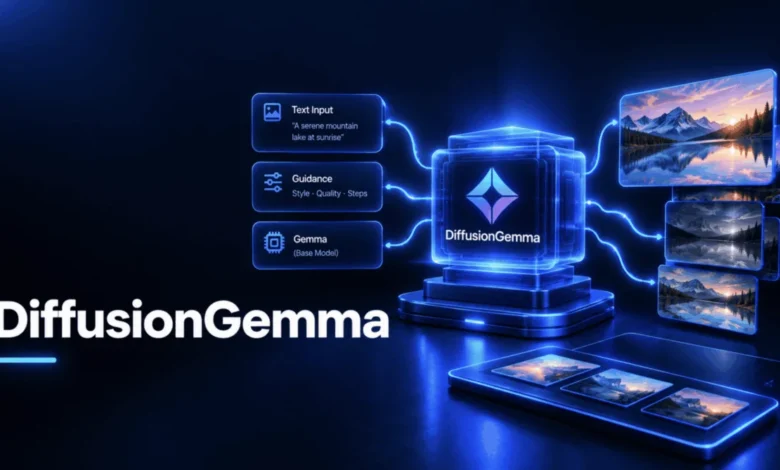
On June 10, 2026, Google DeepMind unveiled DiffusionGemma, a radical departure from the standard architectural paradigms that have governed large language model (LLM) development for the past decade. By applying diffusion-based generative techniques—the same technology that revolutionized text-to-image synthesis in models like Stable Diffusion—to the domain of language, DeepMind has introduced an experimental framework that moves away from the traditional, token-by-token "left-to-right" generation method. This development signals a potential shift in how researchers approach the fundamental bottlenecks of memory bandwidth and sequential latency in AI inference.
The Architectural Shift: From Sequential to Parallel Denoising
Since the inception of the Transformer architecture, the industry standard for text generation has been the autoregressive approach. In this model, the system generates a single token, appends it to the existing context, and feeds the entire sequence back into the model to predict the next token. This process is inherently sequential and creates a massive bottleneck for hardware utilization. Because the model must load its entire weight set into VRAM for every single token produced, the GPU’s high-speed compute cores often sit idle, waiting for the relatively slow memory interface to provide the necessary data.
DiffusionGemma, built upon the foundation of the Gemma 4 26B model, redefines this workflow. Utilizing a Mixture-of-Experts (MoE) design with 26 billion total parameters and 3.8 billion active parameters per token (designated as A4B), the model does not generate text linearly. Instead, it begins with a "canvas" of 256 placeholder tokens represented as Gaussian noise. Through a process of iterative denoising, the model resolves the entire block of text simultaneously. Under this "Uniform State Diffusion" paradigm, tokens with high confidence act as anchors, helping the model resolve ambiguous or low-confidence tokens within the same block.
Chronology and Development Context
The release of DiffusionGemma follows a period of intense experimentation within the AI research community to overcome the "sequential wall." Throughout early 2026, industry observers noted that while LLMs were becoming increasingly capable, their speed was plateauing due to the physical limitations of memory bandwidth.
- Q1 2026: Google DeepMind initiates the "Block-Diffusion" research project, seeking to adapt diffusion probabilistic models—previously reserved for continuous data like images—for discrete language tokens.
- May 2026: Internal benchmarks reveal that the block-based approach significantly improves GPU compute utilization by shifting the primary constraint from memory bandwidth to FLOPs (floating-point operations).
- June 10, 2026: Google officially releases the model under the Apache 2.0 license, positioning it as an experimental research preview.
- Late June 2026: Integration with vLLM is finalized, providing developers with a production-ready pathway to serve the model using standard API formats.
Technical Mechanics: Block-Autoregressive Denoising
For long-form content, the 256-token limitation of the initial canvas would be insufficient. To address this, DiffusionGemma employs "block-autoregressive denoising." Once a 256-token block is resolved and reaches a state of stability, it is committed to the KV (Key-Value) cache. The model then initiates a new 256-token canvas, conditioned on the previously committed history.
This hybrid approach—combining causal, sequential attention for historical context with bidirectional attention within the active canvas—is the model’s most significant innovation. Bidirectional attention allows the model to "look ahead" and "look back" within the current block, enabling a feature previously impossible in LLMs: self-correction. If a token’s confidence level drops during the denoising process, the sampler can effectively "re-noise" that section and attempt a more accurate generation, offering a level of refinement that standard autoregressive models cannot achieve once a token has been finalized.
Deployment and Hardware Requirements
DiffusionGemma is notably demanding, reflecting its status as an experimental, high-performance model. While a full, unquantized version requires an A100 or H100-class enterprise GPU with at least 60GB of VRAM, the quantized builds are optimized for the consumer market. An RTX 4090 or the newer RTX 5090 can comfortably run the 18GB VRAM-budgeted version, making it accessible to individual developers and researchers.
Software requirements are strict. The model relies on transformers version 5.11.0 or higher, as the block-diffusion architecture requires specific model classes—notably DiffusionGemmaForBlockDiffusion—that are absent in earlier library iterations. Developers must also pivot from standard tokenizers to AutoProcessor objects, which handle the model’s multimodal capabilities, including input from text, images, and video.
Industry Implications and Future Outlook
The broader impact of DiffusionGemma lies in its implications for local, single-user inference. In high-concurrency cloud environments, traditional autoregressive models remain highly optimized through batching techniques. However, for a single user running a model locally, DiffusionGemma’s ability to maximize GPU compute is a game-changer. By keeping the compute cores busy with parallel denoising, the model reduces the "dead time" typically associated with waiting for memory-bound token generation.
The introduction of "thinking mode"—a feature where the model explicitly generates a reasoning trace before committing to a final answer—further suggests that Google is moving toward architectures that prioritize reliability and verifiable output. By allowing the model to perform this reasoning in a separate channel, developers can gain insight into the model’s logic, a critical requirement for enterprise-grade AI safety.
Expert Analysis and Limitations
While the potential for increased speed and self-correction is high, the model is not without limitations. As an experimental preview, the model’s performance on highly nuanced, non-English languages or specialized technical domains remains to be tested against the mature, fine-tuned autoregressive leaders.
Furthermore, the complexity of the "diffusion sampler" configuration requires a departure from standard inference tuning. Users must navigate parameters such as the temperature schedule (typically linear from 0.8 to 0.4) and entropy thresholds (0.005 for early stopping). The community consensus, as reflected in early developer documentation, is that DiffusionGemma is not a "drop-in" replacement for GPT-4 or standard Gemini models, but rather a specialized tool for scenarios where hardware utilization and self-correction are the primary engineering goals.
Conclusion: A New Era of Generative Design
DiffusionGemma represents a bold pivot in the trajectory of artificial intelligence. By successfully demonstrating that diffusion processes can be applied to the discrete and structured nature of human language, Google DeepMind has opened a new front in the competition for more efficient, more intelligent, and more reliable AI models. While it currently sits in the experimental category, the architectural lessons learned from DiffusionGemma—particularly regarding block-based parallelism and bidirectional attention—are likely to influence the next generation of large language models, potentially rendering the strict "one-token-at-a-time" rule of the past few years a historical footnote in the evolution of machine intelligence.
As developers continue to integrate the model via vLLM and other inference engines, the industry will watch closely to see if the gains in compute efficiency can be replicated at scale. For now, DiffusionGemma stands as a testament to the fact that when it comes to the architecture of the human mind’s digital surrogate, the most efficient path may not be the one we have been traveling for the last ten years.