Interpretable Text Classification: Probing Scikit-LLM Embedding Spaces to Demystify Large Language Models

The rapid adoption of Large Language Models (LLMs) has fundamentally altered the landscape of natural language processing (NLP). While these models have achieved state-of-the-art performance across a diverse range of classification tasks, their rise has introduced a significant technical hurdle: the "black box" problem. Because LLMs operate via complex, high-dimensional neural architectures, understanding the precise reasoning behind their text representations—and subsequent classifications—remains a persistent challenge for data scientists and AI researchers.
To address this lack of transparency, a new methodological approach has emerged, utilizing probing classifiers, UMAP visualization, and SHAP (SHapley Additive exPlanations) values. By employing these techniques, developers can effectively "peek" inside the latent embedding spaces generated by LLMs, providing a verifiable metric for the quality and semantic depth of the data being fed into downstream applications.
The Evolution of Text Representation and the Need for Interpretability
Historically, text classification relied on feature engineering techniques such as Bag-of-Words (BoW) or TF-IDF, which offered high interpretability but struggled to capture the nuanced semantic relationships between words. The advent of deep learning and, more recently, transformer-based LLMs, shifted the paradigm toward dense, high-dimensional vector representations known as embeddings.
These embeddings capture context, syntax, and sentiment, yet they are notoriously difficult to inspect. When an LLM converts a raw text string into a vector, it maps the input into a mathematical space where proximity indicates semantic similarity. However, the specific features contributing to this positioning are often obscured. As industries—ranging from finance to healthcare—increasingly rely on LLMs for automated document sorting and sentiment analysis, the demand for "Explainable AI" (XAI) has moved from a research curiosity to a regulatory and operational necessity.
A Chronology of Probing Methodologies
The concept of "probing" originated in the linguistic analysis of neural networks. By 2017, researchers began training simple classifiers on top of frozen model representations to determine if specific grammatical features were encoded in hidden layers. This technique has since evolved into a standard diagnostic protocol.
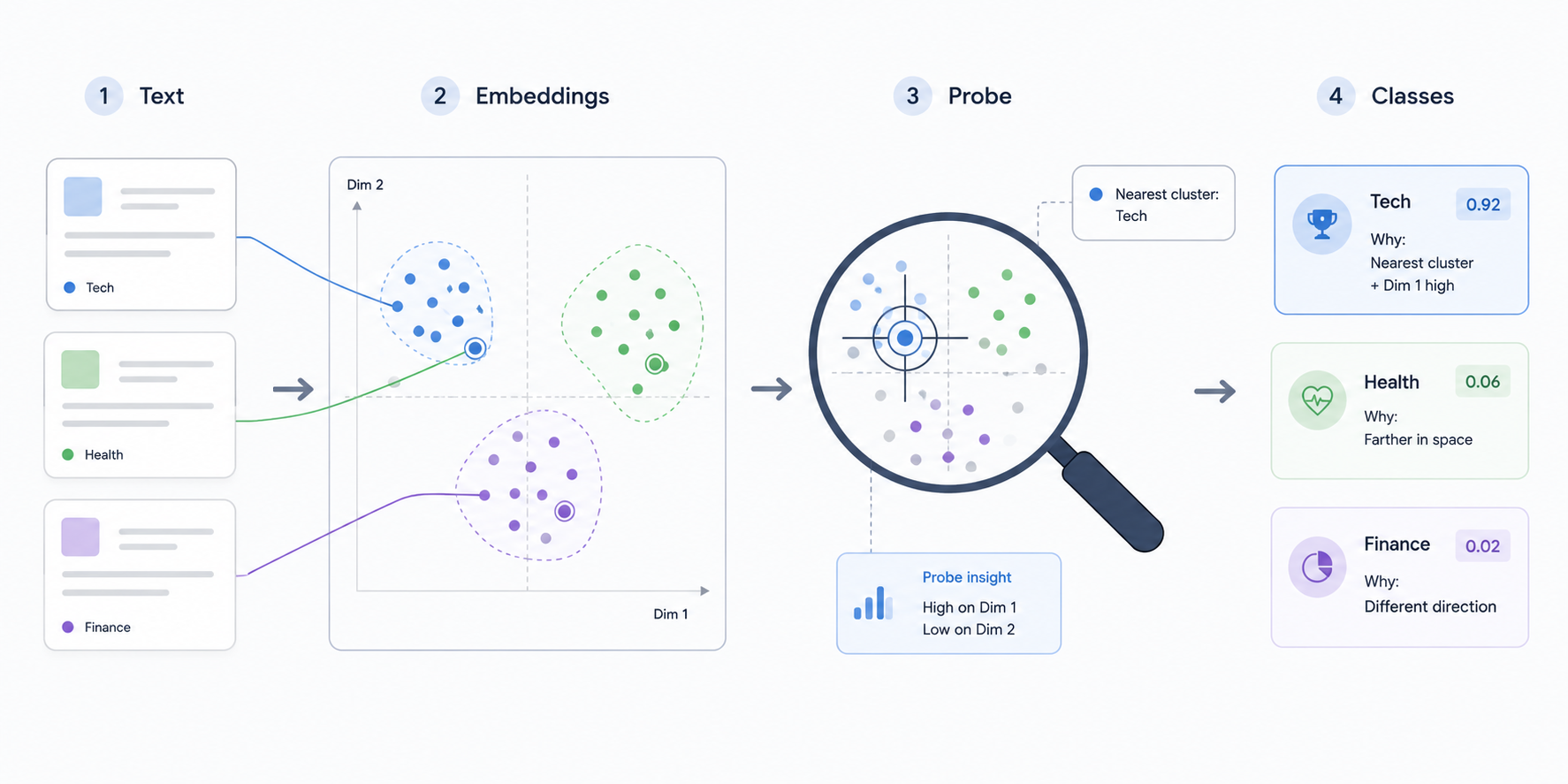
The current workflow, which integrates the Scikit-LLM framework with modern visualization and attribution tools, follows a structured path:
- Model Configuration: Setting up local inference environments using tools like Ollama to ensure data privacy and cost-efficiency.
- Embedding Generation: Utilizing transformer-based models (such as
all-minilm) to convert raw text into numerical vectors. - Probing: Training a linear model, such as Logistic Regression, to determine if the LLM’s embeddings are linearly separable.
- Visualization: Applying UMAP to reduce the dimensions for human-readable scatter plots.
- Attribution: Using SHAP values to assign importance scores to individual latent dimensions.
Technical Implementation and Data Analysis
To demonstrate this, practitioners often utilize the IMDB movie review dataset. By isolating a balanced sample of 1,000 reviews—500 positive and 500 negative—researchers can create a baseline for evaluation. The process of generating embeddings for these samples involves a batch transformation process, often requiring significant computational time depending on the local hardware configuration.
Once the embeddings are generated, the probing classifier acts as a diagnostic lens. If a simple Logistic Regression model achieves high accuracy (e.g., 75–80%) on these embeddings, it confirms that the LLM has effectively compressed the sentiment-rich information into a format that is easily accessible. If the classifier fails, it suggests that the embeddings may be too noisy or that the LLM requires fine-tuning to capture the specific task requirements.
Visualizing the Latent Space with UMAP
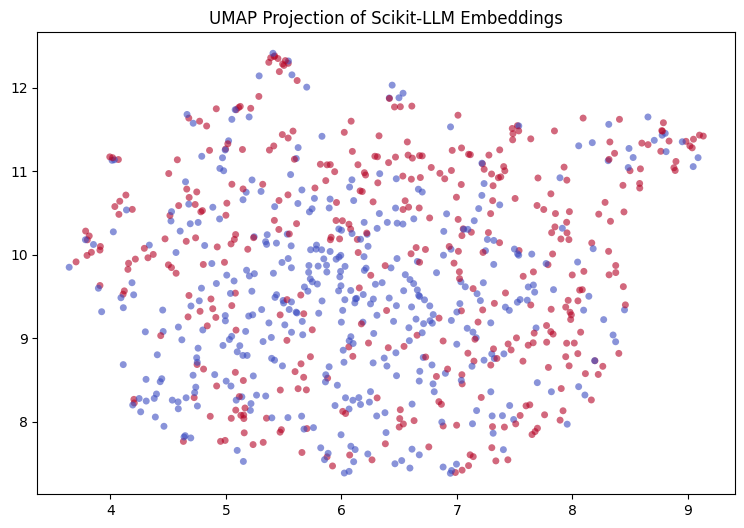
Uniform Manifold Approximation and Projection (UMAP) serves as the bridge between high-dimensional geometry and human intuition. Unlike traditional Principal Component Analysis (PCA), which focuses on linear relationships, UMAP preserves the local and global structure of the data.
In the context of text embeddings, a UMAP projection allows analysts to see "clusters" of sentiment. Even when an LLM is not explicitly trained for a binary sentiment task, its embeddings often show a clear separation between positive and negative polarities in a 2D space. The presence of distinct, albeit overlapping, clusters in a UMAP plot provides visual evidence that the model has internalized the semantic differences between the two classes.
Attribution and Feature Importance: The SHAP Factor
Perhaps the most critical advancement in this pipeline is the use of SHAP values. Based on cooperative game theory, SHAP provides a mathematically sound way to explain the output of any machine learning model. When applied to a probing classifier, SHAP reveals which specific dimensions of the LLM’s embedding vector contribute most significantly to a prediction.
For example, an analysis might reveal that "Dimension 208" and "Dimension 317" are the primary drivers for identifying negative sentiment, while "Dimension 139" strongly correlates with positive sentiment. This level of granularity is transformative. It allows developers to identify if a model is relying on spurious correlations or legitimate semantic patterns, effectively opening the black box of the transformer architecture.
Broader Implications for AI Governance
The integration of these diagnostic tools has profound implications for the future of AI. As organizations face increasing pressure to provide audit trails for algorithmic decisions, the ability to decompose LLM behavior becomes paramount.
"We are moving past the era where ‘it works’ is a sufficient justification for deploying a model," says one senior data science consultant. "Interpretability tools are the new standard for quality assurance. If you cannot explain why your model classified a review as negative, you cannot reliably debug it or ensure its fairness."
Furthermore, this probing approach democratizes AI development. By using libraries like Scikit-LLM, developers can combine the power of state-of-the-art LLMs with the robust, well-understood ecosystem of scikit-learn. This synergy lowers the barrier to entry for building reliable, transparent, and performant AI systems.
Conclusion
The path toward truly trustworthy AI is paved with rigorous introspection. By leveraging probing classifiers to confirm the quality of LLM-generated embeddings, and by utilizing UMAP and SHAP to visualize and attribute decision-making processes, the AI community is gaining the control necessary to manage these powerful systems. As we look toward the next generation of models, these diagnostic frameworks will remain essential tools for any practitioner looking to turn the "black box" of modern deep learning into a transparent, explainable, and accountable asset.
By systematically applying these methods, developers do not just build better classifiers; they build a deeper understanding of the language that defines our digital interactions, ensuring that as models grow in complexity, our capacity to understand them grows in parallel.