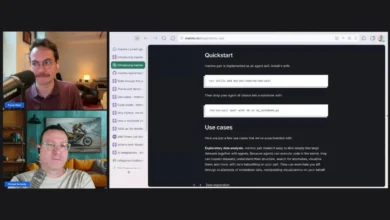
Bridging the Gap Between AI and Interactive Data Science: Marimo Introduces Live In-Memory Agent Access with Marimo Pair

Modern software engineering has been radically transformed by AI-powered coding agents. For traditional backend and full-stack development, workflows have become streamlined: developers scope a feature, direct an agent to edit files on disk, execute test suites, and ship code through standard continuous integration pipelines. However, data science and exploratory data analysis have long resisted this paradigm. Data work is inherently interactive and stateful. Practitioners rarely build software by editing static files in isolation; instead, they load datasets into memory, execute code cells incrementally, inspect live variables, and dynamically determine their next analytical step based on real-time feedback.
Until recently, AI coding assistants were fundamentally walled off from this interactive reality. When tasked with modifying computational notebooks—whether via Jupyter, Google Colab, or reactive platforms—agents were restricted to viewing static file formats on disk, such as raw JSON or Python scripts. They never witnessed the live state, resulting in a persistent disconnect between data science workflows and agentic capabilities. To tear down this barrier, developer tools startup Marimo has officially released Marimo Pair, a groundbreaking agent skill that drops an AI coding agent directly inside a running reactive Python notebook, granting it full, real-time access to every variable currently held in memory.
The Architectural Limitations of Traditional Notebooks for AI
The core friction in applying AI to computational notebooks stems from how legacy tools handle file persistence and execution state. Traditional notebook formats like .ipynb embed extensive historical output data—including long tables, raw text logs, and heavy visualizations—directly into JSON structures. When modern coding agents such as Claude Code, Codex, or custom CLI assistants analyze these files, their context windows become flooded with thousands of lines of irrelevant, and frequently stale, output data.
Furthermore, traditional notebooks lack structural enforcement of execution order. Cells can be run haphazardly, out of sequence, leaving hidden states trapped inside the underlying kernel. When an AI agent attempts to modify a traditional notebook by editing files on disk, it operates blindly, unaware of whether the code it alters reflects the actual runtime conditions of the environment. Consequently, attempting to use autonomous agents for data science tasks frequently led to synchronization errors, broken dependencies, and unrepeatable results.
Marimo was engineered from the ground up to solve these fundamental flaws through a reactive programming model. By tracking explicit variable declarations and dependencies across cells, Marimo guarantees a strict execution order, eliminating hidden states and transforming notebooks into reproducible Python programs rather than chaotic scratchpads. Marimo Pair builds directly upon this robust architectural foundation, shifting the agent’s workspace from the static file system to the dynamic, living kernel.
How Marimo Pair Works
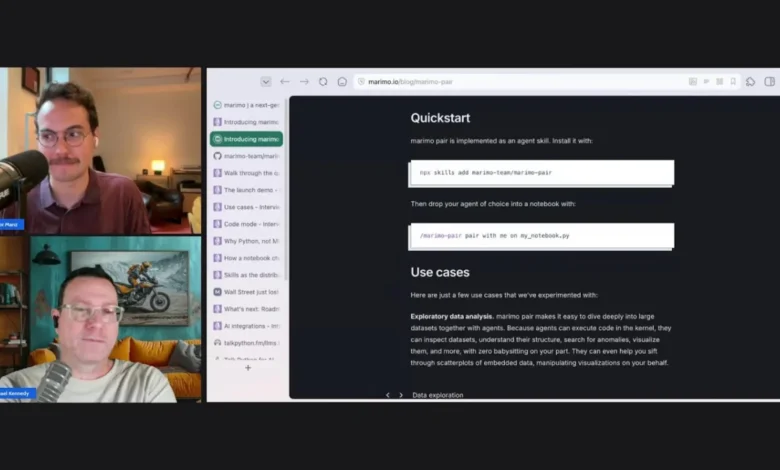
Marimo Pair operates as an agent skill—a modular configuration package compatible with popular AI harnesses including Claude Code and Codex. Once installed via standard package management utilities (such as npm or uv-integrated workflows), the skill equips the agent with a specialized, secure execution interface known within Marimo as "code mode."
Rather than treating the notebook as a static document to be parsed and overwritten, Marimo Pair embeds the agent directly into the active Python kernel. The agent is provided with a concise set of primitives that enable it to execute Python code on demand, inspect live variable types and schemas, query intermediate dataframe states, and programmatically create, edit, or execute cells.
This architecture allows for a profound shift in efficiency and token economics. Instead of reading entire files and processing megabytes of legacy output data, the agent interacts with the notebook programmatically. It can query specific variables, check dataframe schemas, evaluate column types, and verify row counts instantly. If an agent needs to investigate a dataset, it does not need to re-parse raw CSV files from scratch; it simply queries the active dataframe residing in the system’s memory, drastically reducing token overhead and minimizing context pollution.
Industry Implications and Future Outlook
The launch of Marimo Pair arrives at a critical juncture in developer tooling. As the software engineering ecosystem increasingly standardizes around terminal-based AI agents and integrated coding environments, data scientists have frequently felt left behind by tools optimized exclusively for disk-based software development. By bringing the agent into the runtime environment, Marimo is effectively redefining the boundaries of AI-assisted data analysis.
Industry analysts note that this approach circumvents the traditional pitfalls of "vibe coding"—where models generate massive codebases without empirical verification. Because Marimo Pair forces the agent to operate within a reactive, cell-by-cell execution loop, it must validate its outputs, handle exceptions, and confirm state consistency dynamically. This ensures that the final artifact produced at the end of an AI session is not merely a syntactically correct script, but a fully functional, reproducible data science workflow.
As development teams increasingly adopt hybrid workflows combining local development environments, cloud-based sandboxes (such as Marimo’s CoreWeave-backed Molab infrastructure), and multi-agent harnesses, tools that bridge the gap between static code and dynamic runtime states will play an essential role. Marimo Pair demonstrates that the future of data science tooling lies not in building proprietary, closed-ecosystem chat interfaces, but in empowering existing AI agents with deep, native visibility into the running Python state.
Related posts: