365 Data Science Announces Its Annual Free Access Initiative to Bridge the Global AI Skills Gap

Between November 5 and November 20, 2026, the educational technology sector will witness one of its most significant open-access events as 365 Data Science opens its entire platform to the public without charge. Starting at 8:00 a.m. UTC on the first Tuesday of November, users from across the globe will have unrestricted access to over 134 expert-led courses, ranging from foundational data literacy to advanced machine learning and autonomous AI agent engineering. This initiative, now in its sixth year, represents a concerted effort to democratize high-level technical education in an era where data-driven roles are becoming the backbone of the global economy.
A Historical Perspective on the Initiative
The genesis of this program dates back to the early months of the 2020 global pandemic. At a time when traditional education systems faced unprecedented disruption and the workforce began a rapid, involuntary pivot toward remote digital operations, 365 Data Science launched its first "Free Access" window. What began as a temporary measure to support displaced professionals and students looking to upskill during lockdowns has since evolved into a flagship annual event.
By formalizing the initiative as an annual fixture, the organization has consistently aimed to lower the barrier to entry for high-demand technical careers. The success of the project is documented in its year-over-year growth. In 2025 alone, the platform saw an influx of more than 220,000 unique learners from 216 countries. These participants engaged with the material deeply, resulting in 7.2 million minutes of total learning time and the issuance of over 36,000 verified course certificates. This upward trajectory suggests that the demand for structured, accessible, and high-quality data education is not only persistent but accelerating.
The Evolving Landscape of AI Education
The necessity for such an initiative is grounded in the current shifts within the labor market. As generative AI and large language models (LLMs) transition from experimental tools to enterprise-grade infrastructure, the definition of a "data professional" is undergoing a fundamental transformation. According to industry reports from organizations like the World Economic Forum and various labor statistics bureaus, the gap between the skills currently held by the workforce and the skills required for the AI-integrated future is widening.
Ned Krastev, CEO of 365 Data Science, has framed this educational window as a proactive response to these market pressures. "The AI and data landscape is evolving faster than ever, creating extraordinary opportunities for those ready to embrace new technologies," Krastev noted in a recent briefing. The focus for this year’s curriculum is distinct: moving beyond descriptive analytics to emphasize AI engineering, the deployment of intelligent agents, and the architecture of systems capable of autonomous reasoning and planning. By providing free access to these high-level topics, the platform aims to equip a new generation of professionals to navigate the shift from simple data analysis to complex AI orchestration.

Comprehensive Curriculum and Pedagogical Approach
The platform’s offering for the November 2026 window is exhaustive. Learners are granted access to the full library, which is categorized into structured learning paths designed to guide individuals from a novice level to job-ready competency. These paths are mapped against industry standards to ensure that the skills acquired are directly transferable to the workplace.
A key component of the 2026 iteration is the inclusion of enhanced, interactive exercises. In the past, online education often suffered from a lack of "applied" experience, where students could grasp theoretical concepts but struggled to translate them into practical output. 365 Data Science has attempted to mitigate this by integrating real-world project simulations. These exercises mirror actual professional scenarios, requiring learners to clean datasets, build predictive models, and debug code under conditions that approximate a live enterprise environment. This hands-on approach is critical for learners who intend to transition from academic study to professional roles, as it provides them with a portfolio of experience to present to prospective employers.
Professional Certification as a Catalyst for Employment
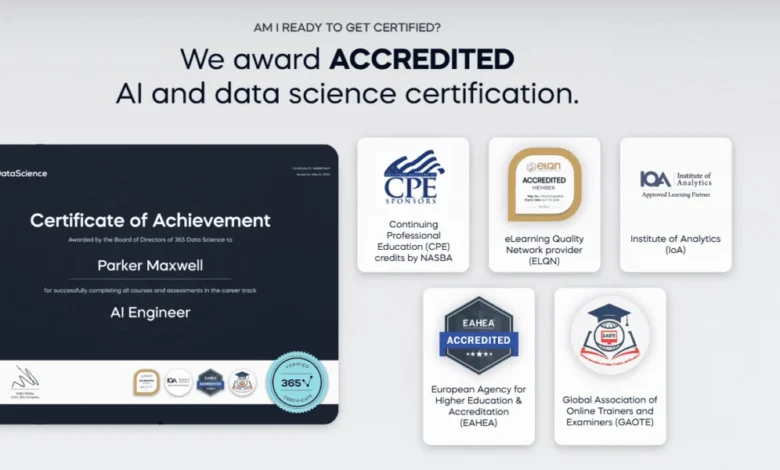
One of the primary challenges in the "upskilling" movement is the lack of verifiable proof of competence. In a hiring market where technical recruiters receive thousands of applications, industry-recognized certifications serve as a vital filter. The 365 Data Science Free Access Initiative addresses this by allowing participants to earn these credentials at no cost during the designated three-week period.
These certificates are designed to provide tangible evidence of proficiency in areas such as Python programming, SQL, data visualization, machine learning, and AI system design. By offering these credentials for free, the initiative effectively removes the financial barrier that often prevents talented individuals in lower-income regions or underrepresented groups from obtaining the validation necessary to secure a career change. This serves as a socioeconomic equalizer, enabling a global cohort of learners to compete for remote and local roles in the digital economy on a more level playing field.
Broader Economic and Industrial Implications
The implications of such a widespread educational initiative extend beyond the individual learner. Industry analysts have noted that the rapid pace of AI adoption often outstrips the ability of traditional universities to update their curricula. Consequently, online platforms like 365 Data Science have become essential "gap fillers" in the global talent pipeline.
By providing access to thousands of professionals simultaneously, the platform helps to standardize the baseline knowledge for entry-level data roles. When a large volume of professionals attains a common standard of competency, it can lead to increased productivity and innovation within the industries that hire them. Furthermore, the global distribution of the platform’s users—covering 216 countries—implies that this knowledge transfer is helping to build localized AI capabilities in emerging markets, potentially reducing the geographic concentration of tech expertise.

Strategic Planning for the November Window
For those intending to participate in the November 5–20, 2026, initiative, success requires a strategic approach. Given the sheer volume of content available, the platform recommends that users identify their career goals early—whether that be in data analysis, data science, or specialized AI engineering—and focus on the specific learning path associated with that role.
The 15-day window is intended to be a concentrated period of study. Unlike subscription-based models, this is a time-limited event that encourages high-intensity learning. The platform’s infrastructure is prepared to handle the expected surge in traffic, ensuring that the 2026 iteration maintains the stability and accessibility that characterized the record-breaking 2025 edition.
Conclusion
The decision by 365 Data Science to continue its Free Access Initiative underscores a long-term commitment to human capital development. As artificial intelligence continues to reshape the fundamental architecture of business, industry, and governance, the ability to understand and build these systems will be a defining factor in professional success.
The upcoming event provides a unique, risk-free opportunity for anyone with an internet connection to gain a foothold in the data-driven future. Whether a student is looking to complement their degree with practical skills, or a mid-career professional is seeking to pivot into a technical field, the resources provided between November 5 and November 20 represent a significant investment in personal and professional growth. As the digital economy continues its relentless evolution, initiatives that facilitate the broad dissemination of knowledge remain essential tools for ensuring that the future of work is both inclusive and technically adept. Prospective learners are encouraged to visit the 365 Data Science website to prepare for the start of the initiative and map out their path toward professional certification.