Large language models (LLMs) are fundamentally designed to predict the most statistically probable next token in a sequence. While this architecture powers their remarkable fluency, it creates a significant bottleneck when faced with complex, multi-stage reasoning tasks. By default, these models prioritize immediate output, often leaping from a prompt to a conclusion without sufficient internal deliberation. In professional environments where accuracy is paramount, this tendency toward "fast thinking" can lead to plausible-sounding but factually incorrect outputs—a phenomenon often described as hallucination. To bridge this gap, developers have adopted two primary frameworks: Chain of Thought (CoT) and Tree of Thoughts (ToT). These methodologies are not merely prompt engineering tricks; they are essential structural adaptations that transform how AI agents plan, execute, and self-correct.
The Evolution of Reasoning Frameworks: A Brief Chronology
The trajectory of AI reasoning began in earnest around 2022, when researchers realized that simply increasing parameter counts did not solve the problem of logical fallacies. In January 2022, Wei et al. introduced the seminal "Chain of Thought Prompting Elicits Reasoning in Large Language Models" paper. This introduced the industry to the "Let’s think step by step" prompt, proving that forcing a model to decompose a problem into linear segments significantly boosted performance in arithmetic and symbolic logic tasks.
By early 2023, however, the limitations of linear reasoning became apparent. Complex problems—such as writing high-quality code with strict constraints or developing multifaceted business strategies—often hit "dead ends" in a linear chain. If the first step was flawed, the entire subsequent logic chain collapsed. This realization led to the emergence of the Tree of Thoughts framework, formally proposed by researchers at Princeton University and Google DeepMind in May 2023. By allowing for branching paths, backtracking, and state evaluation, ToT represented a paradigm shift toward human-like deliberation.
Comparing Methodologies: Linear vs. Branching Architectures
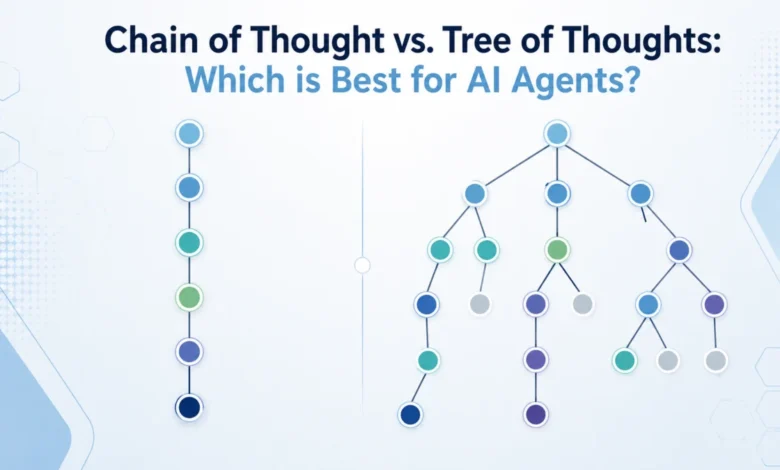
Chain of Thought operates on a linear trajectory. It functions as a single, continuous stream of consciousness. When an AI agent utilizes CoT, it constructs an explicit narrative of its logic. This is highly effective for tasks where the path to the solution is deterministic, such as standard mathematical proofs or factual information retrieval. The primary advantage of CoT is its efficiency. Because it maintains a single path, it requires minimal computational overhead, low latency, and fewer tokens, making it the standard choice for high-frequency, routine agentic tasks.
Conversely, Tree of Thoughts adopts a non-linear, tree-based search strategy. In this model, an AI agent treats a problem as a search space. At any given juncture, the model may propose multiple "branches"—distinct potential next steps. An evaluator module then assesses these branches, pruning those that appear inefficient or logically unsound. If a specific branch leads to a logical impasse, the system possesses the architectural capability to backtrack, discarding the failed path and exploring an alternative branch. This method mirrors human problem-solving, where one considers several options before committing to a final action.
Quantitative Analysis and Performance Data
The shift from linear to branching logic has yielded measurable performance gains in benchmark testing. In the Game of 24, a mathematical puzzle that requires complex planning, standard LLMs utilizing CoT typically achieve success rates below 40%. In contrast, models utilizing the Tree of Thoughts framework have demonstrated success rates as high as 74% to 90% in similar controlled environments.
However, these gains come at a steep price. Empirical data from operational environments indicate that ToT can be between 10 to 50 times more expensive than standard CoT. This disparity arises because ToT requires multiple model calls per step to generate and evaluate candidate branches. For an agent tasked with executing a single, high-stakes decision, this is acceptable; for an agent processing thousands of customer queries per hour, the latency and cost-per-request make pure ToT unsustainable.
Integration in AI Agent Systems
Modern AI agents—software entities capable of using tools like web browsers, calculators, and API interfaces—are increasingly employing a hybrid approach to reasoning. Industry practitioners note that agentic architecture now often features a "dynamic dispatch" system.
In this model, the agent assesses the incoming query’s complexity. If the request is straightforward (e.g., "Summarize this email"), the agent defaults to CoT. If the request involves complex, multi-variable planning (e.g., "Build a deployment script that satisfies these four security constraints and tests for edge-case errors"), the system elevates the task to a ToT framework. This tiered approach allows organizations to balance the requirement for high-accuracy, reliable reasoning with the harsh realities of computational budget and response time.
Expert Perspectives and Technical Implications
Industry experts argue that the choice between these frameworks is fundamentally an exercise in risk management. Dr. Aris Vlahos, a senior researcher in machine learning, notes: "The industry is moving away from the idea that one prompt-strategy fits all. We are seeing a move toward ‘agentic workflows’ where the reasoning layer is modular. The goal is to provide the model with enough ‘workspace’ to fail and recover without exposing the end-user to the overhead of a full tree search unless the task actually demands it."
From a technical standpoint, the implication is clear: the future of AI agents lies in their ability to govern their own reasoning resources. An agent that cannot "think" before acting is dangerous in high-stakes environments, such as medical diagnostics or automated financial trading. Conversely, an agent that over-thinks every trivial request is commercially unviable.
Broader Impacts on the AI Ecosystem
The adoption of these frameworks has broader implications for how we interact with software. As AI agents move from being passive chatbots to active participants in workflows, their ability to self-correct will become the primary differentiator between reliable tools and unreliable toys.
- Increased Reliability: By utilizing ToT, agents can perform "sanity checks" on their own code or plans, reducing the rate of catastrophic failures.
- Computational Costs: As models become more capable, the focus will shift from "how to make models smarter" to "how to make smarter reasoning cheaper." We expect to see specialized, smaller "reasoning-only" models that excel at tree-based search, potentially reducing the cost of ToT significantly.
- Transparency and Auditing: Because both CoT and ToT force the model to output its intermediate steps, they provide a much-needed "audit trail." Organizations can review the reasoning steps of an agent that made a mistake, allowing for more precise fine-tuning and corrective feedback loops.
Conclusion
The distinction between Chain of Thought and Tree of Thoughts is a critical component of modern AI architecture. While CoT offers a fast, linear path suitable for the vast majority of routine tasks, ToT provides the essential depth required for complex, high-stakes problem-solving. As AI agents become more deeply integrated into the fabric of enterprise operations, the ability to selectively apply these frameworks will define the difference between systems that are merely impressive and systems that are genuinely dependable. For developers and business leaders alike, the challenge lies not in choosing one over the other, but in mastering the orchestration of both to build systems that are as efficient as they are intelligent.
Related posts: