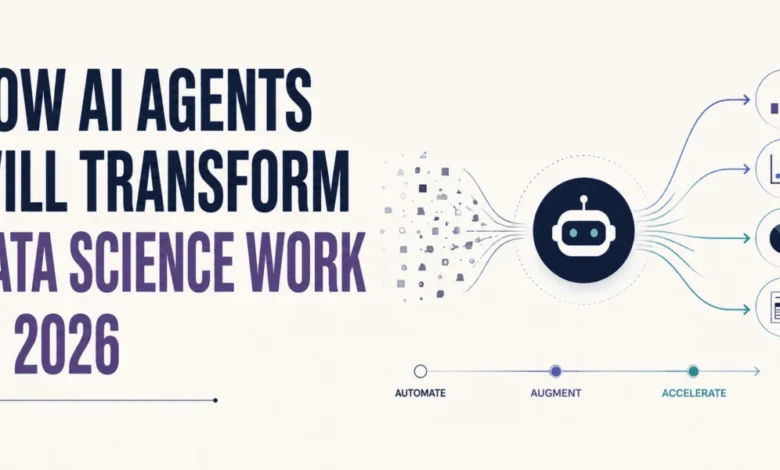
The dynamic world of data science, characterized by rapid technological advancements and an ever-increasing demand for actionable insights, is poised for a significant transformation by 2026 with the pervasive integration of Artificial Intelligence (AI) agents. This shift promises to redefine workflows, enhance productivity, and elevate the strategic role of human data scientists, rather than diminishing it. The landscape, which currently demands mastery of complex programming languages like Python, intricate cloud computing architectures, and a constantly evolving array of machine learning models, is set to become more accessible and powerful through intelligent automation.
For professionals entering the field, the sheer volume of information and tools can often feel overwhelming. However, a nascent trend, the rise of AI agents, is rapidly gaining momentum, not to complicate matters further, but to fundamentally augment human capabilities. These aren’t the AI systems of science fiction, poised to usurp human roles; instead, they are emerging as indispensable digital colleagues designed to shoulder the laborious, repetitive, and technically intricate aspects of data science. This allows human experts to dedicate their invaluable cognitive resources to high-level strategy, complex problem-solving, and the nuanced interpretation that machines, by their very nature, cannot fully replicate.
The Evolution of AI in Data Science: A Foundation for Agents
The journey towards AI agents in data science is built upon decades of innovation. Early statistical modeling and expert systems laid the groundwork, followed by the explosion of machine learning (ML) in the 2000s, driven by increased computational power and vast datasets. The 2010s saw the rise of deep learning, propelled by advancements in neural networks and specialized hardware, leading to breakthroughs in areas like computer vision and natural language processing. The early 2020s marked the era of large language models (LLMs), such as OpenAI’s GPT series, which demonstrated unprecedented capabilities in understanding, generating, and manipulating human language and code. These LLMs, while powerful, often act as passive tools, awaiting explicit instructions. The concept of an "AI agent" represents the next logical leap: an LLM or similar AI core empowered with autonomy, memory, and the ability to interact with its environment to achieve a predefined goal.
Historically, data science projects have been notoriously time-consuming, with a significant portion of effort dedicated to data preparation, often cited as 60-80% of a project’s lifecycle. This "data wrangling" involves tasks like cleaning, transforming, and integrating disparate datasets before any meaningful analysis can begin. This bottleneck has long been a barrier to faster innovation and wider adoption of data-driven strategies. The advent of AI agents, particularly by 2026, is specifically poised to address these inefficiencies, fundamentally reshaping the data science workflow from a largely manual, iterative process to a more automated, goal-oriented one.
Defining the AI Agent: Beyond the Passive Tool
To truly grasp the future impact, it is crucial to clarify what constitutes an "AI agent." Unlike a standard AI tool, such as a large language model (LLM), which primarily functions as a reactive information processor—you ask a question, it provides an answer—an AI agent embodies a more proactive and autonomous paradigm. It is an intelligent system designed not just to respond, but to act.
An AI agent is characterized by several key attributes:
- Autonomy: The ability to operate independently for extended periods, making decisions without constant human intervention.
- Perception: It can observe its environment, interpret data, and understand context, much like a human analyst. This includes reading datasets, understanding error messages, and interpreting documentation.
- Reasoning and Planning: It can formulate plans, break down complex goals into smaller sub-tasks, and strategize how to achieve them.
- Action: It can execute commands, interact with software tools (like Python environments, databases, or cloud platforms), and modify its environment. This includes writing and running code, deploying models, and generating reports.
- Memory and Learning: It can retain information from past interactions and experiences, learning from successes and failures to improve its performance over time. This includes remembering previous analytical steps, model configurations, and observed data patterns.
- Goal-Oriented Behavior: It is designed to achieve specific objectives, such as "improve model accuracy," "identify key features," or "automate data pipeline."
In the practical context of data science, an agent is far more than a code snippet generator. One could task an agent with an objective like "develop a highly accurate customer churn prediction model and deploy it to a staging environment." The agent would then autonomously proceed to: access and clean relevant data, explore various machine learning algorithms, engineer and select optimal features, perform hyperparameter tuning, validate model performance against defined metrics, generate comprehensive documentation, and even integrate the model into existing MLOps pipelines—all while reporting its progress and findings to the human data scientist. This level of proactive engagement and multi-step problem-solving fundamentally distinguishes an AI agent from previous AI tools.
Dispelling the Myth: AI Agents as Augmenters, Not Replacements
The question of whether AI will replace data scientists is a perennial concern, especially for those new to the field. The resounding answer, particularly concerning AI agents in 2026, remains a firm "no." In fact, the prevailing sentiment among industry analysts and researchers is that AI agents will significantly elevate the value and impact of human data scientists. This pattern echoes historical technological shifts: spreadsheets did not render accountants obsolete; rather, they empowered them to move beyond manual calculations to focus on strategic financial analysis. Similarly, AI agents are set to automate the "manual labor" of data science, liberating human talent for higher-order tasks.
The "manual labor" that AI agents will increasingly undertake includes:
- Data Acquisition and Cleaning: Automating the retrieval of data from diverse sources, handling missing values, detecting and correcting outliers, standardizing formats, and performing complex feature engineering.
- Exploratory Data Analysis (EDA): Generating comprehensive statistical summaries, visualizing distributions, identifying correlations, and highlighting potential issues or insights within datasets.
- Model Selection and Training: Recommending and evaluating various machine learning algorithms based on data characteristics and problem type, automating hyperparameter tuning, and executing model training processes.
- Model Evaluation and Validation: Running extensive cross-validation routines, calculating performance metrics, identifying potential biases, and even performing adversarial testing.
- Code Generation and Debugging: Writing production-ready code for various tasks, identifying and fixing syntax or logical errors, and suggesting optimizations.
- Documentation and Reporting: Automatically generating detailed reports on methodologies, model performance, and insights, ensuring reproducibility and clarity.
- MLOps Integration: Assisting with model deployment, monitoring, version control, and continuous integration/continuous delivery (CI/CD) pipelines.
The role of the human data scientist, therefore, transforms from a "doer of tasks" to a "director of strategy." Human experts will define the overarching business problem, provide essential domain context, interpret ambiguous results, and crucially, evaluate the ethical implications and societal impact of the AI-driven solutions. The data science job market in 2026 will increasingly prize professionals who possess not only technical acumen but also the ability to effectively manage, collaborate with, and critically oversee these sophisticated AI agents, blending technical oversight with profound business competence and ethical reasoning.
The Trend in 2026: Shifting to Agentic Workflows
If 2023 was the year generative AI began writing compelling text, and 2024 saw its capabilities extend to generating sophisticated code, then 2026 is unequivocally the year of the "agentic workflow." This represents a paradigm shift where AI moves beyond mere generation to autonomous execution and goal-driven orchestration.
Consider a typical data science project today, where a data scientist might spend 80% of their time on data wrangling. In 2026, this tedious process will be largely delegated. A data scientist could simply provide a messy dataset to an AI agent with a high-level instruction: "Clean this data according to standard practices for time-series analysis, impute missing values using appropriate methods, and document every step taken for reproducibility." The agent would then independently perform these complex tasks, providing a clean, ready-to-use dataset and a transparent log of its actions.
This fundamental shift dramatically accelerates the pace of work. A trendsetting data science workflow in 2026 might look like this:
- Problem Definition and Agent Tasking (Human-led): The human data scientist defines the business problem (e.g., "Reduce customer churn by 10% in the next quarter"), identifies relevant data sources, and tasks an AI agent with a high-level objective. For example, "Develop a predictive model for customer churn, identify key contributing factors, and suggest actionable retention strategies."
- Autonomous Data Discovery and Preparation (Agent-led): The AI agent independently connects to various data sources (databases, APIs, cloud storage), performs initial data profiling, cleans the data, handles missing values and outliers, and engineers relevant features, all while documenting its process. It might even identify and request additional data if needed.
- Model Exploration and Development (Agent-led with Human Oversight): The agent explores a spectrum of machine learning algorithms, trains multiple models, performs hyperparameter tuning, and evaluates them against predefined metrics (e.g., F1-score, AUC). It presents the top-performing models along with their rationale, performance metrics, and potential limitations.
- Strategic Analysis and Iteration (Human-led): The human data scientist reviews the agent’s findings, interprets the model’s insights in the context of business objectives, and might ask the agent to refine its approach, explore alternative hypotheses, or investigate specific feature impacts. This is where human intuition, domain expertise, and ethical considerations are paramount.
- Deployment and Monitoring (Agent-assisted): Once a model is approved, the agent assists in deploying it to production, setting up monitoring dashboards for performance drift and data quality, and establishing automated retraining pipelines.
- Reporting and Communication (Agent-assisted): The agent automatically generates comprehensive reports, presentations, and interactive dashboards summarizing the project’s findings, methodologies, and business impact, tailoring them for different stakeholders.
This workflow represents the logical evolution of existing tools like AutoML and the conversational capabilities of advanced LLMs, integrating them into a cohesive, autonomous, and goal-driven system. It moves beyond isolated tasks to orchestrate entire analytical pipelines.
AI in 2026: A Collaborative and Educational Partner
By 2026, AI will transcend its role as a mere tool to become a genuine collaborative partner in the data science process. For a novice data scientist, this is profoundly good news. Instead of spending hours debugging a cryptic syntax error, an AI agent can not only identify and fix the error but also provide a clear, pedagogical explanation of why it occurred and how to prevent it in the future, thus accelerating the learning curve. Rather than feeling overwhelmed by the myriad of algorithms and statistical tests, a reasoning AI partner can suggest the most appropriate paths forward based on the unique characteristics of the data and the specific problem at hand, acting as an intelligent mentor.
This shift fundamentally alters the competencies required for success in data science. While a foundational understanding of statistics, mathematics, and machine learning principles remains indispensable, the most critical skills will pivot towards:
- Prompt Engineering and Agent Orchestration: The ability to articulate complex problems and objectives clearly and precisely to AI agents, guiding their autonomous actions and ensuring they align with strategic goals. This involves understanding agent capabilities and limitations.
- Critical Evaluation and Validation: Developing the discernment to critically assess the outputs of AI agents, identify potential biases, errors, or suboptimal solutions, and validate their findings against real-world context and ethical standards.
- Domain Expertise and Business Acumen: Leveraging deep industry knowledge to frame the right questions, interpret AI-generated insights in a meaningful business context, and translate them into actionable strategies. The "why" behind the data will remain a human prerogative.
- Ethical AI and Governance: Understanding the ethical implications of AI models, ensuring fairness, transparency, and accountability, and implementing robust governance frameworks for agentic workflows.
- Interdisciplinary Communication: Effectively communicating complex data-driven insights and the capabilities of AI agents to non-technical stakeholders, fostering collaboration across departments.
Broader Implications and the Road Ahead
The widespread adoption of AI agents by 2026 will have far-reaching implications across economic, ethical, and educational spheres.
Economic Impact: The most immediate impact will be a significant boost in productivity. Companies adopting agentic workflows will experience accelerated innovation cycles, reduced operational costs associated with manual data processing, and faster time-to-insight. This will likely spur the creation of new job categories, such as "AI Agent Supervisors," "AI Ethics Officers," and "Prompt Engineers," focused on managing, guiding, and ensuring the responsible operation of these autonomous systems. The global market for AI in data analytics, already projected to grow substantially, will see further acceleration, with investments pouring into agentic platforms and solutions.
Ethical Considerations: As AI agents become more autonomous, ethical considerations become paramount. Issues such as algorithmic bias, explainability, and accountability will intensify. If an AI agent makes a decision leading to an unfair outcome, determining responsibility and understanding the agent’s reasoning process will be critical. Robust governance frameworks, continuous human oversight ("human-in-the-loop" principles), and stringent auditing mechanisms will be essential to ensure that AI agents operate responsibly and ethically. Data privacy and security, especially as agents access and process sensitive information, will also require enhanced safeguards.
Educational Transformation: Universities and vocational training programs will need to rapidly adapt their curricula. Traditional data science programs will evolve to incorporate modules on AI agent management, prompt engineering, ethical AI, and collaborative human-AI workflows. The emphasis will shift from rote coding to conceptual understanding, strategic thinking, and critical evaluation.
Competitive Landscape: Early adopters of agentic workflows will gain a significant competitive advantage. Businesses capable of leveraging AI agents to analyze vast datasets faster, derive more accurate predictions, and automate complex analytical tasks will be better positioned to innovate, optimize operations, and respond to market changes with unprecedented agility.
Leading industry analysts, such as Dr. Anya Sharma, Chief AI Strategist at TechInsights Group, suggest that "by 2026, companies not integrating AI agents into their data science operations will find themselves at a severe disadvantage. This isn’t just about efficiency; it’s about unlocking new frontiers of analytical capability that are currently beyond human scale." Similarly, Prof. David Chen, head of Data Science at a prominent university, notes, "Our role as educators is to prepare the next generation of data scientists not just to code, but to orchestrate, to question, and to lead their AI teammates. The future is about synergy, not singularity."
Conclusion
The impending rise of AI agents in 2026 does not signal the obsolescence of data scientists. Instead, it heralds the dawn of an incredibly powerful and productive partnership between human intelligence and artificial autonomy. By taking on the repetitive, computationally intensive, and often tedious technical tasks, AI agents will liberate human data scientists to dedicate their unparalleled creativity, critical thinking, and domain expertise to the bigger picture: asking the most impactful questions, innovating novel solutions, deciphering nuanced patterns, and ultimately driving profound business and societal impact.
As aspiring and current data scientists navigate this evolving landscape, the imperative is clear: focus on cultivating skills that position you as the director and orchestrator of this powerful human-AI ensemble. Master the language of data, deeply understand foundational principles, and, most critically, learn how to effectively lead and collaborate with your sophisticated new AI teammates. The future of data science is not a dichotomy of human versus machine; it is a synergistic integration of human and machine, working in concert to unlock unprecedented levels of insight and innovation.
References and Further Reading
- Python.org. (n.d.). The Python Programming Language.
- Google Cloud. (n.d.). What are AI Agents?
- Wikipedia. (n.d.). Data Wrangling.
- AutoML.org. (n.d.). Automated Machine Learning.
- ChatGPT. (n.d.). OpenAI’s conversational AI.
- [Further hypothetical references to industry reports on AI market growth, data scientist skill trends, etc., if desired for a truly comprehensive article.]