Airbyte Unveils Agent SDK, Aiming to Bridge the Gap Between Demo Agents and Production Reality

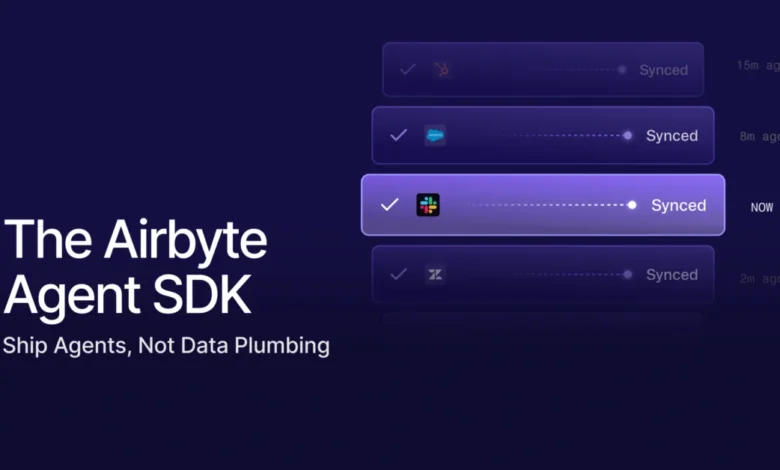
Airbyte, a prominent player in data integration, has officially launched its Agent SDK, a development toolkit designed to empower developers in building and deploying sophisticated AI agents for production environments. The announcement addresses a critical industry challenge: the stark difference between the predictable performance of agents in controlled demonstrations and their often-unpredictable behavior when faced with the complexities of real-world data and user interactions. The SDK introduces a novel split architecture, separating the discovery and execution phases of agent operations to enhance reliability, efficiency, and accuracy.
The fundamental limitation of many current AI agent implementations, particularly those showcased in demos, lies in their reliance on predetermined data paths. These agents operate under the assumption that they know precisely which customer to query, which specific API endpoint to access, and which data fields are relevant. This level of certainty is rarely present in live production scenarios. Users frequently pose ambiguous or multifaceted questions, requiring agents to navigate a labyrinth of disparate data sources, understand unfamiliar data schemas, and rapidly pinpoint the exact location and relevance of the necessary information.
This manual assembly of information at runtime, often involving fetching data from multiple endpoints into a limited context window, degrades the quality of the agent’s eventual output. Raw APIs, the bedrock of many current integrations, are inherently designed for applications that possess a clear understanding of the required data: the endpoint, object ID, specific fields, and the desired operation. Production agents, however, often initiate their tasks at an earlier stage – the discovery phase. Without a robust mechanism to identify pertinent entities and their locations across an organization’s diverse data landscape, these agents are severely hampered before they can even begin to perform their intended functions.
Airbyte’s Agent SDK tackles these challenges head-on with a split architecture that bifurcates agent operations into distinct, yet integrated, layers. This approach comprises a dedicated context layer for intelligent data discovery, live connectors for efficient and accurate execution, and a robust system for audited writes back to source systems, ensuring data integrity and accountability.
The Imperative for Independent Agent Operations: Discovery, Fetch, and Action
The successful implementation of production-grade AI agents hinges on the effective separation and execution of three core operations: discovery, fetching, and action. The prevalent issue within existing API integration paradigms is the attempt to bundle these distinct phases into a single, often inefficient, runtime loop.
Discovery: The Pinnacle of Complexity
The discovery phase is unequivocally the most demanding. It necessitates that an agent meticulously search, identify, and disambiguate relevant data sources, the precise parameters required for querying them, and the specific entities that hold the pertinent information. This complexity escalates exponentially as businesses grow and integrate an increasing number of disparate systems, each with its own unique data structures and access protocols. The agent must act as a highly sophisticated data detective, piecing together clues from various systems to form a coherent understanding of the user’s request.
Fetching: Real-Time Data Acquisition
Once the agent has successfully navigated the discovery phase and pinpointed the relevant systems and parameters, the subsequent step involves fetching fresh, up-to-date state data from the source systems. This data retrieval must be performed in real-time to ensure that the agent is operating with the most current information available, thereby preventing decisions or actions based on outdated or stale data.
Action: Executing with Precision and Auditability
With the necessary information acquired, the agent is then empowered to act. This action could range from updating a customer record in a CRM system, posting a new support ticket in a helpdesk platform, or sending a crucial notification via a messaging application like Slack. Crucially, the action phase carries the highest inherent risk among the agent operations. Therefore, it is paramount that every action undertaken by the agent is meticulously logged and auditable. This provides a transparent trail of the agent’s activities, crucial for troubleshooting, compliance, and maintaining system integrity.
While this entire loop can be executed at runtime, it is only effective when application code already possesses explicit knowledge of the endpoint, object ID, and operation. This approach falters when an agent begins with a user’s intent rather than a specific identifier. For instance, when a production agent is tasked with answering a question like, "Should we refund this customer?", it cannot simply make a call to a predefined API. Instead, it must first embark on a complex discovery process: identifying the customer, correlating them with recent support tickets, scrutinizing their billing history, assessing their account status, and determining which system holds the definitive source of truth for each piece of information.
When these multi-step discovery and data retrieval processes are executed through raw APIs at runtime, the underlying AI model incurs significant costs. These costs manifest not only in terms of token consumption – a critical resource in Large Language Models (LLMs) – but also in increased latency and a higher number of tool calls. Furthermore, the reliability of the agent can be compromised as it is forced to infer data structures from API responses that were not originally designed for such interpretative tasks. The ideal scenario dictates that an agent should only proceed to fetch and act after a successful discovery phase, and this discovery should be conducted against a structured, indexed context. Airbyte’s split architecture, featuring a dedicated context layer and live connectors, provides precisely this solution.
What the Airbyte Agent SDK Redefines
The Agent SDK is engineered to bring this crucial split architecture for discovery and execution to life. It offers developers a seamless Python interface, granting them access to Airbyte’s extensive library of Agent Connectors and the Context Store – a unified and intelligent data index.
The Context Store: Empowering Discovery
The Context Store serves as the linchpin for the discovery process. It ensures that searchable business context is not only structured but also meticulously indexed before the agent begins its operations. This pre-processing eliminates the need for the agent to perform rudimentary data searches and schema interpretation on the fly, significantly accelerating the discovery phase and improving its accuracy.
Connectors: Driving Execution with Auditability
Complementing the Context Store are the live connectors, which are responsible for the execution phase. These connectors facilitate real-time data reads, enable direct writes back into source systems, and crucially, maintain an immutable audit trail for every action performed. This comprehensive logging ensures complete transparency and accountability for all agent-initiated modifications to an organization’s data.
This architectural distinction means that the agent is liberated from the arduous task of stitching together raw API responses at runtime. Instead, it can efficiently locate the precise business entity of interest and then, with confidence, fetch the most current state data or initiate an action when it is most pertinent.
The SDK is designed with developer accessibility in mind, offering a straightforward Python interface. Installation is a one-command operation:
uv add airbyte-agent-sdkThis command, utilizing the UV Python package manager, allows developers to become operational within minutes. The core execution loop is elegantly simple: connect to a source, execute defined operations, and receive strongly typed results back.
from airbyte_agent_sdk import connect

github = connect("github")
result = await github.execute("issues", "list", params="per_page": 10)

for row in result.data:
    print(row)
Each connector within the SDK exposes distinct entities (such as "issues," "contacts," "deals," or "invoices") and a range of actions (including "list," "get," "search," "create," and "update"). For connectors that support typed submodules, developers benefit from invaluable IDE autocompletion and method-level docstrings, making code development intuitive and less error-prone. For instance, await hubspot.contacts.list(limit=10) functions precisely as one would expect, offering predictable and self-documenting code. For connectors that do not offer typed submodules, the generalized execute(entity, action, params) interface provides a flexible means of interaction.
Seamless Integration: Working Alongside Existing Frameworks
A key consideration for development teams is how a new SDK will integrate with their existing technology stacks. Airbyte’s Agent SDK is intentionally designed to complement, rather than replace, existing frameworks. It functions as a robust data layer that can be seamlessly integrated beneath popular orchestration tools and agent development frameworks such as Claude Agent SDK, OpenAI Agents SDK, PydanticAI, LangChain, and FastMCP, or even custom Python-based agent loops. The fundamental pattern involves wrapping an Airbyte connector as a tool, exposing it to the agent, and then allowing the LLM to leverage it for data retrieval and action execution.
For scenarios requiring broad operational coverage without the need for individual operation wiring, the tool_utils decorator proves invaluable. This decorator automatically generates a comprehensive tool description directly from the connector’s schema. It encompasses every entity, every action, and every parameter, providing the LLM with a complete understanding of the available functionalities without requiring additional developer effort.
from pydantic_ai import Agent
from airbyte_agent_sdk import connect
from airbyte_agent_sdk.connectors.github import GithubConnector

agent = Agent("openai:gpt-5.4")
github = connect("github")

@agent.tool_plain
@GithubConnector.tool_utils
async def github_execute(entity: str, action: str, params: dict | None = None):
    return await github.execute(entity, action, params or )
Conversely, for teams desiring granular control over the agent’s perception of available tools, the SDK allows for the definition of individual tools per connector, complete with hand-written, descriptive docstrings. Regardless of the chosen approach, the Context Store remains the foundational element that underpins all operations. The SDK intelligently wraps each connector as a tool accessible by the agent. Developers initiate connections using connect(), and then leverage execute() to perform operations. The agent, guided by the user’s natural language prompt, intelligently determines which entity and action to invoke.
Quantifiable Improvements: Beyond Token Counts
The initial benchmarking of the Context Store against alternative approaches yielded expected reductions in token consumption. However, the true significance of these savings became apparent when considering their compounding effects on overall agent performance and reasoning capabilities.
Compared to agents that rely on raw API calls, the integration of the Context Store has demonstrated a reduction of up to 40% in tool calls and an impressive decrease of up to 80% in token consumption. This finding, detailed further in Airbyte’s launch blog, signifies more than just a cost reduction. These token savings translate directly into an expanded "reasoning budget" for the agent. With fewer tokens dedicated to raw data retrieval and formatting, more of the LLM’s context window becomes available for crucial instructions, prior conversational turns, intermediate reasoning steps, and subsequent tool calls.
In a production environment, agents are not designed for single executions; they are expected to operate continuously, potentially thousands of times a day. For an estimated 10,000 daily calls, the token savings translate into hundreds of millions of tokens that are not paid for, do not introduce unnecessary latency, and do not burden the model with extraneous information. This quantitative improvement represents the critical differentiator between an agent that performs adequately in a controlled demonstration and one that can reliably and efficiently operate in the demanding landscape of production.
Structural Advantages: Consistency and Typed Data
Beyond the raw numerical benefits, two fundamental aspects of the Context Store provide substantial advantages for production agents: consistency and structured data.
Consistency Across Diverse Data Sources:
Every vendor’s system returns information in its own unique way, often without adherence to standardized formats. They impose their own operational limits and truncation rules, forcing agents to dynamically decipher these variations on the fly. The Context Store, however, provides consistently structured information, ensuring that agents can always reason effectively and predictably, regardless of the underlying data source. This standardization significantly reduces the cognitive load on the AI model.
Structured Data for Programmatic Operations:
The Context Store returns data in a typed JSON format, which agents can programmatically filter, sort, and join. Many alternative data retrieval methods, such as those from Multi-Cloud Providers (MCPs), often return loosely structured natural-language outputs or raw API payloads. While a paragraph stating "Sarah opened a P1 issue last Tuesday about the checkout bug" is human-readable, it is not readily amenable to programmatic analysis. An agent cannot easily sort such data by severity or join it with corresponding records in a CRM system. Typed JSON, as provided by the Context Store, bypasses this complex parsing step entirely, delivering data fields that agents can directly operate on.
Enabling Read and Write Operations for Comprehensive Functionality
While read-only agents are capable of reporting on existing data, they lack the ability to enact changes. Recognizing this limitation, the Airbyte SDK actively supports write operations across a growing portfolio of connectors. This enables agents to perform critical tasks such as creating Jira tickets, updating Salesforce records, or posting messages to Slack, all through the same intuitive execute() interface.
Crucially, every write operation is meticulously logged and traceable. In production environments where agents interact with systems of record, it is imperative to maintain a clear record of what actions were performed, when they were executed, and which credentials were used. This level of auditable traceability is considered a fundamental requirement for any production-ready agent.
The Current Landscape and Future Trajectory
The Airbyte Agent SDK represents an early but powerful iteration of a solution designed to address long-standing challenges in AI agent development. The underlying replication infrastructure powering the SDK has been in production for years, serving thousands of companies, and the Context Store is already proving effective for teams actively building on the platform. Airbyte remains committed to continuous development and is actively shipping new features and improvements.
The SDK is launching with an initial offering of 50 production-ready connectors, encompassing popular platforms such as Salesforce, HubSpot, Zendesk, Jira, Slack, GitHub, Stripe, Gong, and Linear. The company has committed to releasing new connectors on a weekly basis, further expanding the SDK’s utility and reach.
Developers can begin building with the Airbyte Agent SDK today through its Free plan, with paid plans available to accommodate scaling usage. Comprehensive installation instructions, code examples, and the complete API reference are readily accessible in the SDK documentation.
For developers grappling with data-related limitations in their agent development endeavors, Airbyte’s Agent SDK offers a potent and purpose-built solution. Its innovative architecture and robust feature set are designed to bridge the critical gap between theoretical agent capabilities and their practical, reliable deployment in production environments.